
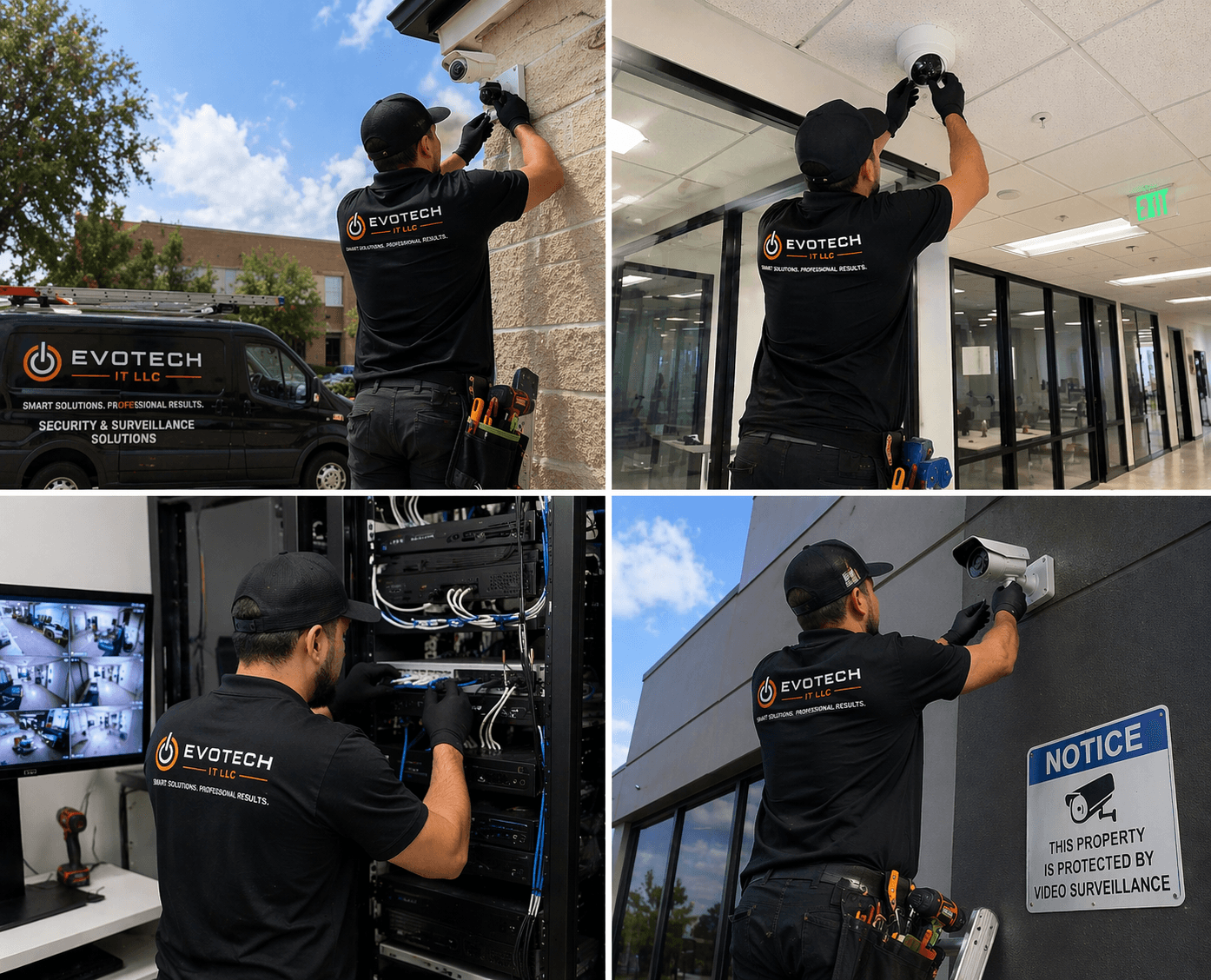
Why this page exists
Floodlight camera installation in Stafford is scoped around the same physical realities EVOTECH weighs everywhere — but read through Stafford's specific conditions: commercial base weighted toward warehouse, showroom, and light-industrial buildings rather than office space. This page pairs what the service actually involves with what the Stafford market changes about it.
A floodlight camera combines a motion-activated light with a camera, so an area lights up and records when something moves — good for deterrence and for usable colour footage at night. The catch is that the camera is looking into its own light source, so placement has to give useful footage without the floodlight washing out the near field or throwing hard shadows, and the motion detection has to trigger on people rather than every passing car or swaying tree.
What floodlight camera installation usually involves
The signature problem is the camera fighting its own light: mounted or aimed poorly, the floodlight blows out the near field, casts hard shadows, or reflects off a nearby wall back into the lens, so the footage is worse than a plain camera would give. Placement that keeps the light on the scene and off the lens's immediate foreground is what makes the combined unit work.
The second is nuisance triggering. A floodlight camera aimed to catch a wide area lights up and records every passing car, pedestrian, and swaying branch, which fills storage and trains everyone to ignore the alerts. Motion zones tuned to the actual approach path are what keep the triggers meaningful.
- Floodlight washing out the near field or reflecting into the lens
- Hard shadows from a poorly angled light hiding the subject
- Nuisance triggering on traffic, pedestrians, and foliage
- Mounted too low for tamper resistance and useful angle
- Depending on battery and Wi-Fi for a device meant to always watch
- Aimed for wide area rather than the approach that matters
Stafford property conditions that change the plan
Steel structure and metal cladding reflect wireless signal, which produces coverage patterns that do not match the intuition built from working in drywall offices. Add racking and stock, and the environment changes again — which is why designs based on an empty-building survey should be treated as provisional here.
Distance is the other constant. A building whose far corner sits beyond 100 metres of cable path from the equipment room needs an intermediate distribution point fed by fiber. That is standard practice, and it is more reliable than any attempt to stretch a copper run or bridge the gap wirelessly.
Two decisions dominate: where the intermediate distribution points go, and how access points are positioned relative to the racking. The first is arithmetic — measure the cable paths and place distribution points so every device sits within the limit. The second is a design judgement that benefits from validating with the racking loaded rather than empty.
- Metal structure reflecting signal and complicating coverage prediction
- Racking and stock changing the environment after the survey
- Footprints exceeding copper distance from a single position
- Small conditioned office areas attached to large operational space
- Dock and yard areas needing their own approach
- Fiber to intermediate distribution points where distance requires
- Access-point positioning designed for aisles, validated with stock in place
- Mounting height chosen deliberately rather than defaulting to the roof deck
- Equipment sited in conditioned space or a filtered enclosure
- Dock and yard camera positions resolved for distance and power
Getting floodlight camera installation done in Stafford
Mounting height and angle balance deterrence, coverage, and tamper resistance. High enough to be out of easy reach and to light the approach, angled so the light falls on the scene rather than into the camera's near foreground, and positioned so a person approaching is lit from a useful angle rather than silhouetted or shadowed. Keeping the light off nearby reflective surfaces — a light wall, a soffit — stops it bouncing back into the lens.
High-level work needs lift access, and that needs floor space clear of racking, stock, and forklift traffic — usually the largest scheduling constraint on a warehouse project. Coordinating it with operations often means working during quieter shifts or scheduled shutdowns.
- Lift access requiring clear floor coordinated with operations
- Work often scheduled during quieter shifts or shutdowns
- Pathways routed clear of forklift and racking impact zones
- Proper support and containment for exposed runs
- Dust protection for equipment in operational areas
Frequently asked questions
Does EVOTECH have an office in Stafford?
No. This is a service-area page: EVOTECH serves Stafford without claiming a physical office there. The wording stays as coverage, not a location claim.
Why is my floodlight camera's footage washed out at night?
The camera is fighting its own light. If the floodlight blows out the near field or reflects off a nearby wall or soffit back into the lens, the footage is worse than a plain camera would give. Aiming the light onto the scene and off the lens's immediate foreground — and away from reflective surfaces — is what fixes it.
Why is wireless harder in a metal building?
Steel reflects, which produces coverage patterns quite unlike those in drywall construction — strong in some places, unexpectedly weak in others, with reflections that interfere with each other. Add stocked racking, which absorbs signal, and a design based on an empty building no longer applies. Validation with stock in place is the step that matters.