
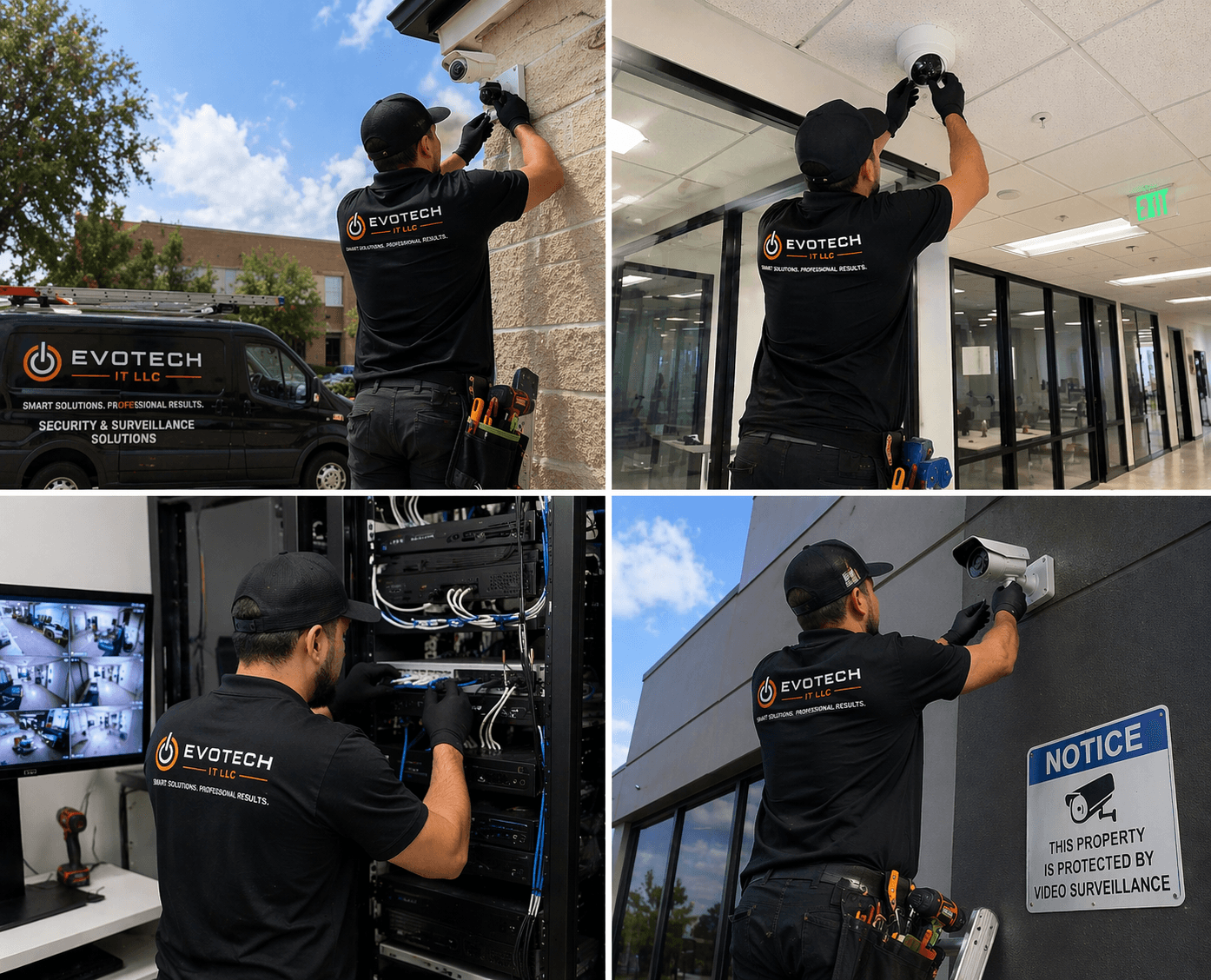
Why this page exists
PoE camera installation in Richmond is scoped around the same physical realities EVOTECH weighs everywhere — but read through Richmond's specific conditions: high proportion of new residential and commercial construction, making rough-in timing the dominant scheduling factor. This page pairs what the service actually involves with what the Richmond market changes about it.
A PoE camera takes its power from the same Ethernet cable that carries its video, which removes the need for a local outlet at every mounting position. That is the entire practical appeal: one run per camera, no electrician at each soffit, and centralised power that can sit behind a UPS so the cameras stay up during a short outage.
What poe camera installation usually involves
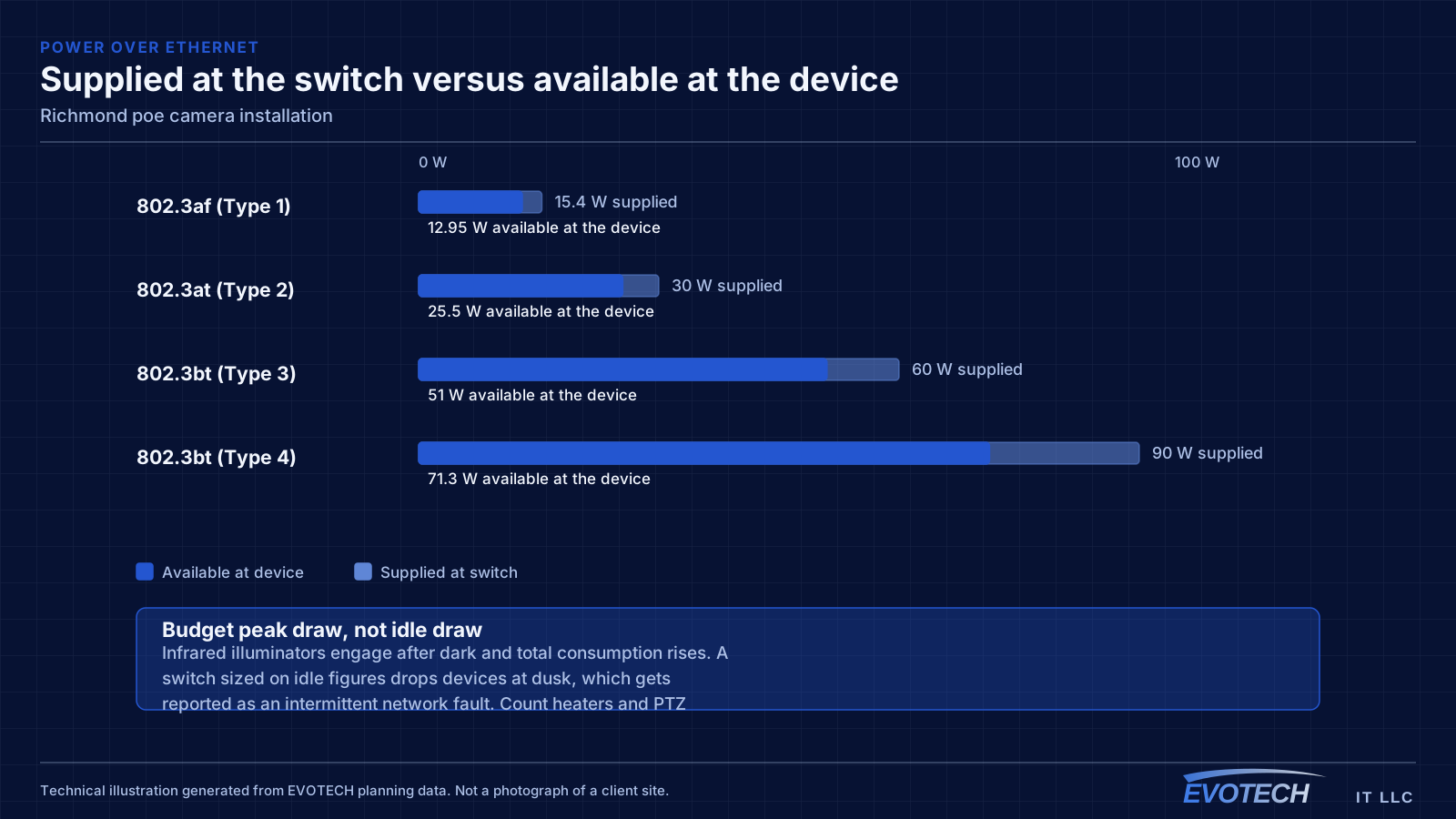
The characteristic PoE problem is a camera that reboots under specific conditions — usually at night when its infrared illuminator switches on and its draw rises. If the switch is near its budget, the additional load pushes it over and devices drop. Because it happens after dark, it often gets reported as an intermittent network fault.
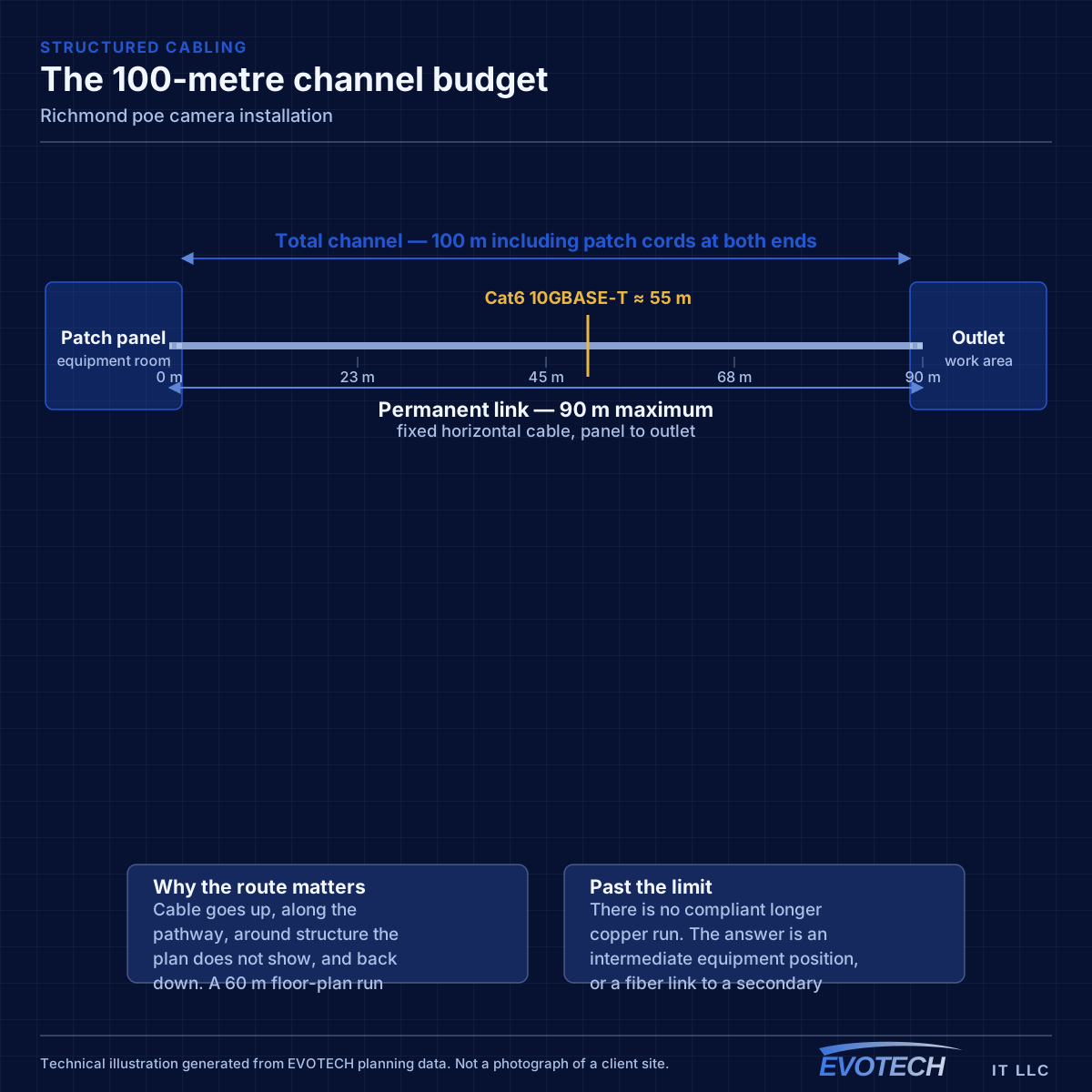
The second problem is distance. PoE inherits the same 100-metre channel limit as any Ethernet run, and voltage drop over long runs on thin conductors reduces the power actually reaching the camera. A run that works at 60 metres may be marginal at 95 with a high-draw device on the end.
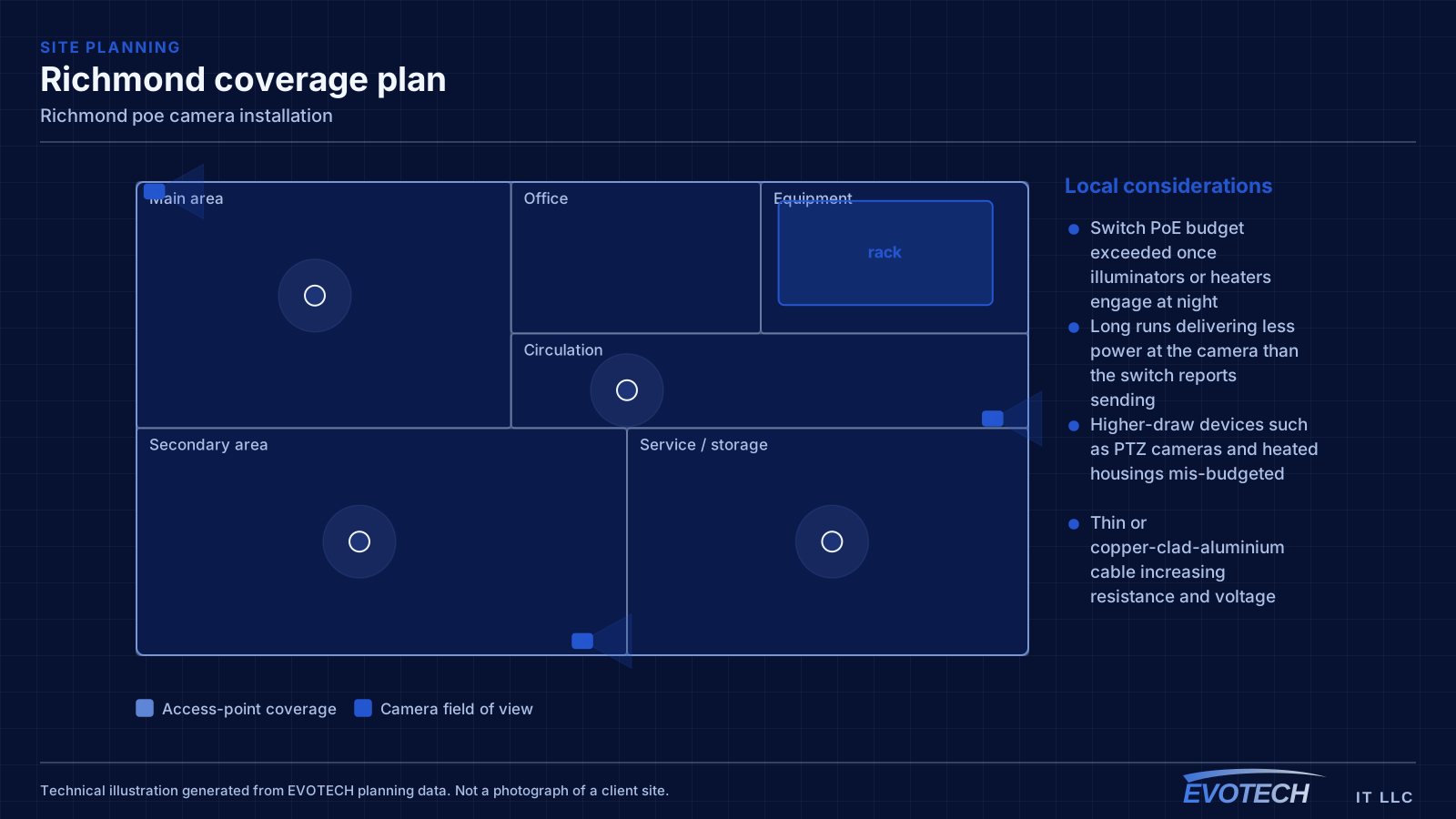
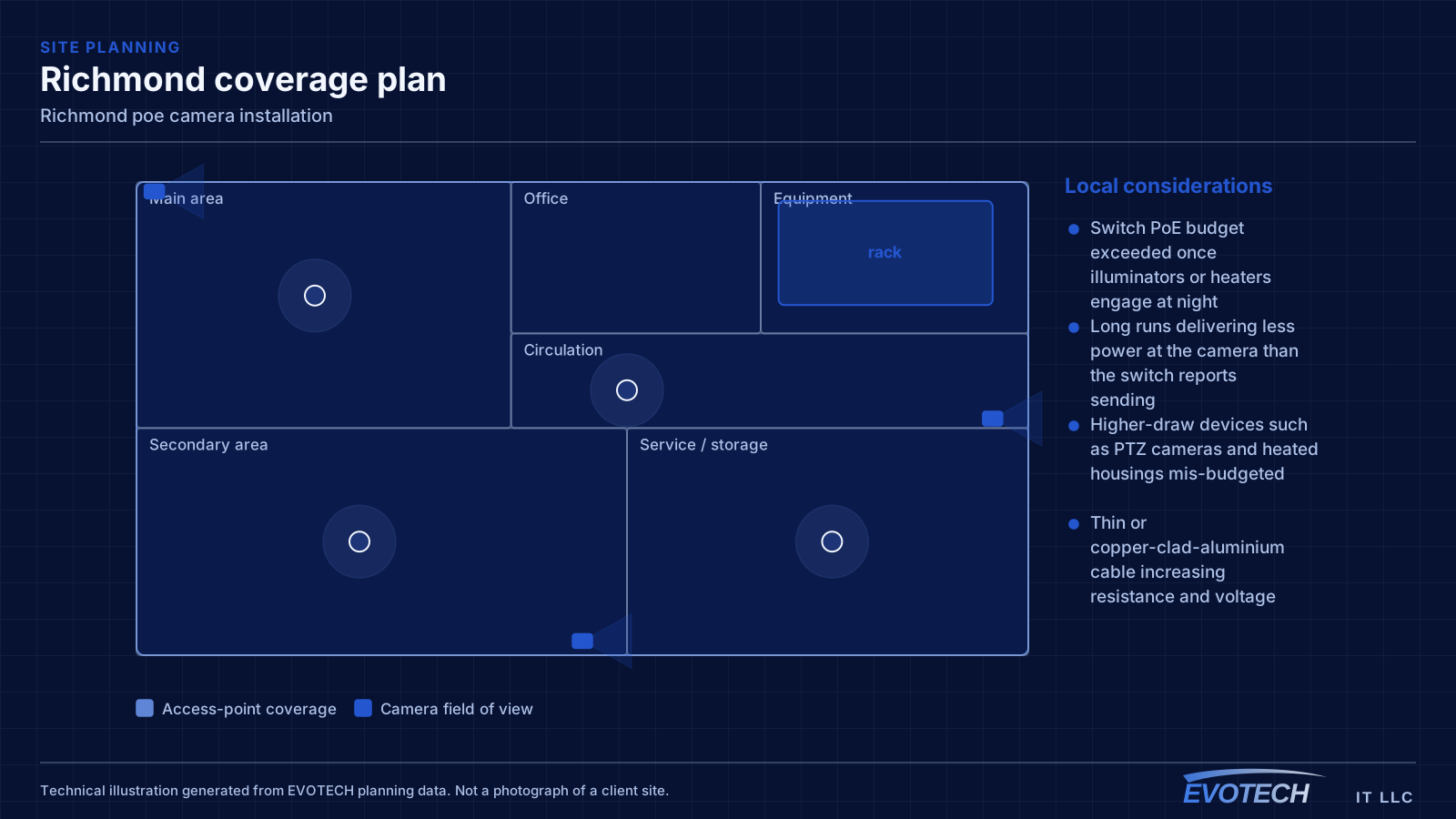
- Switch PoE budget exceeded once illuminators or heaters engage at night
- Long runs delivering less power at the camera than the switch reports sending
- Higher-draw devices such as PTZ cameras and heated housings mis-budgeted
- Thin or copper-clad-aluminium cable increasing resistance and voltage drop
- Dense PoE bundles heating and raising insertion loss
- No UPS on the switch, so cameras drop with any brief power interruption
Richmond property conditions that change the plan
When the walls are open, running cable anywhere is straightforward and running spare cable is nearly free. The value of the pre-rough-in conversation is entirely in deciding where things go, because that decision is what determines whether a future camera, access point, or display position is a simple addition or an impossibility.
Larger lots add a distance dimension that tighter suburban plots do not. A gate position, a detached workshop, or a driveway camera can sit far enough from the equipment room that copper is not the right answer, and that needs establishing during design rather than discovering during installation.
Three sets of decisions have a hard deadline. Device locations, because cable follows them. Pathway — conduit, sleeves, and rated penetrations — because those are built into the structure. And the equipment room, because its size, power, and ventilation are architectural rather than adjustable.
- Rough-in window between electrical and drywall as the controlling constraint
- Spare runs and sleeves to likely future positions while walls are open
- Long runs to gates, outbuildings, and driveway positions
- Distances checked against the 100 m copper channel limit
- Equipment room sized for every system, not just the network
- Device locations agreed and marked before rough-in
- Conduit and sleeves installed to positions that may be used later
- Rated penetrations sleeved and firestopped properly
- Equipment room with dedicated power, ventilation, and clearance
- Between-building routes decided before slabs and hardscape go in
Getting poe camera installation done in Richmond
The standards define escalating power classes. Type 1 (802.3af) supplies up to about 15.4 W at the switch with roughly 12.95 W available at the device. Type 2 (802.3at) raises that to about 30 W supplied and 25.5 W available. Type 3 and Type 4 under 802.3bt reach roughly 60 W and 90 W supplied, with about 51 W and 71 W available respectively. The gap between supplied and available is the loss in the cable, and it grows with length and with thinner conductors.
The rough-in window is controlled by trades upstream. Delays compress it without moving the completion date, so readiness matters more than anything — decisions made, materials on site, pathway plan settled before the window opens.
- Readiness before the window opens, since it cannot be extended
- Cable protected and clearly labeled during the gap to finish
- As-built documentation completed before drywall
- Coordination with electrical and mechanical trades on shared pathway
- Exterior and between-building routes planned before hardscape
Popular services nearby
Frequently searched near this area — the pages people look for most.
Frequently asked questions
Does EVOTECH have an office in Richmond?
No. This is a service-area page: EVOTECH serves Richmond without claiming a physical office there. The wording stays as coverage, not a location claim.
Why do cameras reboot at night but work fine during the day?
Almost always PoE budget. Infrared illuminators engage after dark and the total draw rises, pushing the switch past its budget. It presents as intermittent camera dropouts and gets misdiagnosed as a network fault. The fix is a switch with sufficient budget and headroom, calculated from peak draw rather than idle.
How much spare cable should a new build include?
More than the current plan calls for, because the cost asymmetry is severe. A spare run during rough-in is inexpensive; the same run after drywall may cost several times as much or be impossible. Terminating and labeling spare runs to likely access-point, camera, and display positions is among the cheapest decisions in the whole project.