
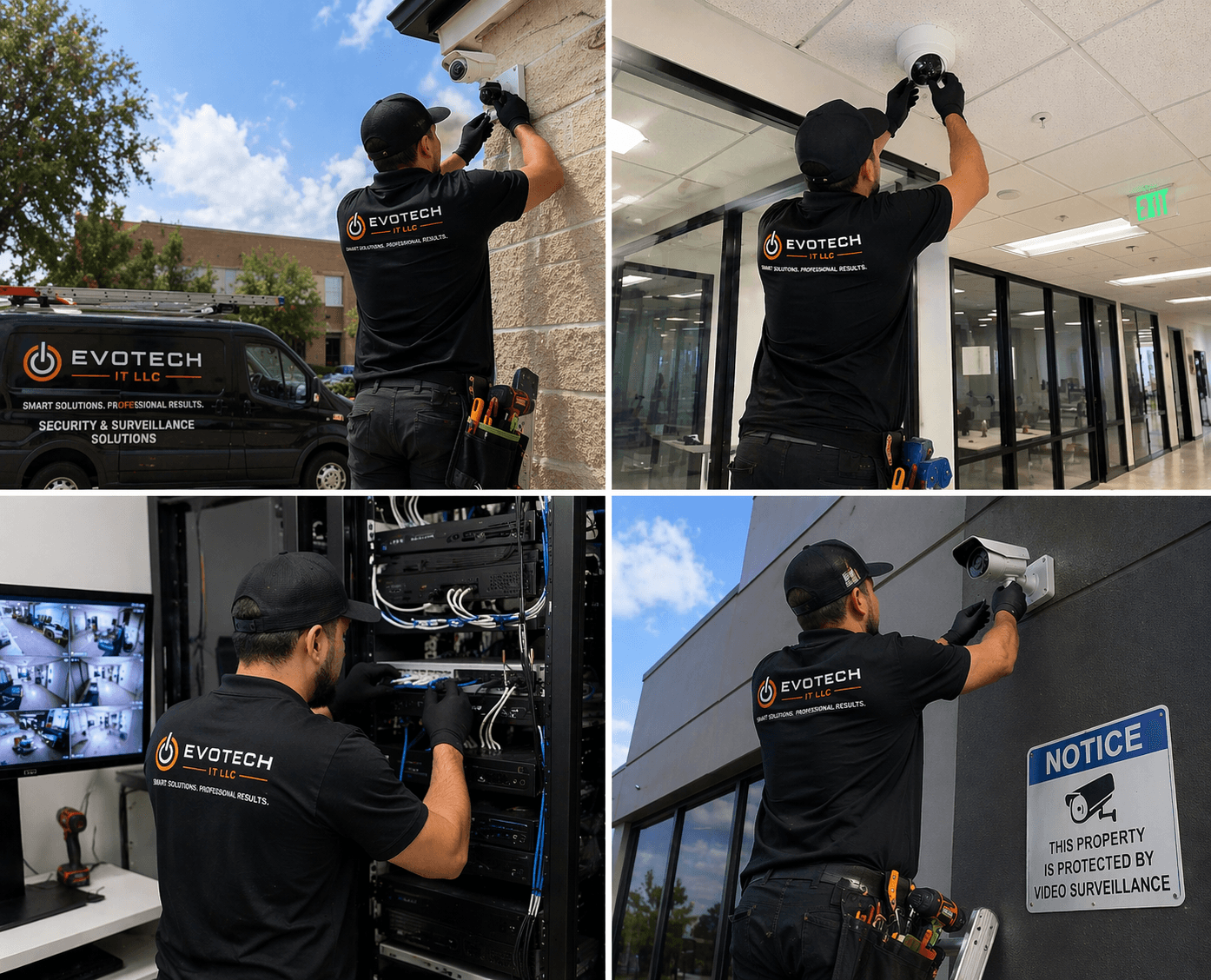
Why this page exists
Gate & license-plate cameras in Richmond is scoped around the same physical realities EVOTECH weighs everywhere — but read through Richmond's specific conditions: high proportion of new residential and commercial construction, making rough-in timing the dominant scheduling factor. This page pairs what the service actually involves with what the Richmond market changes about it.
Watching a gate or driveway and reading the license plates that come through it are two different objectives, and they usually need two different cameras. An overview camera shows the scene — who arrived, what happened — with a wide, well-lit view. A license-plate camera is tuned narrowly for one thing: a fast shutter to freeze a moving plate, a tight field of view and angle aimed at where plates appear, and controlled infrared so the reflective plate is legible at night rather than blown out.
What gate & license-plate cameras usually involves
The core mistake is expecting one camera to both show the scene and read plates. A wide overview camera cannot freeze or resolve a plate on a moving vehicle, and a plate camera's narrow, fast-shutter view is useless as a general scene. Trying to do both with one camera gives a view that is mediocre at each.
The second is night and motion. A plate is retroreflective, so at night an ordinary camera either loses it in the dark or blows it out with too much infrared, and a slow shutter smears the plate on a moving car. And gate positions are often beyond easy power and network reach, so a run planned as if it were a nearby camera fails.
- One camera expected to both show the scene and read plates
- Slow shutter smearing plates on moving vehicles
- Night infrared blowing out the reflective plate or losing it in the dark
- Field of view and angle too wide to resolve a plate
- Gate position beyond easy power and network reach
- No overview camera, so context of the entry is lost
Richmond property conditions that change the plan
When the walls are open, running cable anywhere is straightforward and running spare cable is nearly free. The value of the pre-rough-in conversation is entirely in deciding where things go, because that decision is what determines whether a future camera, access point, or display position is a simple addition or an impossibility.
Larger lots add a distance dimension that tighter suburban plots do not. A gate position, a detached workshop, or a driveway camera can sit far enough from the equipment room that copper is not the right answer, and that needs establishing during design rather than discovering during installation.
Three sets of decisions have a hard deadline. Device locations, because cable follows them. Pathway — conduit, sleeves, and rated penetrations — because those are built into the structure. And the equipment room, because its size, power, and ventilation are architectural rather than adjustable.
- Rough-in window between electrical and drywall as the controlling constraint
- Spare runs and sleeves to likely future positions while walls are open
- Long runs to gates, outbuildings, and driveway positions
- Distances checked against the 100 m copper channel limit
- Equipment room sized for every system, not just the network
- Device locations agreed and marked before rough-in
- Conduit and sleeves installed to positions that may be used later
- Rated penetrations sleeved and firestopped properly
- Equipment room with dedicated power, ventilation, and clearance
- Between-building routes decided before slabs and hardscape go in
Getting gate & license-plate cameras done in Richmond
License-plate capture is a specialised camera task. It needs a fast shutter to freeze a plate on a moving vehicle, a narrow field of view and a shallow angle aimed at where plates present, and a distance matched to the lens so the plate fills enough of the frame to be legible. Because a plate is retroreflective, the infrared is controlled so the plate is lit to read rather than blown out — settings that make the plate legible also make the rest of the scene dark, which is exactly why a separate overview camera covers context.
The rough-in window is controlled by trades upstream. Delays compress it without moving the completion date, so readiness matters more than anything — decisions made, materials on site, pathway plan settled before the window opens.
- Readiness before the window opens, since it cannot be extended
- Cable protected and clearly labeled during the gap to finish
- As-built documentation completed before drywall
- Coordination with electrical and mechanical trades on shared pathway
- Exterior and between-building routes planned before hardscape
Popular services nearby
Frequently searched near this area — the pages people look for most.
Frequently asked questions
Does EVOTECH have an office in Richmond?
No. This is a service-area page: EVOTECH serves Richmond without claiming a physical office there. The wording stays as coverage, not a location claim.
Can one camera watch the gate and read plates?
Rarely well. Reading a plate needs a fast shutter, a narrow view, a shallow angle, and controlled infrared — settings that make the plate legible also make the wider scene dark. A general overview camera cannot resolve a plate on a moving vehicle. The reliable approach is two cameras: one for the scene, one dedicated to plates.
How much spare cable should a new build include?
More than the current plan calls for, because the cost asymmetry is severe. A spare run during rough-in is inexpensive; the same run after drywall may cost several times as much or be impossible. Terminating and labeling spare runs to likely access-point, camera, and display positions is among the cheapest decisions in the whole project.