Network cabling for warehouses, in Missouri City
Network cabling for warehouses in Missouri City is a three-part question: what network cabling involves, what warehouses need from it, and what Missouri City changes about the install. Housing stock spanning both established and recent construction, producing materially different retrofit conditions between neighbourhoods.
The reason cabling deserves planning attention is that it is the longest-lived part of the system. Switches get replaced on a five-year cycle and access points sooner, but the cable in the wall tends to stay for the life of the tenancy. Deciding where outlets go, how many, and what category of cable feeds them is a decision that either quietly supports the next decade or quietly constrains it.
Topology, mounting height, and roaming for handhelds
Where a building exceeds copper reach from a single position, the usual answer is one or more intermediate distribution points fed by fiber, each serving its area with copper within the limit. This is standard structured-cabling practice and it is far more reliable than attempting to stretch copper or bridge wirelessly across the building.
Access-point mounting height is a genuine design decision in high-ceiling spaces, not a default. Mounting at the roof deck maximises line of sight but puts the access point far from the devices and often above the racking, where the signal has to travel down through stock. Mounting lower — at or just above racking height, aimed along the aisles — frequently produces better coverage where the scanners actually are.
Roaming matters because the primary clients are mobile. A forklift-mounted or handheld scanner moving down an aisle needs clean handoffs between cells. That is a function of overlap and channel planning, and it is best validated by walking the aisles with the racking loaded.
- Fiber to intermediate distribution points where distance exceeds copper limits
- Mounting height chosen deliberately rather than defaulting to the roof deck
- Coverage designed along aisles, with directional antennas where useful
- Roaming validated by walking loaded aisles, not an empty floor
- Office, operations, and building-system traffic segmented
What changes network cabling from job to job
Two buildings with the same square footage can differ by a factor of three in cabling effort. What drives that spread is access, not area.
- Ceiling type: accessible grid versus hard lid, and whether the plenum is shared
- Building age and whether existing pathway can be reused
- Number of outlets and whether each location gets one, two, or more
- Rack or wall-cabinet location relative to the incoming service
- Fire-rated wall and floor penetrations requiring proper sleeving and firestop
- Occupied-space constraints: after-hours access, dust control, furniture protection
- Whether the design leaves spare capacity for the next expansion
Missouri City: what the location changes
What separates a Missouri City scope from the rest of the city is concrete and local. Housing stock spanning both established and recent construction, producing materially different retrofit conditions between neighbourhoods. Older homes without structured cabling and with less accessible attic space than newer subdivisions. Newer subdivision homes following the regional pattern of builder panels and good attic access. That short list is what actually drives the design in this pocket, and it is why photographs or a brief site visit beat a floor plan — the plan follows the building's real constraints, not the neighborhood name on the map.
- Housing stock spanning both established and recent construction, producing materially different retrofit conditions between neighbourhoods
- Older homes without structured cabling and with less accessible attic space than newer subdivisions
- Newer subdivision homes following the regional pattern of builder panels and good attic access
- Small office and retail suites where ceiling construction and lease terms are the main variables
- Slab-on-grade construction throughout, keeping attic routing as the primary retrofit path
Getting it done in Missouri City
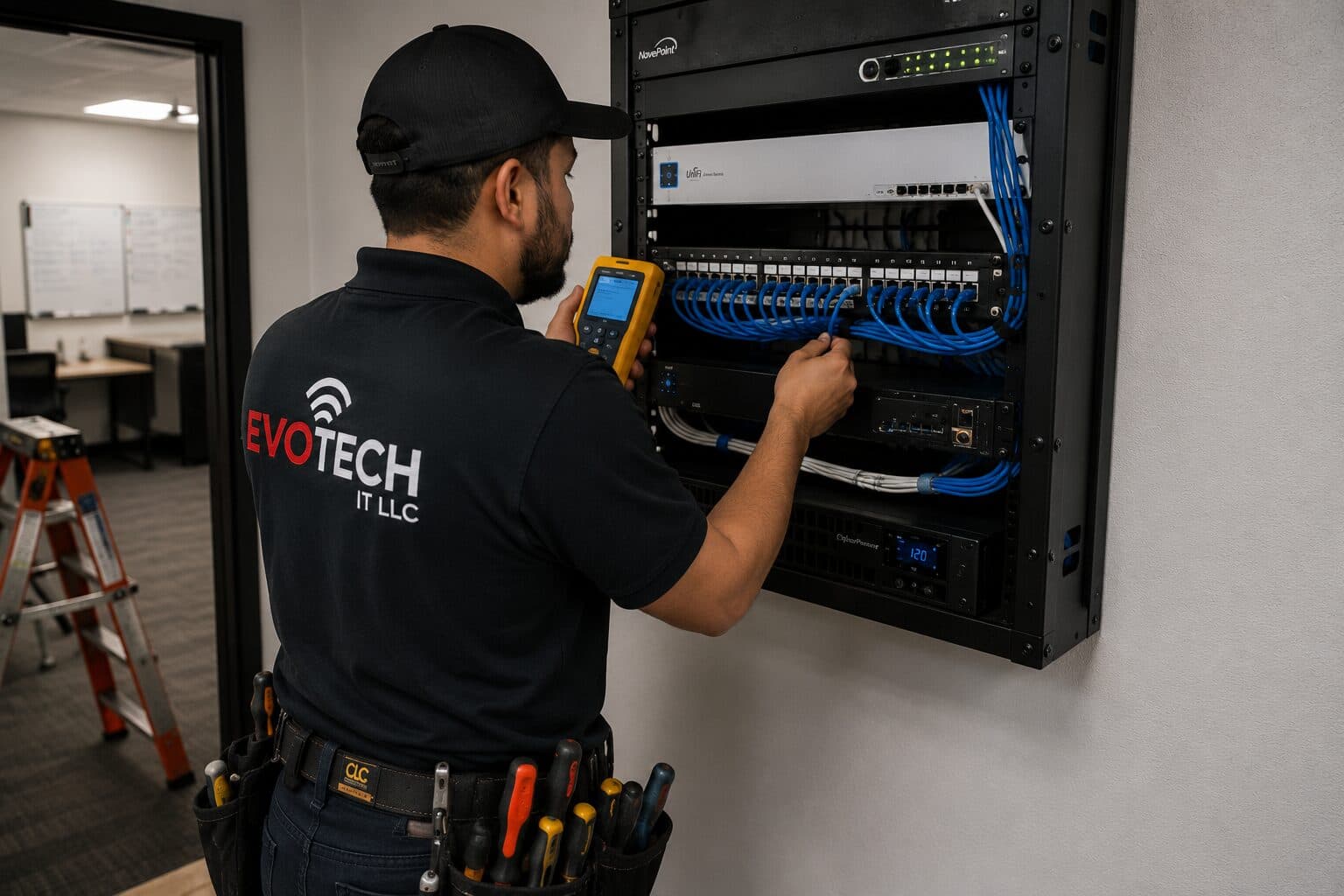
Testing is what separates a cabling installation from a cable pull. A basic continuity or wire-map check confirms the pairs land in the right order; it says nothing about whether the link will carry its rated bandwidth. Certification testing against the relevant TIA channel or permanent-link limits measures insertion loss, return loss, near-end crosstalk, and delay skew, and produces a per-port record.
High-level work needs lift access, and lift access needs floor space clear of racking, stock, and traffic. Coordinating that with warehouse operations is usually the single biggest scheduling constraint, and it is why warehouse installs often happen during shutdowns or quieter shifts.
Execution in Missouri City is planned around real conditions, not a template. Small office and retail suites where ceiling construction and lease terms are the main variables. Slab-on-grade construction throughout, keeping attic routing as the primary retrofit path. These decide the sequence, the access, and the method as much as the design does. EVOTECH describes Missouri City as coverage rather than a place it occupies, and omits any area detail it cannot confirm — building and site conditions only, no invented landmarks or promised arrival times.
Frequently asked questions
Is network cabling for warehouses different in Missouri City?
The sector needs stay the same, but the install changes with the place. In Missouri City, the conditions above — not the warehouses label — decide routes, mounting, and equipment placement, which is why this page pairs all three.
How long can a single network cable run be?
The fixed cable between patch panel and outlet is limited to 90 metres, with patch cords at each end bringing the total channel to 100 metres. Beyond that, the answer is not a longer cable — it is either an intermediate equipment location or a fiber link to a secondary switch.