Wireless bridge (point-to-point) for warehouses, in League City
Wireless bridge (point-to-point) for warehouses in League City is a three-part question: what wireless bridge (point-to-point) involves, what warehouses need from it, and what League City changes about the install. Coastal proximity raising the weight on exterior sealing, rated housings, and surge protection.
The engineering is about the path, not the hardware. The two radios need clear line of sight and a clear Fresnel zone (the football-shaped space around the direct line that also has to stay unobstructed), precise alignment so the narrow beams actually meet, and realistic expectations that throughput falls with distance and obstruction. Where those conditions hold, a bridge is reliable; where they don't, no radio fixes it.
Cover the aisles, reach the far end, watch the docks
Warehouse projects come down to three things: wireless that works down the aisles with stock in place, a network topology that reaches the far end of the building properly, and camera coverage at the points where goods and vehicles move.
Office areas within the warehouse are comparatively ordinary and are usually the easiest part of the project.
- Access points positioned to cover along aisles rather than across them
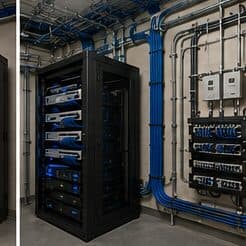
- Intermediate equipment positions linked by fiber where distance requires
- Dock doors, receiving, and yard gates covered by cameras
- Scanner and handheld roaming validated with stock in place
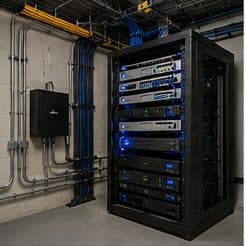
- Equipment protected from dust and temperature in unconditioned areas
What changes wireless bridge (point-to-point) from job to job
Scope depends on distance, obstruction, and mounting.
- Distance between the two points
- Line-of-sight quality and required mounting height
- Radios and antennas for the throughput target
- Mounting structures and access at each end
- Power provision at both ends
- Local interference in the chosen band
League City: what the location changes
What separates a League City scope from the rest of the city is concrete and local. Coastal proximity raising the weight on exterior sealing, rated housings, and surge protection. Storm-season resilience planning, favouring UPS and failover where uptime matters. Newer suburban slab-foundation homes with multi-room coverage needs. That short list is what actually drives the design in this pocket, and it is why photographs or a brief site visit beat a floor plan — the plan follows the building's real constraints, not the neighborhood name on the map.
- Coastal proximity raising the weight on exterior sealing, rated housings, and surge protection
- Storm-season resilience planning, favouring UPS and failover where uptime matters
- Newer suburban slab-foundation homes with multi-room coverage needs
- Growing medical and retail commercial space
- Gulf Coast humidity and driven-rain events as a routine design factor
Getting it done in League City
A bridge is commissioned on signal, throughput, and stability.
Warehouse camera coverage concentrates where goods and vehicles move: dock doors, receiving and shipping areas, yard gates, and the boundary between operational and office space. These views answer the questions warehouse footage is actually asked — what arrived, what left, and when.
Getting League City work done means planning around the site as it actually is. Growing medical and retail commercial space. Gulf Coast humidity and driven-rain events as a routine design factor. Both matter as much as the design to how and when the work happens. The scope is drawn from the real property, the coverage is stated as a service area rather than an office, and unverifiable specifics about League City are kept off the page on purpose.
Frequently asked questions
Is wireless bridge (point-to-point) for warehouses different in League City?
The sector needs stay the same, but the install changes with the place. In League City, the conditions above — not the warehouses label — decide routes, mounting, and equipment placement, which is why this page pairs all three.
When should I use a wireless bridge instead of running cable?
When a physical run is genuinely impractical — a road, a parking lot, or a distance that would mean major trenching between two buildings. Where a cable can reasonably go, especially fiber between separately grounded structures, it is more reliable. A bridge is the right tool specifically when the gap can't be crossed physically and there is clear line of sight.