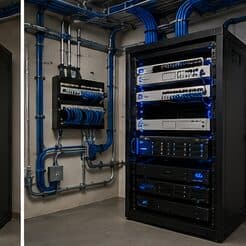
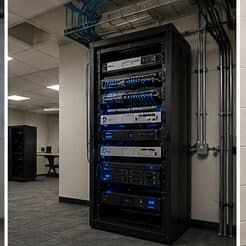
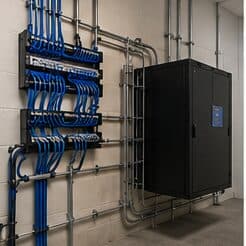
Cat6 cabling for warehouses, in Cypress
Cat6 cabling for warehouses in Cypress is a three-part question: what cat6 cabling involves, what warehouses need from it, and what Cypress changes about the install. Large newer residential floor plans that exceed single-position wireless coverage.
So the honest framing is this: specify Cat6 when the device locations need gigabit and the building is unlikely to push 10G to the desk. Specify Cat6A when a run has to support 10G at full distance, when the cable will sit in a dense bundle, or when the location feeds equipment that already asks for more than gigabit.
The building changes its own radio environment
A warehouse surveyed empty and a warehouse full of stock are different radio environments. Metal racking reflects, palletised inventory absorbs, and coverage that measured well across an open floor can disappear once the aisles fill. Any design based on an empty-building survey should be treated as provisional.
The second defining feature is distance. Warehouse footprints regularly exceed what a single equipment room can serve within the 100-metre copper limit, which means either intermediate equipment positions connected by fiber or a deliberately distributed design.
- Racking and stock materially change coverage after the survey
- Distances frequently exceed the 100 m copper channel limit
- High ceilings complicate mounting, access, and coverage geometry
- Dock doors, yard, and office areas each have distinct requirements
Where cat6 cabling goes wrong — and how it's avoided
The common errors are decisions made once and regretted for years.
- Specifying Cat6 for a run that will need 10G at 80 metres
- Specifying Cat6A everywhere and losing pathway space that a mixed design would have kept
- Terminating a Cat6 run on leftover Cat5e hardware
- Bundling forty identical runs tightly and then expecting short-run 10G to hold
- Treating the certification report as paperwork rather than reading the margins
Cypress: what the location changes
The starting point for any Cypress job is one local fact. Large newer residential floor plans that exceed single-position wireless coverage. That single condition shapes where cable can run, where equipment can sit, and how coverage is laid out — more than any spec sheet does. Two more conditions weigh on it. Community and worship facilities with large main spaces and high ceilings requiring distributed coverage. Retail centres with substantial footprints and mixed ceiling construction between units. Together they make the route specific to this pocket, which is why a short walkthrough or a few clear photos settle the scope faster than a floor plan can.
- Large newer residential floor plans that exceed single-position wireless coverage
- Community and worship facilities with large main spaces and high ceilings requiring distributed coverage
- Retail centres with substantial footprints and mixed ceiling construction between units
- Renovation and remodel work common, with pathway discovery a genuine part of the project rather than a formality
- Slab foundations with attic access as the standard residential retrofit route
Getting it done in Cypress
Certification for a Cat6 link measures the parameters that define the category: insertion loss, near-end and far-end crosstalk, return loss, and propagation delay skew across the frequency range up to 250 MHz. A pass means the link meets the standard's limits with margin recorded.
Where a building exceeds copper reach from a single position, the usual answer is one or more intermediate distribution points fed by fiber, each serving its area with copper within the limit. This is standard structured-cabling practice and it is far more reliable than attempting to stretch copper or bridge wirelessly across the building.
Execution in Cypress is planned around real conditions, not a template. Renovation and remodel work common, with pathway discovery a genuine part of the project rather than a formality. Slab foundations with attic access as the standard residential retrofit route. These decide the sequence, the access, and the method as much as the design does. EVOTECH describes Cypress as coverage rather than a place it occupies, and omits any area detail it cannot confirm — building and site conditions only, no invented landmarks or promised arrival times.
Frequently asked questions
Is cat6 cabling for warehouses different in Cypress?
The sector needs stay the same, but the install changes with the place. In Cypress, the conditions above — not the warehouses label — decide routes, mounting, and equipment placement, which is why this page pairs all three.
Is Cat6 enough, or should everything be Cat6A?
For most device locations Cat6 is enough, because most devices need gigabit and will for a long time. Cat6A earns its place on runs that must carry 10G at distance, runs sitting in dense bundles, and uplinks between equipment positions. Specifying Cat6A for the whole building is rarely wrong technically, but it costs pathway space and termination time that a mixed design keeps.