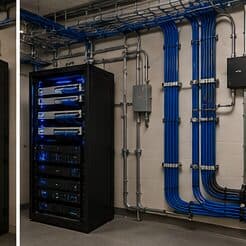
Wi-Fi installation for schools and educational facilities, in Spring
Wi-Fi installation for schools and educational facilities in Spring is a three-part question: what wi-fi installation involves, what schools and educational facilities need from it, and what Spring changes about the install. Retail and food-service commercial base where payment-system separation is a standing requirement.
The part people skip is the channel plan. Two access points on the same channel that can hear each other do not add capacity — they share it, because Wi-Fi devices take turns on a channel. That is why adding more access points to a struggling network sometimes makes it worse, and why 2.4 GHz, with only three non-overlapping channels, is usually the band causing the complaints.
Entry control and perimeter coverage
Camera coverage on a school campus concentrates on entrances, circulation between buildings, parking and drop-off areas, and the perimeter. Corridors are common; classrooms are not, and that boundary is agreed at design.
Entry control is typically the higher priority. Controlled main entry with a visitor process, secondary doors that are secured but permit free egress, and records of who entered when address the requirement more directly than camera coverage does. Free egress on every controlled door is non-negotiable and is designed in from the start.
- Main and secondary entrances with controlled access and free egress
- Circulation routes between buildings
- Parking, drop-off, and perimeter coverage
- Corridor coverage where required; classrooms excluded
- Entry records available to administration
What drives the cost of wi-fi installation here
Wireless cost is mostly cabling and access-point count, with survey depth as the third variable.
- Number of access points the coverage design requires
- Cable runs to each AP position and the difficulty of those runs
- Ceiling type and mounting hardware, especially at height
- Switch capacity and PoE budget to power the APs
- Survey depth, from a walkthrough to a full measured survey
- Whether outdoor or warehouse coverage is included
Spring: what the location changes
What separates a Spring scope from the rest of the city is concrete and local. Retail and food-service commercial base where payment-system separation is a standing requirement. Ceiling construction varying considerably between adjacent units, from open deck to hard lid to suspended grid. Restaurant kitchen environments requiring equipment placement away from heat, steam, and grease-laden air. That short list is what actually drives the design in this pocket, and it is why photographs or a brief site visit beat a floor plan — the plan follows the building's real constraints, not the neighborhood name on the map.
- Retail and food-service commercial base where payment-system separation is a standing requirement
- Ceiling construction varying considerably between adjacent units, from open deck to hard lid to suspended grid
- Restaurant kitchen environments requiring equipment placement away from heat, steam, and grease-laden air
- Storefront glazing on retail units complicating daylight entrance camera placement
- Residential areas following the regional slab-foundation and attic-routing pattern
Getting it done in Spring
A wireless installation is validated by walking it. Signal level, signal-to-noise ratio, and the channel each AP settled on are measured at the places people actually work, not from the middle of the room.
A classroom with thirty students on devices is one of the densest wireless environments in any building type, and it happens simultaneously in every classroom on a bell schedule. That is a capacity problem of a specific shape: predictable, synchronised, and concentrated.
Execution in Spring is planned around real conditions, not a template. Storefront glazing on retail units complicating daylight entrance camera placement. Residential areas following the regional slab-foundation and attic-routing pattern. These decide the sequence, the access, and the method as much as the design does. EVOTECH describes Spring as coverage rather than a place it occupies, and omits any area detail it cannot confirm — building and site conditions only, no invented landmarks or promised arrival times.
Frequently asked questions
Is wi-fi installation for schools and educational facilities different in Spring?
The sector needs stay the same, but the install changes with the place. In Spring, the conditions above — not the schools and educational facilities label — decide routes, mounting, and equipment placement, which is why this page pairs all three.
Why does a call drop when walking between rooms?
That is a roaming symptom. Either the coverage areas do not overlap enough, so the device holds a fading signal past the point of usefulness, or they overlap heavily on the same channel, so the handoff happens into a congested cell. Both are fixed by adjusting placement, power, and the channel plan rather than by adding another access point at the same settings.