Wi-Fi installation for schools and educational facilities, in Sugar Land
Wi-Fi installation for schools and educational facilities in Sugar Land is a three-part question: what wi-fi installation involves, what schools and educational facilities need from it, and what Sugar Land changes about the install. Commercial base weighted toward professional offices and medical suites rather than industrial space.
Good Wi-Fi comes from deciding where signal needs to be strong, then placing access points so that each area gets a solid signal from one AP without excessive overlap from others. The target most designs work to is around -67 dBm at the edge of each coverage area for voice and video, with signal comfortably above the local noise floor. Placement follows from that number and from the walls between the AP and the users.
Per-classroom capacity and controlled entry
Two priorities dominate: enough wireless capacity in each classroom to serve a full class simultaneously, and controlled entry at the points where people come into the campus.
Both benefit from being designed at a campus level rather than building by building, because the addressing, segmentation, and management overhead of a piecemeal approach grows quickly.
- Access-point capacity planned per classroom, not per building area
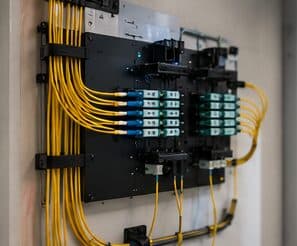
- Fiber backbone between buildings and to distribution points
- Controlled entry at main and secondary access points
- Separate segments for student, staff, administrative, and building systems
- Coverage extended to gymnasiums, libraries, and outdoor gathering areas
What drives the cost of wi-fi installation here
Wireless cost is mostly cabling and access-point count, with survey depth as the third variable.
- Number of access points the coverage design requires
- Cable runs to each AP position and the difficulty of those runs
- Ceiling type and mounting hardware, especially at height
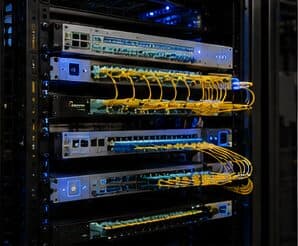
- Switch capacity and PoE budget to power the APs
- Survey depth, from a walkthrough to a full measured survey
- Whether outdoor or warehouse coverage is included
Sugar Land: what the location changes
Commercial base weighted toward professional offices and medical suites rather than industrial space. In Sugar Land, that is where the plan begins, because it changes cable paths, device placement, and access-point counts before anything else does. Multi-tenant buildings where base-building rules govern riser access, core penetrations, and after-hours work. Suspended-grid ceilings common in office suites, with hard-lid areas in reception and clinical spaces. None of these are generic checklist items — each moves the design in a direction a citywide assumption would miss, and the honest recommendation always depends on what this particular property allows.
- Commercial base weighted toward professional offices and medical suites rather than industrial space
- Multi-tenant buildings where base-building rules govern riser access, core penetrations, and after-hours work
- Suspended-grid ceilings common in office suites, with hard-lid areas in reception and clinical spaces
- Retail centres with storefront glazing that complicates entrance camera placement due to daylight backlighting
- Master-planned commercial development producing comparatively consistent, newer construction
Getting it done in Sugar Land
A wireless installation is validated by walking it. Signal level, signal-to-noise ratio, and the channel each AP settled on are measured at the places people actually work, not from the middle of the room.
Camera coverage on a school campus concentrates on entrances, circulation between buildings, parking and drop-off areas, and the perimeter. Corridors are common; classrooms are not, and that boundary is agreed at design.
Getting Sugar Land work done means planning around the site as it actually is. Retail centres with storefront glazing that complicates entrance camera placement due to daylight backlighting. Master-planned commercial development producing comparatively consistent, newer construction. Both matter as much as the design to how and when the work happens. The scope is drawn from the real property, the coverage is stated as a service area rather than an office, and unverifiable specifics about Sugar Land are kept off the page on purpose.
Frequently asked questions
Is wi-fi installation for schools and educational facilities different in Sugar Land?
The sector needs stay the same, but the install changes with the place. In Sugar Land, the conditions above — not the schools and educational facilities label — decide routes, mounting, and equipment placement, which is why this page pairs all three.
Why does a call drop when walking between rooms?
That is a roaming symptom. Either the coverage areas do not overlap enough, so the device holds a fading signal past the point of usefulness, or they overlap heavily on the same channel, so the handoff happens into a congested cell. Both are fixed by adjusting placement, power, and the channel plan rather than by adding another access point at the same settings.