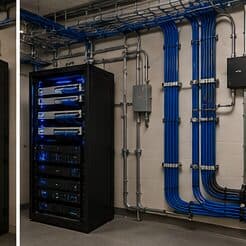
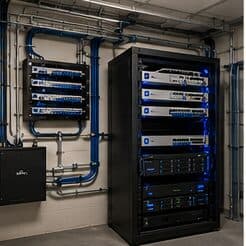
Low-voltage installation for schools and educational facilities, in Cypress
Low-voltage installation for schools and educational facilities in Cypress is a three-part question: what low-voltage installation involves, what schools and educational facilities need from it, and what Cypress changes about the install. Large newer residential floor plans that exceed single-position wireless coverage.
The scheduling reality is that low voltage sits between the electrical rough-in and drywall, in a window that is often short and frequently compressed when earlier trades run late. Being ready to work in that window — with device locations agreed and the pathway plan settled — is most of what makes new-construction low voltage go smoothly.
Classroom capacity and campus topology
Classroom wireless is a capacity design. A single access point serving a full class of devices needs adequate spectrum, and neighbouring classrooms on the same channel will contend with each other through the wall. That makes the channel plan across a corridor of classrooms as important as the access-point count — a plan that ignores the neighbours produces a corridor where every room is slow.
Campus topology follows standard structured-cabling practice at a larger scale: a main equipment position, fiber to distribution points in each building or wing, and copper from those points out to classrooms within the distance limit. Between-building links are fiber for both distance and electrical isolation.
Segmentation separates student devices, staff devices, administrative systems, and building systems such as cameras and door controllers. Student access is typically the most restricted and the most heavily used, and separating it means student traffic cannot affect administrative systems.
- Capacity designed per classroom with a corridor-wide channel plan
- Fiber backbone between buildings and to per-building distribution
- Student, staff, administrative, and building-system segments
- Coverage for gymnasiums, libraries, cafeterias, and outdoor areas
- Portable classroom connectivity planned rather than improvised
What changes low-voltage installation from job to job
Low-voltage scope depends heavily on how many systems are in play and how coordinated the schedule is.
- Which systems are included and whether they share pathways
- Building size, floor count, and pathway complexity
- New construction versus occupied retrofit
- Ceiling type and how much of the pathway is accessible
- Number and type of rated penetrations
- Equipment room provision and whether it exists yet
- Schedule reliability and whether the rough-in window is likely to compress
- Gap between rough-in and finish, which affects protection and re-identification
Cypress: what the location changes
What separates a Cypress scope from the rest of the city is concrete and local. Large newer residential floor plans that exceed single-position wireless coverage. Community and worship facilities with large main spaces and high ceilings requiring distributed coverage. Retail centres with substantial footprints and mixed ceiling construction between units. That short list is what actually drives the design in this pocket, and it is why photographs or a brief site visit beat a floor plan — the plan follows the building's real constraints, not the neighborhood name on the map.
- Large newer residential floor plans that exceed single-position wireless coverage
- Community and worship facilities with large main spaces and high ceilings requiring distributed coverage
- Retail centres with substantial footprints and mixed ceiling construction between units
- Renovation and remodel work common, with pathway discovery a genuine part of the project rather than a formality
- Slab foundations with attic access as the standard residential retrofit route
Getting it done in Cypress
Each system is commissioned on its own terms, but the low-voltage handover is the point where they are verified together.
Substantial infrastructure work happens during breaks. That concentrates a lot of activity into a short window and makes preparation disproportionately important — materials on site, pathways confirmed, and decisions made before the window opens, because there is no extending it.
Getting Cypress work done means planning around the site as it actually is. Renovation and remodel work common, with pathway discovery a genuine part of the project rather than a formality. Slab foundations with attic access as the standard residential retrofit route. Both matter as much as the design to how and when the work happens. The scope is drawn from the real property, the coverage is stated as a service area rather than an office, and unverifiable specifics about Cypress are kept off the page on purpose.
Frequently asked questions
Is low-voltage installation for schools and educational facilities different in Cypress?
The sector needs stay the same, but the install changes with the place. In Cypress, the conditions above — not the schools and educational facilities label — decide routes, mounting, and equipment placement, which is why this page pairs all three.
When should low-voltage work happen in a construction schedule?
Rough-in sits after electrical and framing and before insulation and drywall. Finish work — terminations, device mounting, and commissioning — happens after paint and ceilings. The risk is that upstream delays compress the rough-in window, so having device locations and pathway plans settled in advance is what keeps that window usable.