Data-jack installation for schools and educational facilities, in Brookshire
Data-jack installation for schools and educational facilities in Brookshire is a three-part question: what data-jack installation involves, what schools and educational facilities need from it, and what Brookshire changes about the install. Large warehousing and distribution buildings along the I-10 corridor.
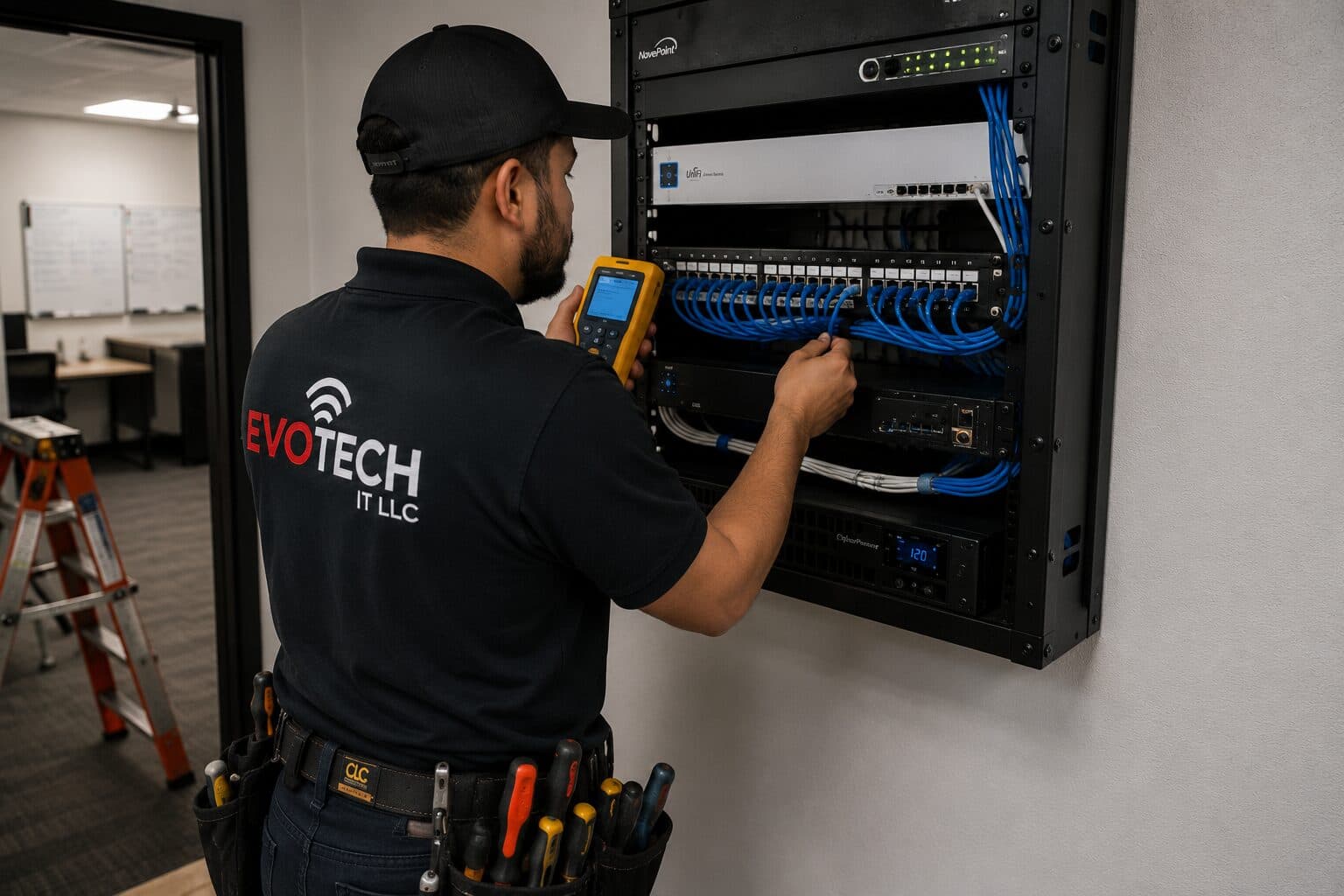
Most data-jack work is one of three things: adding new outlets to existing runs that were left coiled in a wall, replacing damaged or worn jacks, or re-terminating outlets that fail a test. The third is the most common on inherited buildings.
The academic calendar sets the schedule
Substantial infrastructure work happens during breaks. That concentrates a lot of activity into a short window and makes preparation disproportionately important — materials on site, pathways confirmed, and decisions made before the window opens, because there is no extending it.
Work during term time is possible but constrained: classroom access has to fit around teaching, and any work in occupied areas requires appropriate coordination with the school's own procedures for contractors on site.
- Major work concentrated into scheduled breaks
- Preparation completed before the window opens, since it cannot be extended
- Term-time work coordinated around teaching schedules
- Contractor procedures and site access governed by school policy
- Phased approaches common where budgets follow academic years
What changes data-jack installation from job to job
Small job, but several things change the effort.
- Whether usable cable already exists at the location
- Amount of slack available for termination
- Wall construction and whether a bracket can be installed cleanly
- Number of ports per plate and plate layout consistency
- Whether shielded components are involved, which adds bonding steps
- Whether the corresponding patch-panel port needs work too
Brookshire: what the location changes
The starting point for any Brookshire job is one local fact. Large warehousing and distribution buildings along the I-10 corridor. That single condition shapes where cable can run, where equipment can sit, and how coverage is laid out — more than any spec sheet does. Two more conditions weigh on it. Metal construction that reflects wireless signal and complicates coverage. Building footprints frequently exceeding the 100 m copper channel limit. Together they make the route specific to this pocket, which is why a short walkthrough or a few clear photos settle the scope faster than a floor plan can.
- Large warehousing and distribution buildings along the I-10 corridor
- Metal construction that reflects wireless signal and complicates coverage
- Building footprints frequently exceeding the 100 m copper channel limit
- Unconditioned operational areas affecting equipment placement
- Long cable runs and yard/dock areas needing distinct approaches
Getting it done in Brookshire
A jack is only finished when the link tests clean. Wire map catches scheme errors and split pairs; a full certification confirms the termination preserved enough margin for the rated category.
Two priorities dominate: enough wireless capacity in each classroom to serve a full class simultaneously, and controlled entry at the points where people come into the campus.
Getting Brookshire work done means planning around the site as it actually is. Unconditioned operational areas affecting equipment placement. Long cable runs and yard/dock areas needing distinct approaches. Both matter as much as the design to how and when the work happens. The scope is drawn from the real property, the coverage is stated as a service area rather than an office, and unverifiable specifics about Brookshire are kept off the page on purpose.
Frequently asked questions
Is data-jack installation for schools and educational facilities different in Brookshire?
The sector needs stay the same, but the install changes with the place. In Brookshire, the conditions above — not the schools and educational facilities label — decide routes, mounting, and equipment placement, which is why this page pairs all three.
Why did a link start failing after a jack was replaced?
Usually untwist or category mismatch. If more pair was untwisted at the punch-down than the standard allows, crosstalk performance drops, and a link that previously passed with small margin can fail. If the replacement jack is a lower category than the cable, the whole channel is capped at the lower rating. Both show up immediately in a certification test.