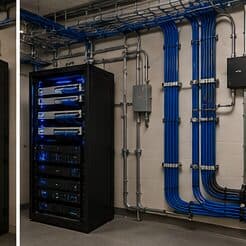
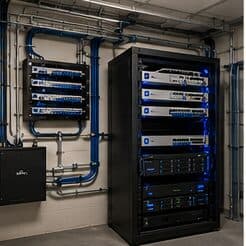
Low-voltage installation for schools and educational facilities, in Baytown
Low-voltage installation for schools and educational facilities in Baytown is a three-part question: what low-voltage installation involves, what schools and educational facilities need from it, and what Baytown changes about the install. An industrial and refining base with rugged operational environments.
Low-voltage work covers the systems that run on cable rather than mains power: data, wireless, cameras, door access, intercoms, and audio-visual. In a new build or a fit-out these systems share pathways, share an equipment position, and increasingly share a network — so planning them together during rough-in costs far less than adding each one separately after the walls close.
Per-classroom capacity and controlled entry
Two priorities dominate: enough wireless capacity in each classroom to serve a full class simultaneously, and controlled entry at the points where people come into the campus.
Both benefit from being designed at a campus level rather than building by building, because the addressing, segmentation, and management overhead of a piecemeal approach grows quickly.
- Access-point capacity planned per classroom, not per building area
- Fiber backbone between buildings and to distribution points
- Controlled entry at main and secondary access points
- Separate segments for student, staff, administrative, and building systems
- Coverage extended to gymnasiums, libraries, and outdoor gathering areas
Where low-voltage installation goes wrong — and how it's avoided
The expensive low-voltage mistakes all happen before anyone pulls cable.
- Specifying systems one at a time instead of planning them together
- Sizing the equipment room for the network only
- Missing the rough-in window and having to retrofit through closed walls
- Leaving device locations unresolved and guessing during rough-in
- Making rated penetrations without sleeves and firestopping
- Leaving cable unlabeled and unprotected between rough-in and finish
Baytown: what the location changes
An industrial and refining base with rugged operational environments. In Baytown, that is where the plan begins, because it changes cable paths, device placement, and access-point counts before anything else does. Older commercial stock needing pathway remediation and rack cleanup. Newer retail development with more straightforward conditions. None of these are generic checklist items — each moves the design in a direction a citywide assumption would miss, and the honest recommendation always depends on what this particular property allows.
- An industrial and refining base with rugged operational environments
- Older commercial stock needing pathway remediation and rack cleanup
- Newer retail development with more straightforward conditions
- Coastal humidity and driven rain requiring durable exterior sealing and surge protection
- Slab-foundation residential following the regional pattern
Getting it done in Baytown
Each system is commissioned on its own terms, but the low-voltage handover is the point where they are verified together.
Camera coverage on a school campus concentrates on entrances, circulation between buildings, parking and drop-off areas, and the perimeter. Corridors are common; classrooms are not, and that boundary is agreed at design.
Getting Baytown work done means planning around the site as it actually is. Coastal humidity and driven rain requiring durable exterior sealing and surge protection. Slab-foundation residential following the regional pattern. Both matter as much as the design to how and when the work happens. The scope is drawn from the real property, the coverage is stated as a service area rather than an office, and unverifiable specifics about Baytown are kept off the page on purpose.
Frequently asked questions
Is low-voltage installation for schools and educational facilities different in Baytown?
The sector needs stay the same, but the install changes with the place. In Baytown, the conditions above — not the schools and educational facilities label — decide routes, mounting, and equipment placement, which is why this page pairs all three.
When should low-voltage work happen in a construction schedule?
Rough-in sits after electrical and framing and before insulation and drywall. Finish work — terminations, device mounting, and commissioning — happens after paint and ceilings. The risk is that upstream delays compress the rough-in window, so having device locations and pathway plans settled in advance is what keeps that window usable.