Fiber-optic cabling for retail stores, in The Woodlands
Fiber-optic cabling for retail stores in The Woodlands is a three-part question: what fiber-optic cabling involves, what retail stores need from it, and what The Woodlands changes about the install. Mature tree cover on many residential lots, attenuating outdoor wireless signal and generating constant motion in camera scenes.
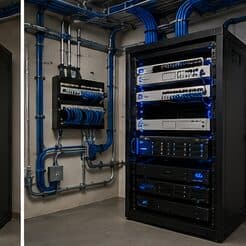
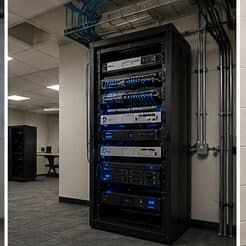
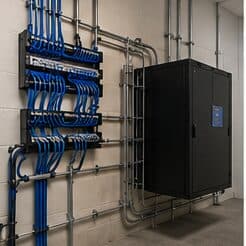
Inside a single building, fiber typically appears as a backbone between the main equipment room and intermediate closets, with copper handling the horizontal runs from those closets out to devices. That split is the standard structured-cabling shape and it exists because each medium is doing what it is good at.
Coverage that answers retail questions
Retail camera coverage typically concentrates on registers, entrances and exits, the stockroom door, and receiving. Those four locations answer most of what retail footage gets asked about — transaction disputes, entry and exit identification, and inventory movement.
Sales floor coverage is a different objective. It shows activity and general movement rather than identifying individuals, and framing it that way avoids the common mistake of installing wide floor cameras and expecting identification-grade footage from them.
Entrances have a lighting problem worth planning around. A camera pointed at a glass storefront during daylight sees a bright background and a dark figure. Positioning the identification camera to view the approach from inside, rather than shooting straight out through the glass, produces far better results than any camera setting.
- Register views framed for transaction detail
- Entrance and exit views framed for identification, avoiding backlight
- Stockroom and receiving door coverage for inventory questions
- Sales floor coverage framed for activity rather than identification
- Retention set to cover the lag before discrepancies are noticed
What changes fiber-optic cabling from job to job
Fiber scope varies mostly with route difficulty and strand count.
- Distance and whether the route is indoor, outdoor, or both
- Fiber type and strand count, including spares
- Termination method and connector count
- Enclosure and splice-tray hardware at each end
- Outdoor path construction: aerial, direct burial, or in conduit
- Transceiver selection at each switch
- Testing depth requested, from loss testing to trace analysis
The Woodlands: what the location changes
What separates a The Woodlands scope from the rest of the city is concrete and local. Mature tree cover on many residential lots, attenuating outdoor wireless signal and generating constant motion in camera scenes. Corporate and professional office stock with meeting-room density driving wireless capacity requirements. Larger residential lots with detached structures and outbuildings beyond practical house-coverage range. That short list is what actually drives the design in this pocket, and it is why photographs or a brief site visit beat a floor plan — the plan follows the building's real constraints, not the neighborhood name on the map.
- Mature tree cover on many residential lots, attenuating outdoor wireless signal and generating constant motion in camera scenes
- Corporate and professional office stock with meeting-room density driving wireless capacity requirements
- Larger residential lots with detached structures and outbuildings beyond practical house-coverage range
- Master-planned development producing relatively consistent, newer commercial construction with usable pathway
- Wooded exterior camera positions requiring careful framing to avoid constant vegetation-triggered motion events
Getting it done in The Woodlands
The baseline test is an insertion-loss measurement across the installed link, compared against the calculated budget for that distance and connector count. A link that passes with margin is a link that will tolerate a future re-patch.
Retail interiors get reset. Fixtures move, register positions shift for seasonal layouts, and a stockroom gets reorganised around whatever the current inventory demands. A network installed as if the layout were fixed becomes an obstacle within a couple of resets.
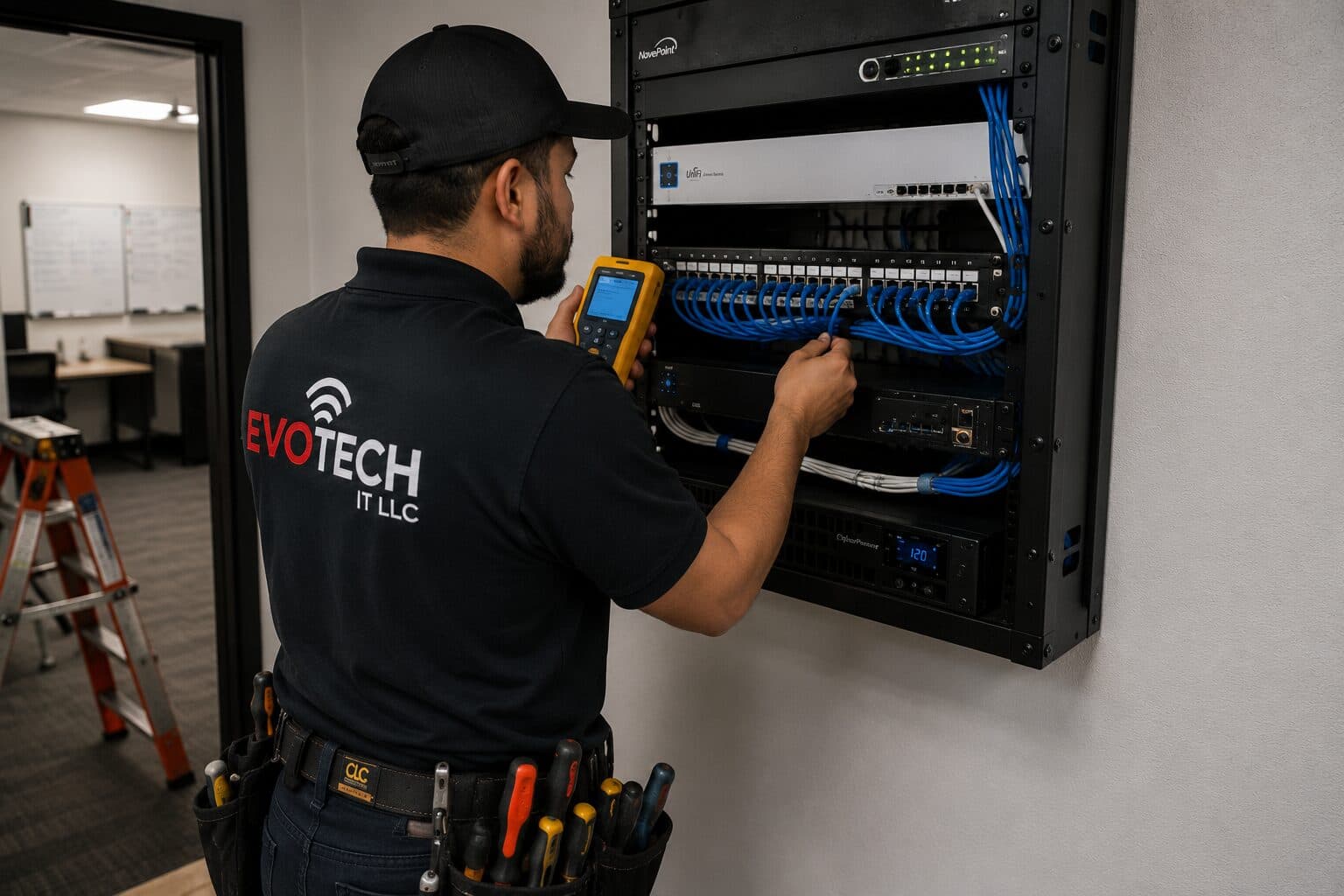
Execution in The Woodlands is planned around real conditions, not a template. Master-planned development producing relatively consistent, newer commercial construction with usable pathway. Wooded exterior camera positions requiring careful framing to avoid constant vegetation-triggered motion events. These decide the sequence, the access, and the method as much as the design does. EVOTECH describes The Woodlands as coverage rather than a place it occupies, and omits any area detail it cannot confirm — building and site conditions only, no invented landmarks or promised arrival times.
Popular services nearby
Frequently searched near this area — the pages people look for most.
Frequently asked questions
Is fiber-optic cabling for retail stores different in The Woodlands?
The sector needs stay the same, but the install changes with the place. In The Woodlands, the conditions above — not the retail stores label — decide routes, mounting, and equipment placement, which is why this page pairs all three.
When is fiber necessary rather than optional?
Two situations make it necessary rather than a preference. First, distance: past the 100-metre copper channel limit there is no compliant copper answer. Second, links between separate buildings, where a copper conductor creates a path for surge and ground-potential differences. Inside those two cases fiber is not an upgrade — it is the correct method.