Why this page exists
Technology for retail stores in the Panther Creek and Cochran's Crossing villages sits where two things meet: how retail stores actually operate, and what the Panther Creek and Cochran's Crossing villages specifically brings to the building. 77381 covers original Woodlands villages like Panther Creek and Cochran's Crossing, defined by heavy preserved forest canopy and tree-protection covenants.
The cheapest moment to add a cable is while the ceiling is already open. Retail benefits more than most environments from spare runs terminated at likely future positions, because the alternative is a surface raceway across a sales floor.
Design for the next layout, not this one
The cheapest moment to add a cable is while the ceiling is already open. Retail benefits more than most environments from spare runs terminated at likely future positions, because the alternative is a surface raceway across a sales floor.
Coverage should be planned by zone — sales floor, fitting areas, stockroom, receiving, office — rather than by pointing access points at where equipment currently sits. Zones survive resets; equipment positions do not.
- Spare terminated runs at likely fixture and register positions
- Zone-based wireless coverage rather than equipment-position coverage
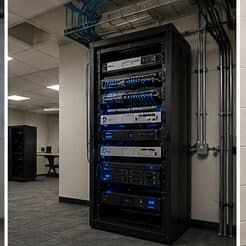
- Rack sized with genuine spare capacity
- Stockroom and receiving treated as distinct coverage areas
- Payment systems segmented from guest and general store traffic
the Panther Creek and Cochran's Crossing villages: what the location adds
What separates a the Panther Creek and Cochran's Crossing villages scope from the rest of the city is concrete and local. 77381 covers original Woodlands villages like Panther Creek and Cochran's Crossing, defined by heavy preserved forest canopy and tree-protection covenants. Dense mature trees strongly favor wired backbones and mesh over line-of-sight wireless and heavily shade exterior camera views. 1980s-1990s homes here predate structured wiring, making retrofits the norm. That short list is what actually drives the design in this pocket, and it is why photographs or a brief site visit beat a floor plan — the plan follows the building's real constraints, not the neighborhood name on the map.
- 77381 covers original Woodlands villages like Panther Creek and Cochran's Crossing, defined by heavy preserved forest canopy and tree-protection covenants
- Dense mature trees strongly favor wired backbones and mesh over line-of-sight wireless and heavily shade exterior camera views
- 1980s-1990s homes here predate structured wiring, making retrofits the norm
- Tree-preservation rules and architectural covenants govern exterior equipment placement and any trenching
- Wooded, deep lots put distance between the house, driveway, and street for camera and gate runs
Registers, handhelds, and the guest question
Payment systems sit on their own segment for the same reasons they do in food service. What differs in retail is the number of mobile devices: handheld scanners, mobile checkout tablets, and inventory devices that move continuously across the floor and depend on clean roaming between access points.
Roaming is therefore a first-class design concern rather than an afterthought. A scanner that drops its session walking from the sales floor into the stockroom generates a support call every day. That means coverage areas need to overlap enough for a clean handoff, with a channel plan that keeps adjacent cells from contending.
Guest Wi-Fi in retail is a marketing decision as much as a technical one. Where it exists, it needs isolation and a bandwidth cap. Where it does not, saying so plainly is better than an open network nobody maintains.
- Payment systems on a dedicated segment
- Coverage designed for clean roaming across the sales floor and into the stockroom
- Handheld and mobile checkout devices treated as the primary wireless clients
- Guest access isolated and rate-limited where offered
- Back-office and inventory systems separated from customer-facing traffic
Installing in the Panther Creek and Cochran's Crossing villages
Retail camera coverage typically concentrates on registers, entrances and exits, the stockroom door, and receiving. Those four locations answer most of what retail footage gets asked about — transaction disputes, entry and exit identification, and inventory movement.
Execution in the Panther Creek and Cochran's Crossing villages is planned around real conditions, not a template. Tree-preservation rules and architectural covenants govern exterior equipment placement and any trenching. Wooded, deep lots put distance between the house, driveway, and street for camera and gate runs. These decide the sequence, the access, and the method as much as the design does. EVOTECH describes the Panther Creek and Cochran's Crossing villages as coverage rather than a place it occupies, and omits any area detail it cannot confirm — building and site conditions only, no invented landmarks or promised arrival times.
Popular services nearby
Frequently searched near this area — the pages people look for most.
Frequently asked questions
What do retail stores in the Panther Creek and Cochran's Crossing villages usually need first?
It varies by site, but the pattern for retail stores holds in the Panther Creek and Cochran's Crossing villages: get the network and cabling backbone right, then layer cameras and access on top. What the Panther Creek and Cochran's Crossing villages changes is the physical install — the conditions listed above drive routes and equipment placement more than the sector alone does.
How many network outlets should a retail space have?
More than the current fixture plan suggests. Retail layouts get reset, and adding a run while the ceiling is open costs a fraction of retrofitting one across a finished sales floor. Terminated spare runs at likely register and fixture positions are among the cheapest insurance in a retail fit-out.