Business phone & VoIP for retail stores, in The Woodlands
Business phone & VoIP for retail stores in The Woodlands is a three-part question: what business phone & voip involves, what retail stores need from it, and what The Woodlands changes about the install. Mature tree cover on many residential lots, attenuating outdoor wireless signal and generating constant motion in camera scenes.
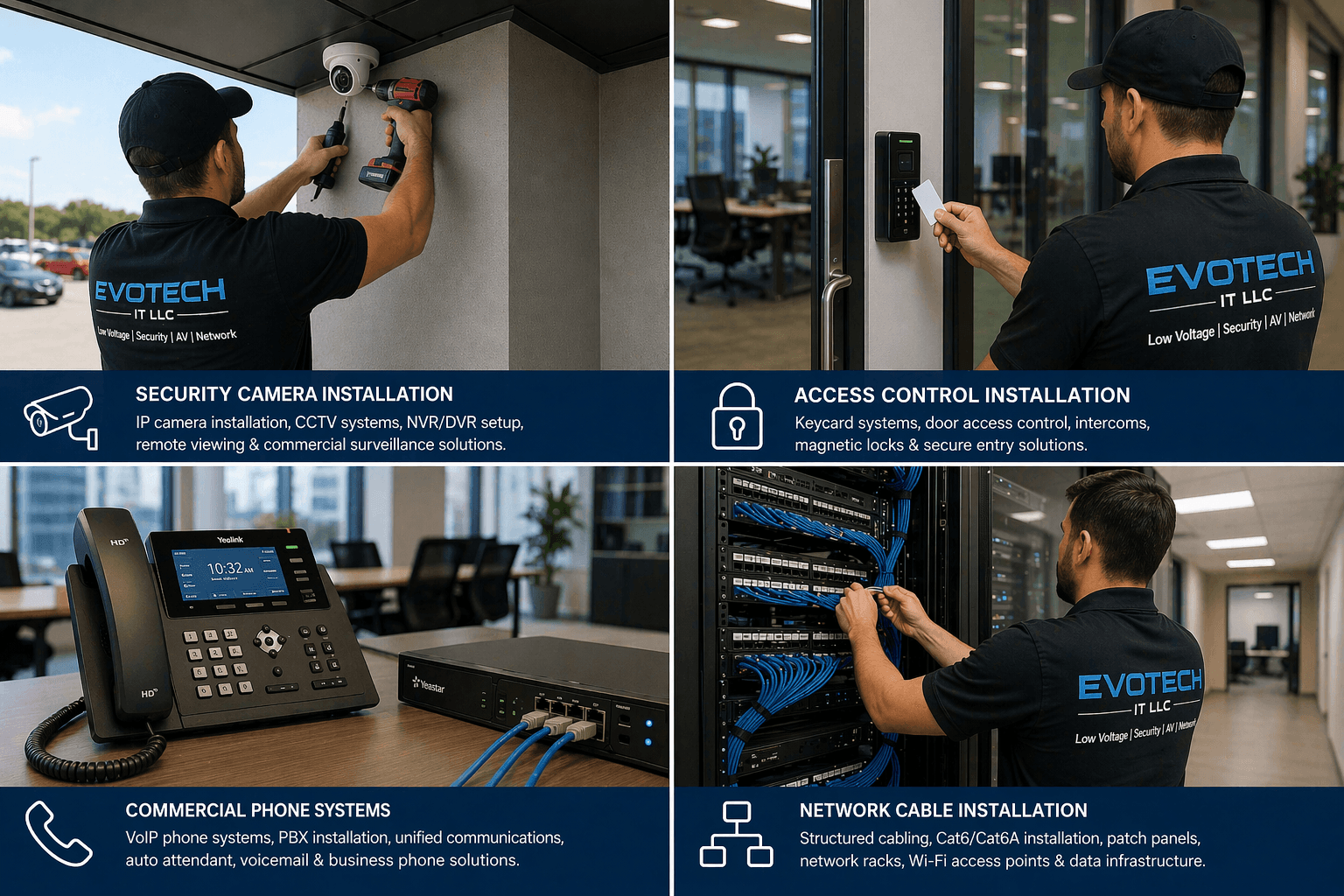
Modern business phones run over the data network — VoIP handsets plug into the same switches as everything else and draw their power from PoE. That is the appeal: one cabling system, central management, and features like auto-attendant, voicemail-to-email, call groups, and remote extensions that older key systems could not offer. The decision that shapes the rest is on-premise versus cloud: an on-site call server you own and maintain, or a hosted service where the provider runs the platform and the site just needs handsets, power, and a good circuit.
Coverage that answers retail questions
Retail camera coverage typically concentrates on registers, entrances and exits, the stockroom door, and receiving. Those four locations answer most of what retail footage gets asked about — transaction disputes, entry and exit identification, and inventory movement.
Sales floor coverage is a different objective. It shows activity and general movement rather than identifying individuals, and framing it that way avoids the common mistake of installing wide floor cameras and expecting identification-grade footage from them.
Entrances have a lighting problem worth planning around. A camera pointed at a glass storefront during daylight sees a bright background and a dark figure. Positioning the identification camera to view the approach from inside, rather than shooting straight out through the glass, produces far better results than any camera setting.
- Register views framed for transaction detail
- Entrance and exit views framed for identification, avoiding backlight
- Stockroom and receiving door coverage for inventory questions
- Sales floor coverage framed for activity rather than identification
- Retention set to cover the lag before discrepancies are noticed
What changes business phone & voip from job to job
Phone-system scope moves with the number of extensions and the call features, not the building size.
- Handset count and any conference, paging, or door-phone endpoints
- On-premise call server versus a hosted platform
- Peak concurrent calls and the resulting upload requirement
- Whether the existing cabling and switching can carry the handsets
- Number porting complexity and how many numbers move
- Auto-attendant, voicemail, call-group, and after-hours routing complexity
- Multi-site dial plan requirements
The Woodlands: what the location changes
In The Woodlands, the plan is built outward from the conditions that are actually here. Mature tree cover on many residential lots, attenuating outdoor wireless signal and generating constant motion in camera scenes. Corporate and professional office stock with meeting-room density driving wireless capacity requirements. Larger residential lots with detached structures and outbuildings beyond practical house-coverage range. Each one changes where cable can run, where equipment can sit, and how coverage is shaped, which is why a walkthrough settles a The Woodlands scope faster than any generic estimate.
- Mature tree cover on many residential lots, attenuating outdoor wireless signal and generating constant motion in camera scenes
- Corporate and professional office stock with meeting-room density driving wireless capacity requirements
- Larger residential lots with detached structures and outbuildings beyond practical house-coverage range
- Master-planned development producing relatively consistent, newer commercial construction with usable pathway
- Wooded exterior camera positions requiring careful framing to avoid constant vegetation-triggered motion events
Getting it done in The Woodlands
Phones are commissioned by making real calls under real conditions, not by confirming the handsets register.
Retail interiors get reset. Fixtures move, register positions shift for seasonal layouts, and a stockroom gets reorganised around whatever the current inventory demands. A network installed as if the layout were fixed becomes an obstacle within a couple of resets.
Getting The Woodlands work done means planning around the site as it actually is. Master-planned development producing relatively consistent, newer commercial construction with usable pathway. Wooded exterior camera positions requiring careful framing to avoid constant vegetation-triggered motion events. Both matter as much as the design to how and when the work happens. The scope is drawn from the real property, the coverage is stated as a service area rather than an office, and unverifiable specifics about The Woodlands are kept off the page on purpose.
Popular services nearby
Frequently searched near this area — the pages people look for most.
Frequently asked questions
Is business phone & voip for retail stores different in The Woodlands?
The sector needs stay the same, but the install changes with the place. In The Woodlands, the conditions above — not the retail stores label — decide routes, mounting, and equipment placement, which is why this page pairs all three.
Why do our VoIP calls sound choppy when the internet seems fine?
Almost always jitter or contention rather than raw bandwidth. Voice packets are time-sensitive, and on a network that treats them the same as a backup or a large upload they get delayed or dropped whenever the network is busy. A dedicated voice segment with quality-of-service prioritisation fixes the majority of these cases without changing the internet plan.