Low-voltage installation for retail stores, in Stafford
Low-voltage installation for retail stores in Stafford is a three-part question: what low-voltage installation involves, what retail stores need from it, and what Stafford changes about the install. Commercial base weighted toward warehouse, showroom, and light-industrial buildings rather than office space.
Low-voltage work covers the systems that run on cable rather than mains power: data, wireless, cameras, door access, intercoms, and audio-visual. In a new build or a fit-out these systems share pathways, share an equipment position, and increasingly share a network — so planning them together during rough-in costs far less than adding each one separately after the walls close.
Design for the next layout, not this one
The cheapest moment to add a cable is while the ceiling is already open. Retail benefits more than most environments from spare runs terminated at likely future positions, because the alternative is a surface raceway across a sales floor.
Coverage should be planned by zone — sales floor, fitting areas, stockroom, receiving, office — rather than by pointing access points at where equipment currently sits. Zones survive resets; equipment positions do not.
- Spare terminated runs at likely fixture and register positions
- Zone-based wireless coverage rather than equipment-position coverage
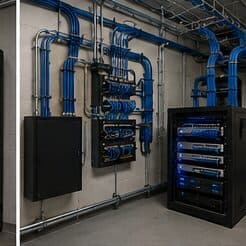
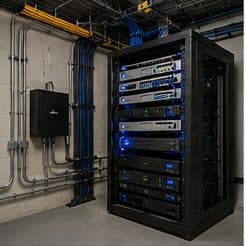
- Rack sized with genuine spare capacity
- Stockroom and receiving treated as distinct coverage areas
- Payment systems segmented from guest and general store traffic
Where low-voltage installation goes wrong — and how it's avoided
The expensive low-voltage mistakes all happen before anyone pulls cable.
- Specifying systems one at a time instead of planning them together
- Sizing the equipment room for the network only
- Missing the rough-in window and having to retrofit through closed walls
- Leaving device locations unresolved and guessing during rough-in
- Making rated penetrations without sleeves and firestopping
- Leaving cable unlabeled and unprotected between rough-in and finish
Stafford: what the location changes
In Stafford, the plan is built outward from the conditions that are actually here. Commercial base weighted toward warehouse, showroom, and light-industrial buildings rather than office space. Metal building construction that reflects wireless signal and changes coverage behaviour compared with drywall interiors. Building footprints frequently exceeding the 100 m copper channel limit from a single equipment position. Each one changes where cable can run, where equipment can sit, and how coverage is shaped, which is why a walkthrough settles a Stafford scope faster than any generic estimate.
- Commercial base weighted toward warehouse, showroom, and light-industrial buildings rather than office space
- Metal building construction that reflects wireless signal and changes coverage behaviour compared with drywall interiors
- Building footprints frequently exceeding the 100 m copper channel limit from a single equipment position
- Largely unconditioned operational areas where equipment placement has to account for summer temperatures and dust
- Mixed occupancy within single buildings, with small conditioned office areas attached to large operational space
Getting it done in Stafford
Each system is commissioned on its own terms, but the low-voltage handover is the point where they are verified together.
Retail camera coverage typically concentrates on registers, entrances and exits, the stockroom door, and receiving. Those four locations answer most of what retail footage gets asked about — transaction disputes, entry and exit identification, and inventory movement.
On site, the schedule and working method turn on conditions like these. Largely unconditioned operational areas where equipment placement has to account for summer temperatures and dust. Mixed occupancy within single buildings, with small conditioned office areas attached to large operational space. Both shape how and when a crew can actually operate, which is why EVOTECH scopes each Stafford job from the property itself rather than assuming one approach fits every address. Coverage is stated as a service area, never an office claim, and anything about Stafford that cannot be verified is left out instead of invented.
Popular services nearby
Frequently searched near this area — the pages people look for most.
Frequently asked questions
Is low-voltage installation for retail stores different in Stafford?
The sector needs stay the same, but the install changes with the place. In Stafford, the conditions above — not the retail stores label — decide routes, mounting, and equipment placement, which is why this page pairs all three.
When should low-voltage work happen in a construction schedule?
Rough-in sits after electrical and framing and before insulation and drywall. Finish work — terminations, device mounting, and commissioning — happens after paint and ceilings. The risk is that upstream delays compress the rough-in window, so having device locations and pathway plans settled in advance is what keeps that window usable.