Business phone & VoIP for restaurants, in Pearland
Business phone & VoIP for restaurants in Pearland is a three-part question: what business phone & voip involves, what restaurants need from it, and what Pearland changes about the install. Newer residential subdivisions with wide floor plans and builder-installed structured cable of variable quality.
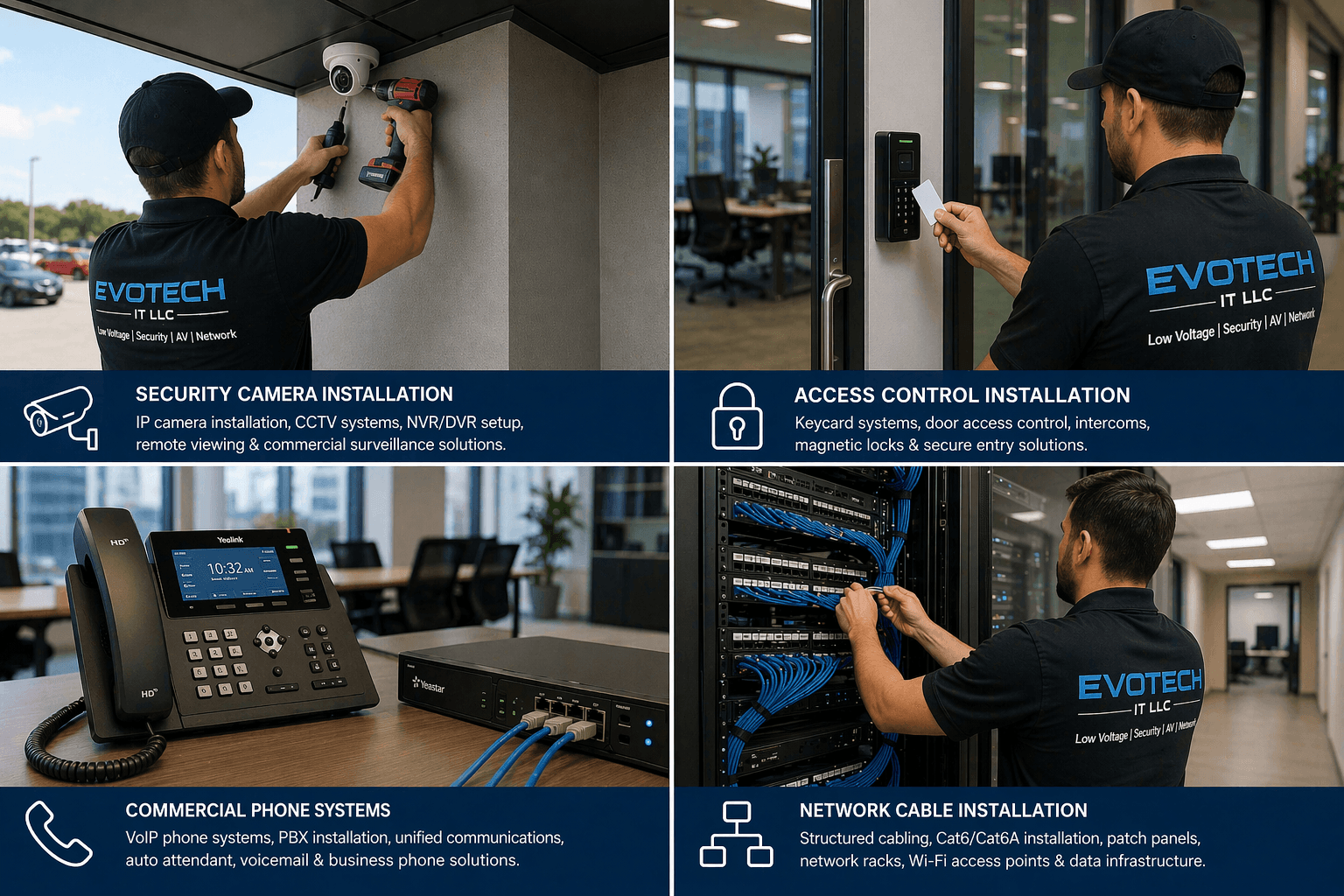
Modern business phones run over the data network — VoIP handsets plug into the same switches as everything else and draw their power from PoE. That is the appeal: one cabling system, central management, and features like auto-attendant, voicemail-to-email, call groups, and remote extensions that older key systems could not offer. The decision that shapes the rest is on-premise versus cloud: an on-site call server you own and maintain, or a hosted service where the provider runs the platform and the site just needs handsets, power, and a good circuit.
Where cameras earn their place
Restaurant camera coverage tends to concentrate on a small number of high-value views rather than blanketing the space. The point-of-sale line, the safe or cash-handling area, the back door, and the dry and walk-in storage entrances answer most of the questions that get asked of restaurant footage.
Framing matters more than count. A camera at the register needs enough pixel density to show what was on the screen and in the drawer; a camera on the back door needs to identify who came through it. A wide shot of the whole dining room satisfies neither and is the most commonly installed view.
Ambient lighting in a dining room is deliberately low, which is the other complication. Cameras selected for a brightly lit retail floor often perform poorly in restaurant lighting, and this is worth checking against recorded footage in actual service conditions rather than a live view during setup.
- Register and cash-handling views framed tightly enough to be useful
- Back door and delivery entrance framed for identification
- Storage and walk-in entrances for inventory questions
- Camera selection checked against real dining-room light levels
- Retention long enough to cover the delay before an issue is noticed
What drives the cost of business phone & voip here
Handsets are visible; the network readiness and porting usually decide the total.
- Number of handsets and specialty endpoints
- On-premise server versus hosted subscription model
- Network work: voice segment, prioritisation, and PoE capacity
- UPS provision
- Number porting and any temporary overlap of old and new service
- Configuration depth for routing and after-hours behaviour
Pearland: what the location changes
In Pearland, the plan is built outward from the conditions that are actually here. Newer residential subdivisions with wide floor plans and builder-installed structured cable of variable quality. Expanding medical office space with controlled-area access requirements and clinical scheduling constraints. Food-service commercial space with kitchen environments and narrow after-hours working windows. Each one changes where cable can run, where equipment can sit, and how coverage is shaped, which is why a walkthrough settles a Pearland scope faster than any generic estimate.
- Newer residential subdivisions with wide floor plans and builder-installed structured cable of variable quality
- Expanding medical office space with controlled-area access requirements and clinical scheduling constraints
- Food-service commercial space with kitchen environments and narrow after-hours working windows
- Slab-on-grade residential foundations making attic routing the standard retrofit path
- Newer commercial construction generally offering suspended-grid ceilings and usable pathway
Getting it done in Pearland
Phones are commissioned by making real calls under real conditions, not by confirming the handsets register.
Restaurant networks do not carry much data. What makes them difficult is everything else: heat and grease near the kitchen, wash-down areas, a guest population that will connect anything to anything, payment systems that must not share a network with either, and an operating schedule that leaves a narrow window for anyone to work.
Getting Pearland work done means planning around the site as it actually is. Slab-on-grade residential foundations making attic routing the standard retrofit path. Newer commercial construction generally offering suspended-grid ceilings and usable pathway. Both matter as much as the design to how and when the work happens. The scope is drawn from the real property, the coverage is stated as a service area rather than an office, and unverifiable specifics about Pearland are kept off the page on purpose.
Popular services nearby
Frequently searched near this area — the pages people look for most.
Frequently asked questions
Is business phone & voip for restaurants different in Pearland?
The sector needs stay the same, but the install changes with the place. In Pearland, the conditions above — not the restaurants label — decide routes, mounting, and equipment placement, which is why this page pairs all three.
Why do our VoIP calls sound choppy when the internet seems fine?
Almost always jitter or contention rather than raw bandwidth. Voice packets are time-sensitive, and on a network that treats them the same as a backup or a large upload they get delayed or dropped whenever the network is busy. A dedicated voice segment with quality-of-service prioritisation fixes the majority of these cases without changing the internet plan.