Why this page exists
Technology for restaurants in Downtown Houston sits where two things meet: how restaurants actually operate, and what Downtown Houston specifically brings to the building. Downtown 77002 is a high-rise central business district where most work happens above the ground floor, so pathways run through core risers, plenum ceilings, and existing building conduit rather than open attic space.
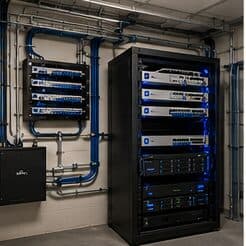
The payment environment should sit on its own network segment with restricted access to and from everything else. That is standard practice, it simplifies any compliance conversation the operator has with their payment provider, and it means a compromised guest device cannot reach a terminal. Building it in at installation is straightforward; retrofitting it into a flat network during business hours is not.
Segmentation and the point-of-sale question
The payment environment should sit on its own network segment with restricted access to and from everything else. That is standard practice, it simplifies any compliance conversation the operator has with their payment provider, and it means a compromised guest device cannot reach a terminal. Building it in at installation is straightforward; retrofitting it into a flat network during business hours is not.
Operations traffic — kitchen display screens, tablets, printers, back-office computers, phone systems — belongs on a third segment. These need reliability more than bandwidth, and several of them work better wired than wireless. A kitchen display or receipt printer on a cable stops being a wireless troubleshooting problem permanently.
Guest Wi-Fi should be isolated from everything internal, isolated from other guest devices, and rate-limited. Without a limit, a handful of guests streaming can degrade the connection that the payment system depends on, which turns a hospitality feature into an operational risk.
- Payment systems on a dedicated segment with restricted cross-network access
- Kitchen displays, printers, and back-office equipment wired where practical
- Guest network isolated from internal systems and from other guest devices
- Guest bandwidth capped so it cannot starve operations at peak
- Access points covering the dining room, bar, and patio as distinct areas
Downtown Houston: what the location adds
In Downtown Houston, the plan is built outward from the conditions that are actually here. Downtown 77002 is a high-rise central business district where most work happens above the ground floor, so pathways run through core risers, plenum ceilings, and existing building conduit rather than open attic space. Many residential units here are converted lofts inside older commercial towers, where concrete floor slabs and demising walls decide what can be fished and what has to be surface-routed. Building engineers and property management control roof, riser, and MDF access, so scheduling and escort requirements shape the work as much as the design. Each one changes where cable can run, where equipment can sit, and how coverage is shaped, which is why a walkthrough settles a Downtown Houston scope faster than any generic estimate.
- Downtown 77002 is a high-rise central business district where most work happens above the ground floor, so pathways run through core risers, plenum ceilings, and existing building conduit rather than open attic space
- Many residential units here are converted lofts inside older commercial towers, where concrete floor slabs and demising walls decide what can be fished and what has to be surface-routed
- Building engineers and property management control roof, riser, and MDF access, so scheduling and escort requirements shape the work as much as the design
- Tenant-improvement churn is constant, so structured cabling is planned around future moves, not just the current floor plan
- The dense tower environment means Wi-Fi and camera coverage are planned around concrete, elevator cores, and interior rooms with no exterior sightlines
Where cameras earn their place
Restaurant camera coverage tends to concentrate on a small number of high-value views rather than blanketing the space. The point-of-sale line, the safe or cash-handling area, the back door, and the dry and walk-in storage entrances answer most of the questions that get asked of restaurant footage.
Framing matters more than count. A camera at the register needs enough pixel density to show what was on the screen and in the drawer; a camera on the back door needs to identify who came through it. A wide shot of the whole dining room satisfies neither and is the most commonly installed view.
Ambient lighting in a dining room is deliberately low, which is the other complication. Cameras selected for a brightly lit retail floor often perform poorly in restaurant lighting, and this is worth checking against recorded footage in actual service conditions rather than a live view during setup.
- Register and cash-handling views framed tightly enough to be useful
- Back door and delivery entrance framed for identification
- Storage and walk-in entrances for inventory questions
- Camera selection checked against real dining-room light levels
- Retention long enough to cover the delay before an issue is noticed
Installing in Downtown Houston
Nearly all restaurant installation happens outside operating hours. That does not usually change the total labour, but it changes the sequencing: every session has to end with the site fully operational, because the doors open regardless of whether the project is finished.
Getting Downtown Houston work done means planning around the site as it actually is. Tenant-improvement churn is constant, so structured cabling is planned around future moves, not just the current floor plan. The dense tower environment means Wi-Fi and camera coverage are planned around concrete, elevator cores, and interior rooms with no exterior sightlines. Both matter as much as the design to how and when the work happens. The scope is drawn from the real property, the coverage is stated as a service area rather than an office, and unverifiable specifics about Downtown Houston are kept off the page on purpose.
Popular services nearby
Frequently searched near this area — the pages people look for most.
Frequently asked questions
What do restaurants in Downtown Houston usually need first?
It varies by site, but the pattern for restaurants holds in Downtown Houston: get the network and cabling backbone right, then layer cameras and access on top. What Downtown Houston changes is the physical install — the conditions listed above drive routes and equipment placement more than the sector alone does.
Should the point-of-sale system be on the guest Wi-Fi?
No. Payment systems belong on their own network segment with restricted access to and from everything else. Beyond the security argument, it also removes a real operational risk: guests saturating the connection should never be able to slow down payment processing.