Why this page exists
Technology for restaurants in The Heights sits where two things meet: how restaurants actually operate, and what The Heights specifically brings to the building. The Heights 77008 is a historic district of early-1900s bungalows and Victorians, many under deed restrictions and historic-district guidelines that affect exterior-mounted equipment and visible cabling.
In order of consequence: keep the payment systems isolated, put the equipment somewhere it will survive, cover the dining room and patio properly, and place cameras where they answer real questions.
What to get right first
In order of consequence: keep the payment systems isolated, put the equipment somewhere it will survive, cover the dining room and patio properly, and place cameras where they answer real questions.
The ordering matters because the failure modes differ. A congested guest network is an annoyance. A payment terminal on a shared flat network is a genuine exposure. Equipment cooked in a hot back room is a recurring replacement cost.
- Segment payment, operations, and guest traffic onto distinct networks
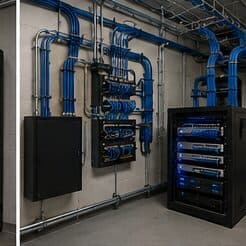
- Locate the rack away from kitchen heat, steam, and wash-down zones
- Rate-limit guest access so it cannot saturate the circuit at peak
- Cover the patio deliberately rather than hoping indoor access points reach
- Put the network equipment and recorder on a UPS
The Heights: what the location adds
The Heights 77008 is a historic district of early-1900s bungalows and Victorians, many under deed restrictions and historic-district guidelines that affect exterior-mounted equipment and visible cabling. In The Heights, that is where the plan begins, because it changes cable paths, device placement, and access-point counts before anything else does. Original homes are pier-and-beam with plaster walls and shallow, low-pitch attics, so pathways favor the crawlspace and careful wall-fishing over attic runs. Extensive teardown-and-rebuild activity means a single street can hold a 1920s bungalow next to a brand-new build with modern prewire. None of these are generic checklist items — each moves the design in a direction a citywide assumption would miss, and the honest recommendation always depends on what this particular property allows.
- The Heights 77008 is a historic district of early-1900s bungalows and Victorians, many under deed restrictions and historic-district guidelines that affect exterior-mounted equipment and visible cabling
- Original homes are pier-and-beam with plaster walls and shallow, low-pitch attics, so pathways favor the crawlspace and careful wall-fishing over attic runs
- Extensive teardown-and-rebuild activity means a single street can hold a 1920s bungalow next to a brand-new build with modern prewire
- Mature protected tree canopy shades lots and can block exterior camera sightlines and rooftop wireless paths
- Detached garages and garage apartments are common, creating a second structure that often needs its own buried or aerial low-voltage link
Segmentation and the point-of-sale question
The payment environment should sit on its own network segment with restricted access to and from everything else. That is standard practice, it simplifies any compliance conversation the operator has with their payment provider, and it means a compromised guest device cannot reach a terminal. Building it in at installation is straightforward; retrofitting it into a flat network during business hours is not.
Operations traffic — kitchen display screens, tablets, printers, back-office computers, phone systems — belongs on a third segment. These need reliability more than bandwidth, and several of them work better wired than wireless. A kitchen display or receipt printer on a cable stops being a wireless troubleshooting problem permanently.
Guest Wi-Fi should be isolated from everything internal, isolated from other guest devices, and rate-limited. Without a limit, a handful of guests streaming can degrade the connection that the payment system depends on, which turns a hospitality feature into an operational risk.
- Payment systems on a dedicated segment with restricted cross-network access
- Kitchen displays, printers, and back-office equipment wired where practical
- Guest network isolated from internal systems and from other guest devices
- Guest bandwidth capped so it cannot starve operations at peak
- Access points covering the dining room, bar, and patio as distinct areas
Installing in The Heights
Restaurant camera coverage tends to concentrate on a small number of high-value views rather than blanketing the space. The point-of-sale line, the safe or cash-handling area, the back door, and the dry and walk-in storage entrances answer most of the questions that get asked of restaurant footage.
On site, the schedule and working method turn on conditions like these. Mature protected tree canopy shades lots and can block exterior camera sightlines and rooftop wireless paths. Detached garages and garage apartments are common, creating a second structure that often needs its own buried or aerial low-voltage link. Both shape how and when a crew can actually operate, which is why EVOTECH scopes each The Heights job from the property itself rather than assuming one approach fits every address. Coverage is stated as a service area, never an office claim, and anything about The Heights that cannot be verified is left out instead of invented.
Popular services nearby
Frequently searched near this area — the pages people look for most.
Frequently asked questions
What do restaurants in The Heights usually need first?
It varies by site, but the pattern for restaurants holds in The Heights: get the network and cabling backbone right, then layer cameras and access on top. What The Heights changes is the physical install — the conditions listed above drive routes and equipment placement more than the sector alone does.
Should the point-of-sale system be on the guest Wi-Fi?
No. Payment systems belong on their own network segment with restricted access to and from everything else. Beyond the security argument, it also removes a real operational risk: guests saturating the connection should never be able to slow down payment processing.