Business phone & VoIP for professional offices, in Webster
Business phone & VoIP for professional offices in Webster is a three-part question: what business phone & voip involves, what professional offices need from it, and what Webster changes about the install. A concentration of medical suites with controlled areas and clinical scheduling.
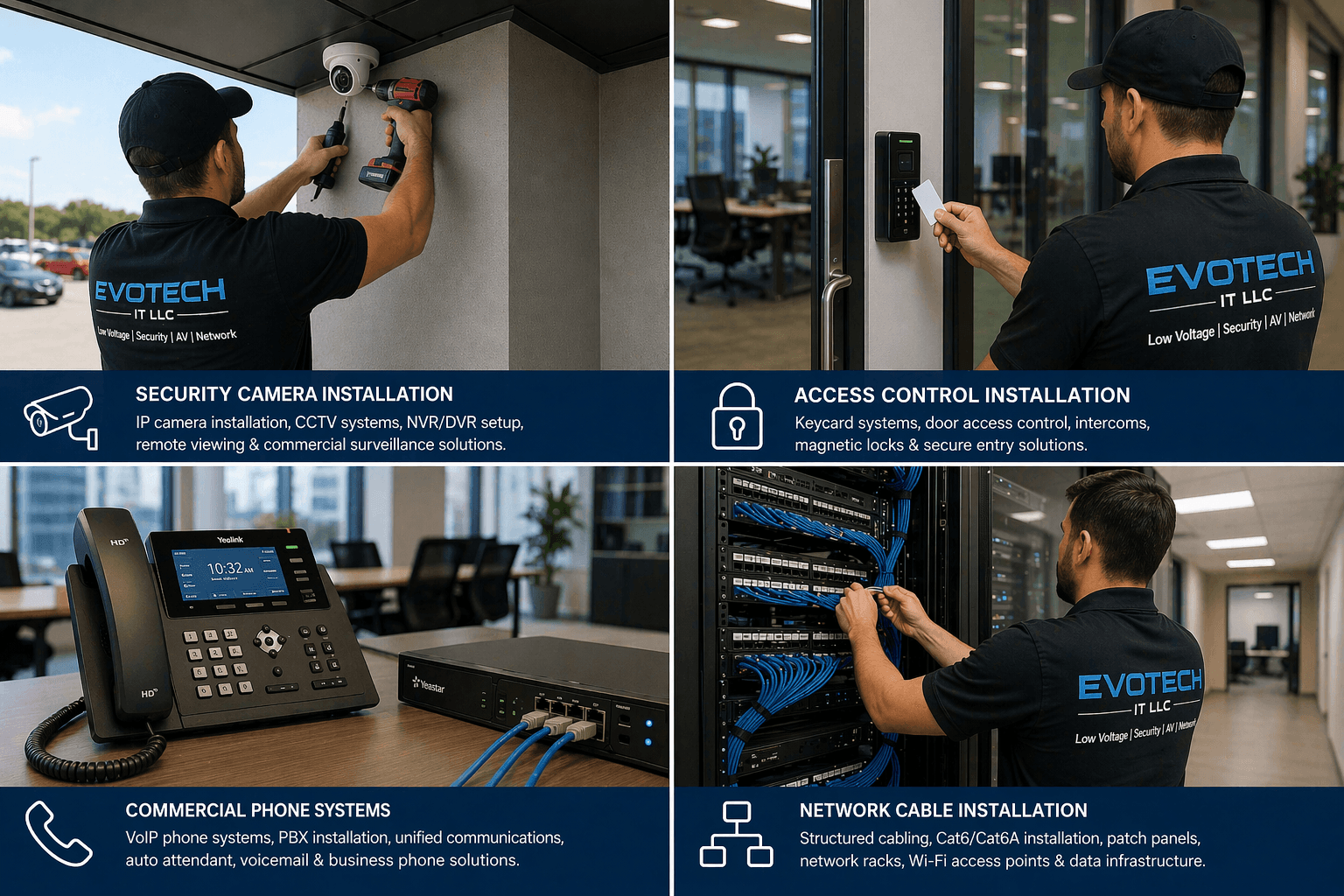
Modern business phones run over the data network — VoIP handsets plug into the same switches as everything else and draw their power from PoE. That is the appeal: one cabling system, central management, and features like auto-attendant, voicemail-to-email, call groups, and remote extensions that older key systems could not offer. The decision that shapes the rest is on-premise versus cloud: an on-site call server you own and maintain, or a hosted service where the provider runs the platform and the site just needs handsets, power, and a good circuit.
Entry control and modest camera coverage
Office camera requirements are usually limited: the main entrance, the suite door, any rear or service entrance, and sometimes the server or equipment room. Interior open-plan coverage is less common and is worth questioning when requested, since it changes the character of the workplace for limited benefit.
Access control frequently matters more. A suite door with credential access, an after-hours schedule, and a record of entries covers most of what an office actually needs. In multi-tenant buildings this also handles the situation where base-building hours differ from a tenant's own working pattern.
- Main entrance and suite door coverage framed for identification
- Rear and service entrances where they exist
- Equipment room access controlled and logged
- Access schedules matched to actual working patterns
- Interior general coverage questioned rather than assumed
What drives the cost of business phone & voip here
Handsets are visible; the network readiness and porting usually decide the total.
- Number of handsets and specialty endpoints
- On-premise server versus hosted subscription model
- Network work: voice segment, prioritisation, and PoE capacity
- UPS provision
- Number porting and any temporary overlap of old and new service
- Configuration depth for routing and after-hours behaviour
Webster: what the location changes
In Webster, the plan is built outward from the conditions that are actually here. A concentration of medical suites with controlled areas and clinical scheduling. Retail and hospitality venues requiring guest and payment segmentation. Multi-tenant buildings with base-building rules on riser and core access. Each one changes where cable can run, where equipment can sit, and how coverage is shaped, which is why a walkthrough settles a Webster scope faster than any generic estimate.
- A concentration of medical suites with controlled areas and clinical scheduling
- Retail and hospitality venues requiring guest and payment segmentation
- Multi-tenant buildings with base-building rules on riser and core access
- Tenant-improvement buildouts with suspended-grid ceilings and usable pathway
- Slab-foundation residential secondary to the commercial base
Getting it done in Webster
Phones are commissioned by making real calls under real conditions, not by confirming the handsets register.
An office floor's network demand is not spread evenly. Individual desks are undemanding. Meeting rooms concentrate a dozen people, their laptops and phones, a display system, and a video call into one radio cell for an hour at a time. That concentration is where the design effort belongs.
Getting Webster work done means planning around the site as it actually is. Tenant-improvement buildouts with suspended-grid ceilings and usable pathway. Slab-foundation residential secondary to the commercial base. Both matter as much as the design to how and when the work happens. The scope is drawn from the real property, the coverage is stated as a service area rather than an office, and unverifiable specifics about Webster are kept off the page on purpose.
Popular services nearby
Frequently searched near this area — the pages people look for most.
Frequently asked questions
Is business phone & voip for professional offices different in Webster?
The sector needs stay the same, but the install changes with the place. In Webster, the conditions above — not the professional offices label — decide routes, mounting, and equipment placement, which is why this page pairs all three.
Why do our VoIP calls sound choppy when the internet seems fine?
Almost always jitter or contention rather than raw bandwidth. Voice packets are time-sensitive, and on a network that treats them the same as a backup or a large upload they get delayed or dropped whenever the network is busy. A dedicated voice segment with quality-of-service prioritisation fixes the majority of these cases without changing the internet plan.