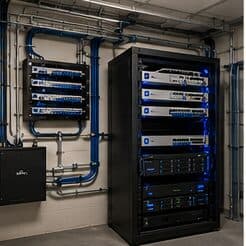
Cat6A cabling for professional offices, in Webster
Cat6A cabling for professional offices in Webster is a three-part question: what cat6a cabling involves, what professional offices need from it, and what Webster changes about the install. A concentration of medical suites with controlled areas and clinical scheduling.
Cat6A is specified to 500 MHz and supports 10GBASE-T across a full 100-metre channel. It achieves that mainly by controlling alien crosstalk — the interference between adjacent cables that constrains Cat6 at 10G — through larger construction, tighter pair geometry, and in shielded variants a foil layer.
Entry control and modest camera coverage
Office camera requirements are usually limited: the main entrance, the suite door, any rear or service entrance, and sometimes the server or equipment room. Interior open-plan coverage is less common and is worth questioning when requested, since it changes the character of the workplace for limited benefit.
Access control frequently matters more. A suite door with credential access, an after-hours schedule, and a record of entries covers most of what an office actually needs. In multi-tenant buildings this also handles the situation where base-building hours differ from a tenant's own working pattern.
- Main entrance and suite door coverage framed for identification
- Rear and service entrances where they exist
- Equipment room access controlled and logged
- Access schedules matched to actual working patterns
- Interior general coverage questioned rather than assumed
What drives the cost of cat6a cabling here
Cat6A raises cost in three places at once — material, pathway, and labour — which is why selective specification usually beats blanket specification.
- Cable and component cost per run
- Pathway modifications where fill limits are exceeded
- Termination time, especially for shielded constructions
- Rack space and cable management to dress larger cable cleanly
- Test time at the higher frequency range
Webster: what the location changes
In Webster, the plan is built outward from the conditions that are actually here. A concentration of medical suites with controlled areas and clinical scheduling. Retail and hospitality venues requiring guest and payment segmentation. Multi-tenant buildings with base-building rules on riser and core access. Each one changes where cable can run, where equipment can sit, and how coverage is shaped, which is why a walkthrough settles a Webster scope faster than any generic estimate.
- A concentration of medical suites with controlled areas and clinical scheduling
- Retail and hospitality venues requiring guest and payment segmentation
- Multi-tenant buildings with base-building rules on riser and core access
- Tenant-improvement buildouts with suspended-grid ceilings and usable pathway
- Slab-foundation residential secondary to the commercial base
Getting it done in Webster
Certification to Cat6A runs the same parameter set as Cat6 but across the full 500 MHz range, where margins are naturally tighter. Passing at 250 MHz says nothing about behaviour at 500 MHz, so the test configuration has to match the intended rating.
An office floor's network demand is not spread evenly. Individual desks are undemanding. Meeting rooms concentrate a dozen people, their laptops and phones, a display system, and a video call into one radio cell for an hour at a time. That concentration is where the design effort belongs.
Getting Webster work done means planning around the site as it actually is. Tenant-improvement buildouts with suspended-grid ceilings and usable pathway. Slab-foundation residential secondary to the commercial base. Both matter as much as the design to how and when the work happens. The scope is drawn from the real property, the coverage is stated as a service area rather than an office, and unverifiable specifics about Webster are kept off the page on purpose.
Popular services nearby
Frequently searched near this area — the pages people look for most.
Frequently asked questions
Is cat6a cabling for professional offices different in Webster?
The sector needs stay the same, but the install changes with the place. In Webster, the conditions above — not the professional offices label — decide routes, mounting, and equipment placement, which is why this page pairs all three.
Is Cat6A worth it if nothing today runs 10 gigabit?
Sometimes. The argument for it is that reopening a ceiling is far more expensive than the cable premium, so runs that are hard to reach and likely to matter later are good candidates. The argument against blanket use is pathway fill and labour. A common middle path is Cat6A on uplinks, dense areas, and inaccessible runs, with Cat6 elsewhere.