Ubiquiti UniFi installation for professional offices, in Stafford
Ubiquiti UniFi installation for professional offices in Stafford is a three-part question: what ubiquiti unifi installation involves, what professional offices need from it, and what Stafford changes about the install. Commercial base weighted toward warehouse, showroom, and light-industrial buildings rather than office space.
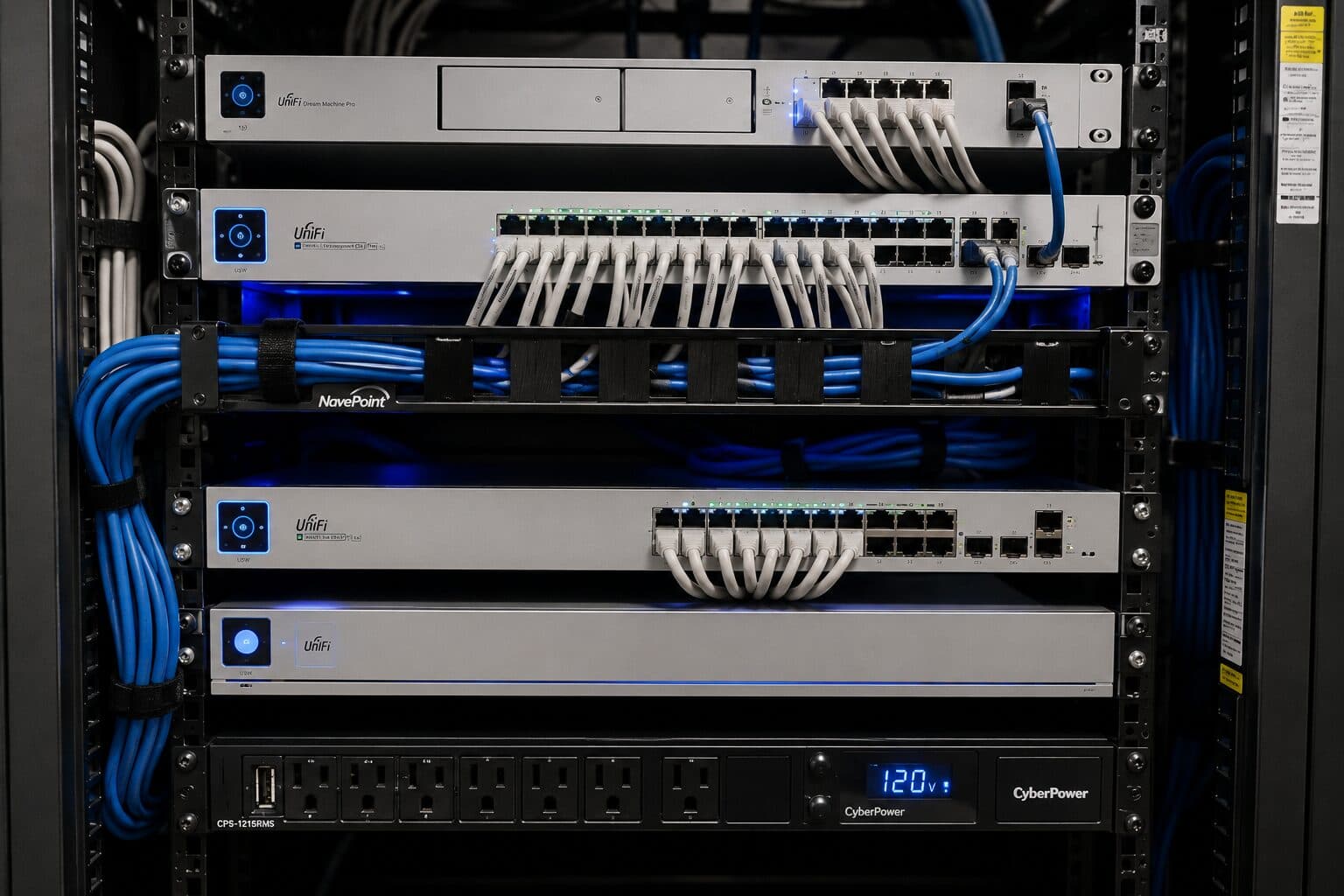
A UniFi deployment puts the gateway, switching, wireless, and often cameras and door access under one controller. The practical benefit is operational rather than raw performance: one interface for network configuration, client visibility, firmware updates, and camera review, instead of separate systems that each need their own knowledge.
Capacity, segmentation, and the wired positions worth keeping
Wireless capacity should be planned from peak simultaneous use in each area. A floor with several meeting rooms in constant use needs more cells concentrated around them than its square footage would suggest, and those cells need a channel plan that stops them contending with each other.
Segmentation in an office is usually simpler than in retail or clinical settings but still worth doing: staff devices, guest and visitor access, building systems such as cameras and door controllers, and any dedicated systems. Guests should reach the internet and nothing else.
Some positions are still worth wiring even in a wireless-first office. Meeting-room equipment, printers, desk phones, ceiling access points, and any position handling large files all benefit from cable, and the incremental cost during a fit-out is small.
- Capacity planned from peak simultaneous devices per area
- Staff, guest, and building-system traffic separated
- Meeting-room equipment, printers, and access points wired
- Channel plan set deliberately in multi-tenant buildings
- Switch PoE budget sized for access points, phones, and cameras together
What drives the cost of ubiquiti unifi installation here
Equipment is visible, but configuration and cabling usually decide the total.
- Device count across gateway, switching, wireless, cameras, and access
- Cable runs and their difficulty
- Storage capacity for the camera retention target
- Number of segments and depth of the policy configuration
- Migration complexity from existing equipment
- Whether structured documentation and handover training are included
Stafford: what the location changes
Commercial base weighted toward warehouse, showroom, and light-industrial buildings rather than office space. In Stafford, that is where the plan begins, because it changes cable paths, device placement, and access-point counts before anything else does. Metal building construction that reflects wireless signal and changes coverage behaviour compared with drywall interiors. Building footprints frequently exceeding the 100 m copper channel limit from a single equipment position. None of these are generic checklist items — each moves the design in a direction a citywide assumption would miss, and the honest recommendation always depends on what this particular property allows.
- Commercial base weighted toward warehouse, showroom, and light-industrial buildings rather than office space
- Metal building construction that reflects wireless signal and changes coverage behaviour compared with drywall interiors
- Building footprints frequently exceeding the 100 m copper channel limit from a single equipment position
- Largely unconditioned operational areas where equipment placement has to account for summer temperatures and dust
- Mixed occupancy within single buildings, with small conditioned office areas attached to large operational space
Getting it done in Stafford
Validation covers the network design as well as the radio coverage, because segmentation that was configured but not tested is not yet segmentation.
The easiest time to do office low-voltage work is during a fit-out, when ceilings are open and the space is empty. Work in an occupied office is entirely feasible but slower, with furniture protection, containment, and noise consideration all adding time.
On site, the schedule and working method turn on conditions like these. Largely unconditioned operational areas where equipment placement has to account for summer temperatures and dust. Mixed occupancy within single buildings, with small conditioned office areas attached to large operational space. Both shape how and when a crew can actually operate, which is why EVOTECH scopes each Stafford job from the property itself rather than assuming one approach fits every address. Coverage is stated as a service area, never an office claim, and anything about Stafford that cannot be verified is left out instead of invented.
Frequently asked questions
Is ubiquiti unifi installation for professional offices different in Stafford?
The sector needs stay the same, but the install changes with the place. In Stafford, the conditions above — not the professional offices label — decide routes, mounting, and equipment placement, which is why this page pairs all three.
Is UniFi the right choice for a small business?
It suits sites that want proper segmentation, decent wireless, and cameras under one interface without employing a network administrator. The tradeoff is committing to one vendor's ecosystem. A mixed-vendor design gives more freedom to pick the best component for each role; the single-vendor version is easier to live with day to day. Both are defensible — it is worth choosing on purpose.