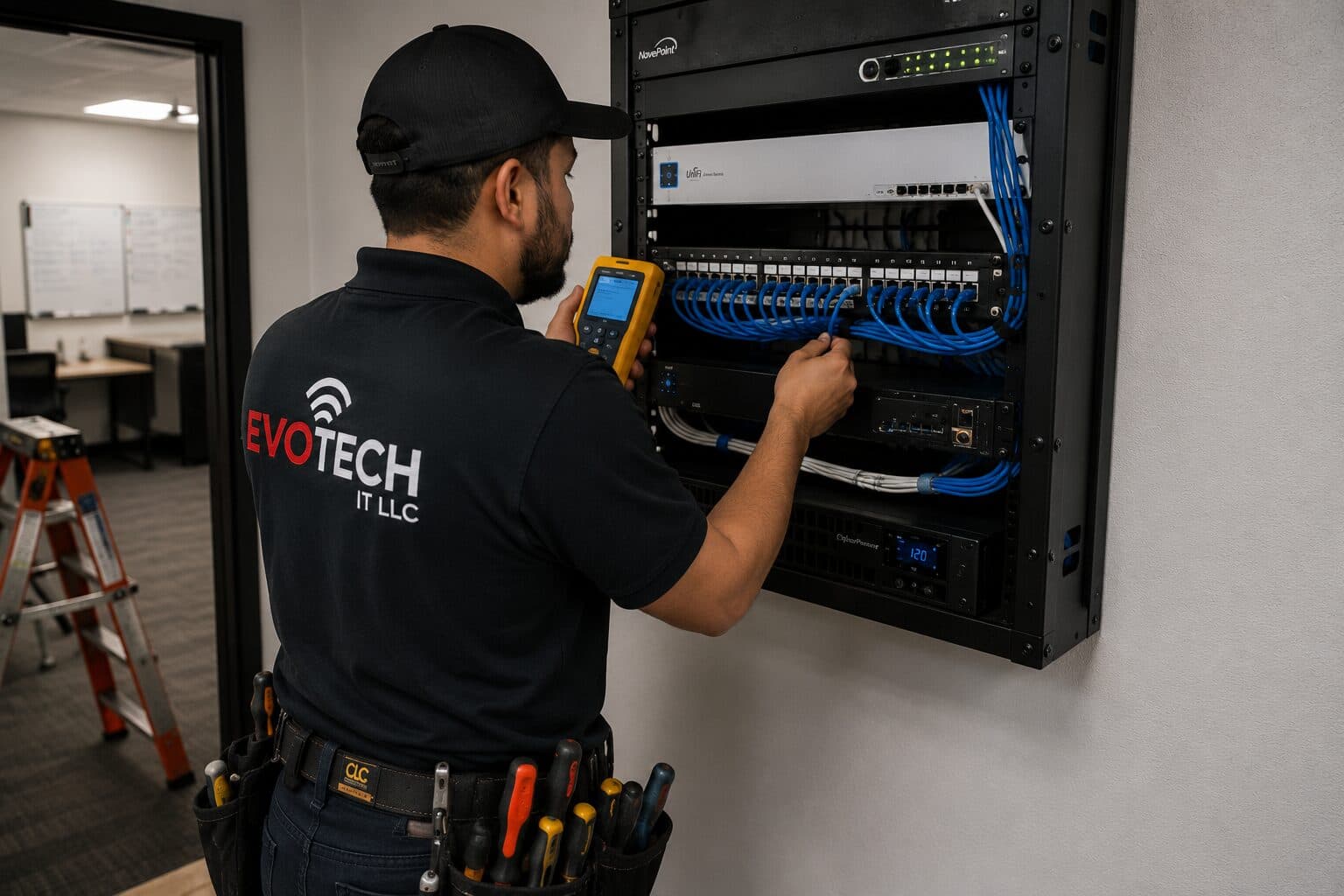
Ubiquiti UniFi installation for professional offices, in Rosenberg
Ubiquiti UniFi installation for professional offices in Rosenberg is a three-part question: what ubiquiti unifi installation involves, what professional offices need from it, and what Rosenberg changes about the install. Warehousing and light-industrial buildings along the highway corridor, with metal construction that reflects wireless signal and needs proper cable support.
A UniFi deployment puts the gateway, switching, wireless, and often cameras and door access under one controller. The practical benefit is operational rather than raw performance: one interface for network configuration, client visibility, firmware updates, and camera review, instead of separate systems that each need their own knowledge.
Fit-outs, occupied floors, and landlords
The easiest time to do office low-voltage work is during a fit-out, when ceilings are open and the space is empty. Work in an occupied office is entirely feasible but slower, with furniture protection, containment, and noise consideration all adding time.
Multi-tenant buildings introduce a third party. Base-building rules on core access, riser use, after-hours work, and ceiling penetration vary considerably, and confirming them before scheduling avoids a crew arriving to find they cannot access the riser.
- Fit-out timing preferred where the schedule allows
- Furniture protection and containment in occupied areas
- Base-building rules on riser and core access confirmed in advance
- After-hours access arrangements agreed with building management
- Noise-sensitive work scheduled outside core hours
What drives the cost of ubiquiti unifi installation here
Equipment is visible, but configuration and cabling usually decide the total.
- Device count across gateway, switching, wireless, cameras, and access
- Cable runs and their difficulty
- Storage capacity for the camera retention target
- Number of segments and depth of the policy configuration
- Migration complexity from existing equipment
- Whether structured documentation and handover training are included
Rosenberg: what the location changes
In Rosenberg, the plan is built outward from the conditions that are actually here. Warehousing and light-industrial buildings along the highway corridor, with metal construction that reflects wireless signal and needs proper cable support. An older rail-town commercial core with masonry buildings and limited existing pathway. Newer suburban subdivisions on slab foundations following the regional attic-routing pattern. Each one changes where cable can run, where equipment can sit, and how coverage is shaped, which is why a walkthrough settles a Rosenberg scope faster than any generic estimate.
- Warehousing and light-industrial buildings along the highway corridor, with metal construction that reflects wireless signal and needs proper cable support
- An older rail-town commercial core with masonry buildings and limited existing pathway
- Newer suburban subdivisions on slab foundations following the regional attic-routing pattern
- Dust exposure in industrial and distribution environments, affecting rack and equipment placement
- Gulf Coast humidity and driven-rain events requiring rated exterior housings and sealed penetrations
Getting it done in Rosenberg
Validation covers the network design as well as the radio coverage, because segmentation that was configured but not tested is not yet segmentation.
In an office, the technology most people judge is the meeting room, and the two things they judge it on are whether the far end can hear them and whether the meeting started on time. Both are solvable, and both are more about microphone coverage and simple control than about display specification.
Getting Rosenberg work done means planning around the site as it actually is. Dust exposure in industrial and distribution environments, affecting rack and equipment placement. Gulf Coast humidity and driven-rain events requiring rated exterior housings and sealed penetrations. Both matter as much as the design to how and when the work happens. The scope is drawn from the real property, the coverage is stated as a service area rather than an office, and unverifiable specifics about Rosenberg are kept off the page on purpose.
Frequently asked questions
Is ubiquiti unifi installation for professional offices different in Rosenberg?
The sector needs stay the same, but the install changes with the place. In Rosenberg, the conditions above — not the professional offices label — decide routes, mounting, and equipment placement, which is why this page pairs all three.
Is UniFi the right choice for a small business?
It suits sites that want proper segmentation, decent wireless, and cameras under one interface without employing a network administrator. The tradeoff is committing to one vendor's ecosystem. A mixed-vendor design gives more freedom to pick the best component for each role; the single-vendor version is easier to live with day to day. Both are defensible — it is worth choosing on purpose.