Wireless bridge (point-to-point) for professional offices, in Katy
Wireless bridge (point-to-point) for professional offices in Katy is a three-part question: what wireless bridge (point-to-point) involves, what professional offices need from it, and what Katy changes about the install. Housing stock skewed toward newer, larger single-family construction with wide floor plans that exceed single-router coverage.
A point-to-point wireless bridge connects two buildings or locations across a distance where trenching fiber is impractical — a yard, a road, a parking lot between two structures. A pair of directional radios, aimed precisely at each other, carry the network link through the air. It is the right tool when a physical run is genuinely not feasible, and it depends almost entirely on one thing: a clear, unobstructed line of sight between the two points.
Meeting rooms first
In an office, the technology most people judge is the meeting room, and the two things they judge it on are whether the far end can hear them and whether the meeting started on time. Both are solvable, and both are more about microphone coverage and simple control than about display specification.
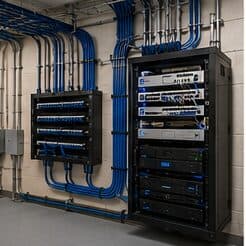
After that: wireless capacity in the areas where people gather, enough desk outlets to survive a layout change, and an equipment room that someone can actually work in.
- Meeting-room audio coverage matched to the seating, not to the room's floor area
- One obvious action that starts a meeting
- Wireless capacity concentrated where people gather
- Two outlets at each desk position rather than one
- Equipment room with ventilation, power, and working clearance
What drives the cost of wireless bridge (point-to-point) here
Distance, mounting height, and access drive the cost.
- Distance and the radios/antennas it requires
- Mounting height and structures at each end
- Access for installation at both ends
- Power provision at each end
- Weatherproof mounting and cabling
- Any redundancy or failover
Katy: what the location changes
In Katy, the plan is built outward from the conditions that are actually here. Housing stock skewed toward newer, larger single-family construction with wide floor plans that exceed single-router coverage. Structured media panels commonly present but frequently located in a garage or perimeter utility space rather than centrally. Builder-installed cable often terminated to a panel but not extended to ceiling positions suitable for access points. Each one changes where cable can run, where equipment can sit, and how coverage is shaped, which is why a walkthrough settles a Katy scope faster than any generic estimate.
- Housing stock skewed toward newer, larger single-family construction with wide floor plans that exceed single-router coverage
- Structured media panels commonly present but frequently located in a garage or perimeter utility space rather than centrally
- Builder-installed cable often terminated to a panel but not extended to ceiling positions suitable for access points
- Slab foundations with accessible attics, making attic-to-interior-wall routing the standard retrofit path
- Suburban commercial development in retail pads and medical suites with suspended-grid ceilings and comparatively straightforward pathway
Getting it done in Katy
A bridge is commissioned on signal, throughput, and stability.
Office camera requirements are usually limited: the main entrance, the suite door, any rear or service entrance, and sometimes the server or equipment room. Interior open-plan coverage is less common and is worth questioning when requested, since it changes the character of the workplace for limited benefit.
Getting Katy work done means planning around the site as it actually is. Slab foundations with accessible attics, making attic-to-interior-wall routing the standard retrofit path. Suburban commercial development in retail pads and medical suites with suspended-grid ceilings and comparatively straightforward pathway. Both matter as much as the design to how and when the work happens. The scope is drawn from the real property, the coverage is stated as a service area rather than an office, and unverifiable specifics about Katy are kept off the page on purpose.
Frequently asked questions
Is wireless bridge (point-to-point) for professional offices different in Katy?
The sector needs stay the same, but the install changes with the place. In Katy, the conditions above — not the professional offices label — decide routes, mounting, and equipment placement, which is why this page pairs all three.
When should I use a wireless bridge instead of running cable?
When a physical run is genuinely impractical — a road, a parking lot, or a distance that would mean major trenching between two buildings. Where a cable can reasonably go, especially fiber between separately grounded structures, it is more reliable. A bridge is the right tool specifically when the gap can't be crossed physically and there is clear line of sight.