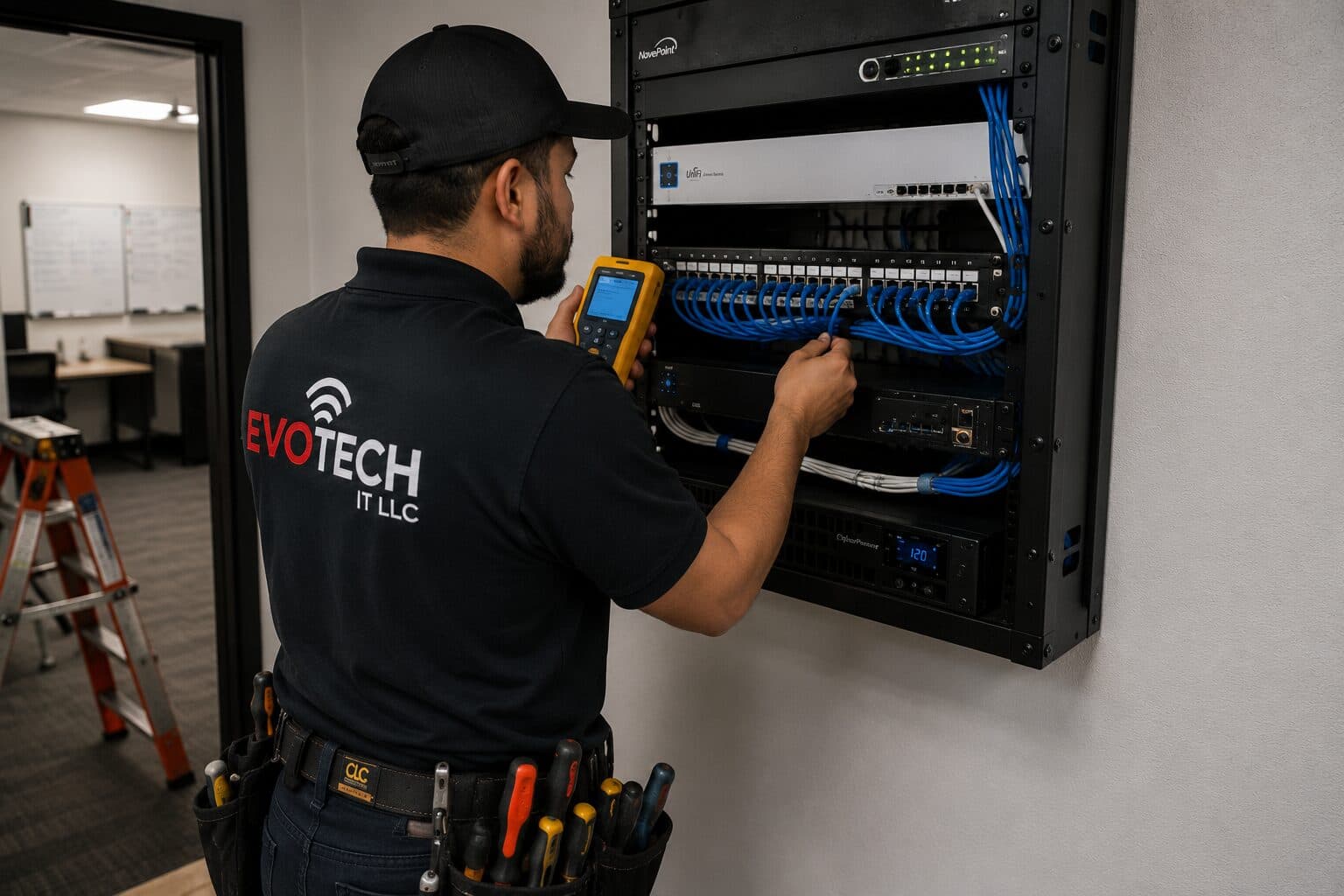
Network troubleshooting for professional offices, in Humble
Network troubleshooting for professional offices in Humble is a three-part question: what network troubleshooting involves, what professional offices need from it, and what Humble changes about the install. A retail and commercial hub with a broad mix of building ages.
Effective troubleshooting is a process of elimination against a specific, reproducible symptom. 'The internet is slow' is not yet a diagnosis — slow for whom, on which devices, wired or wireless, at what times, to which destinations. Those answers usually point at a layer before any equipment is touched.
Density is concentrated, not distributed
An office floor's network demand is not spread evenly. Individual desks are undemanding. Meeting rooms concentrate a dozen people, their laptops and phones, a display system, and a video call into one radio cell for an hour at a time. That concentration is where the design effort belongs.
The second characteristic is churn. Desk layouts change, teams grow, hot-desking arrives and departs. Offices benefit from more outlets than the current plan requires and from wireless coverage designed around areas rather than around today's seating chart.
- Demand concentrated in meeting and collaboration areas
- Desk layouts changing more often than the cabling can economically follow
- Video calls as the most visible and least forgiving workload
- Printers, phones, and access points adding to the wired device count
Where network troubleshooting goes wrong — and how it's avoided
Troubleshooting goes wrong mainly by skipping the narrowing step.
- Replacing the router first because it is the most visible device
- Changing several things at once, so the actual cause stays unknown
- Accepting 'the internet is slow' without narrowing scope and timing
- Ignoring switch error counters that already identify the faulty port
- Blaming wireless for a saturated circuit or an oversubscribed uplink
- Fixing the symptom without documenting the cause, so it recurs unrecognised
Humble: what the location changes
In Humble, the plan is built outward from the conditions that are actually here. A retail and commercial hub with a broad mix of building ages. Warehousing and distribution requiring aisle coverage and longer runs. Older commercial stock needing pathway remediation and rack cleanup. Each one changes where cable can run, where equipment can sit, and how coverage is shaped, which is why a walkthrough settles a Humble scope faster than any generic estimate.
- A retail and commercial hub with a broad mix of building ages
- Warehousing and distribution requiring aisle coverage and longer runs
- Older commercial stock needing pathway remediation and rack cleanup
- Retail point-of-sale environments requiring network segmentation
- Slab-foundation residential across established and newer neighbourhoods
Getting it done in Humble
The test that matters is the one that reproduces the original complaint, run again after the change.
Wireless capacity should be planned from peak simultaneous use in each area. A floor with several meeting rooms in constant use needs more cells concentrated around them than its square footage would suggest, and those cells need a channel plan that stops them contending with each other.
Getting Humble work done means planning around the site as it actually is. Retail point-of-sale environments requiring network segmentation. Slab-foundation residential across established and newer neighbourhoods. Both matter as much as the design to how and when the work happens. The scope is drawn from the real property, the coverage is stated as a service area rather than an office, and unverifiable specifics about Humble are kept off the page on purpose.
Frequently asked questions
Is network troubleshooting for professional offices different in Humble?
The sector needs stay the same, but the install changes with the place. In Humble, the conditions above — not the professional offices label — decide routes, mounting, and equipment placement, which is why this page pairs all three.
Why is the network slow only in the afternoon?
Time-correlated symptoms usually mean capacity rather than a fault. Something is consuming the shared resource at that time — backups, updates, more people on site, or a scheduled process. Measuring at the gateway during the slow period, and comparing it to a quiet period, distinguishes a saturated circuit from an internal bottleneck quickly.