Business phone & VoIP for professional offices, in Fulshear
Business phone & VoIP for professional offices in Fulshear is a three-part question: what business phone & voip involves, what professional offices need from it, and what Fulshear changes about the install. Predominantly recent residential construction, so prewire timing rather than retrofit access is the usual constraint.
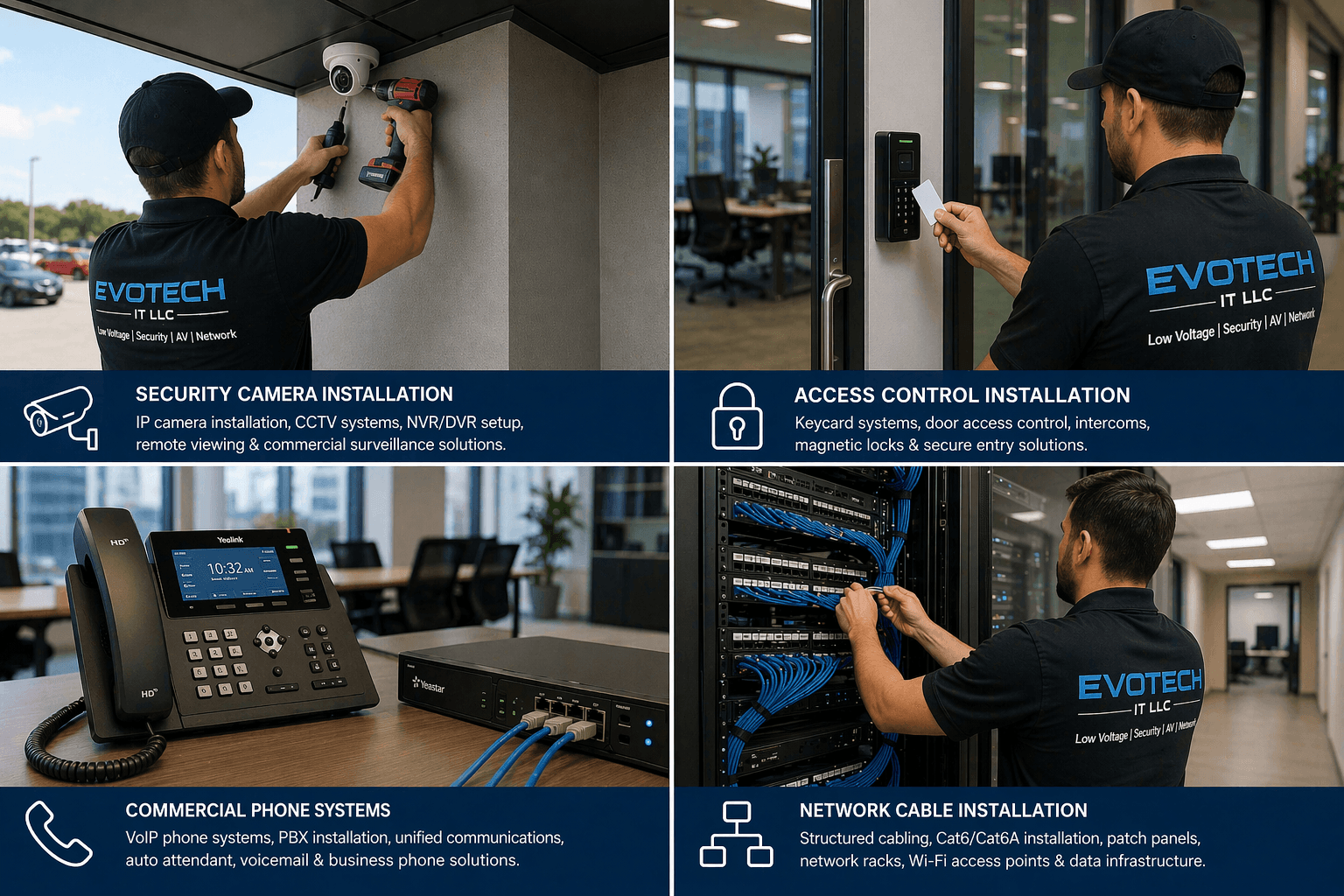
Modern business phones run over the data network — VoIP handsets plug into the same switches as everything else and draw their power from PoE. That is the appeal: one cabling system, central management, and features like auto-attendant, voicemail-to-email, call groups, and remote extensions that older key systems could not offer. The decision that shapes the rest is on-premise versus cloud: an on-site call server you own and maintain, or a hosted service where the provider runs the platform and the site just needs handsets, power, and a good circuit.
Density is concentrated, not distributed
An office floor's network demand is not spread evenly. Individual desks are undemanding. Meeting rooms concentrate a dozen people, their laptops and phones, a display system, and a video call into one radio cell for an hour at a time. That concentration is where the design effort belongs.
The second characteristic is churn. Desk layouts change, teams grow, hot-desking arrives and departs. Offices benefit from more outlets than the current plan requires and from wireless coverage designed around areas rather than around today's seating chart.
- Demand concentrated in meeting and collaboration areas
- Desk layouts changing more often than the cabling can economically follow
- Video calls as the most visible and least forgiving workload
- Printers, phones, and access points adding to the wired device count
Where business phone & voip goes wrong — and how it's avoided
VoIP disappoints for network reasons far more often than handset reasons.
- Putting phones on a flat, unprioritised network and blaming the handsets for choppy calls
- Sizing for download and running out of upload at busy times
- Adding handsets to a switch with no PoE budget left
- Leaving the phone equipment off a UPS
- Porting numbers before the new system is tested and ready
- No defined process for adding an extension, so the system ossifies
Fulshear: what the location changes
Predominantly recent residential construction, so prewire timing rather than retrofit access is the usual constraint. In Fulshear, that is where the plan begins, because it changes cable paths, device placement, and access-point counts before anything else does. Large single-family floor plans requiring multiple wired coverage positions rather than a single router. Builder-provided media enclosures frequently undersized, unventilated, or awkwardly positioned for wireless coverage. None of these are generic checklist items — each moves the design in a direction a citywide assumption would miss, and the honest recommendation always depends on what this particular property allows.
- Predominantly recent residential construction, so prewire timing rather than retrofit access is the usual constraint
- Large single-family floor plans requiring multiple wired coverage positions rather than a single router
- Builder-provided media enclosures frequently undersized, unventilated, or awkwardly positioned for wireless coverage
- Slab-on-grade foundations with accessible attics for post-construction additions
- Larger lots with detached garages and outbuildings needing their own deliberate connectivity approach
Getting it done in Fulshear
Phones are commissioned by making real calls under real conditions, not by confirming the handsets register.
Wireless capacity should be planned from peak simultaneous use in each area. A floor with several meeting rooms in constant use needs more cells concentrated around them than its square footage would suggest, and those cells need a channel plan that stops them contending with each other.
Getting Fulshear work done means planning around the site as it actually is. Slab-on-grade foundations with accessible attics for post-construction additions. Larger lots with detached garages and outbuildings needing their own deliberate connectivity approach. Both matter as much as the design to how and when the work happens. The scope is drawn from the real property, the coverage is stated as a service area rather than an office, and unverifiable specifics about Fulshear are kept off the page on purpose.
Frequently asked questions
Is business phone & voip for professional offices different in Fulshear?
The sector needs stay the same, but the install changes with the place. In Fulshear, the conditions above — not the professional offices label — decide routes, mounting, and equipment placement, which is why this page pairs all three.
Why do our VoIP calls sound choppy when the internet seems fine?
Almost always jitter or contention rather than raw bandwidth. Voice packets are time-sensitive, and on a network that treats them the same as a backup or a large upload they get delayed or dropped whenever the network is busy. A dedicated voice segment with quality-of-service prioritisation fixes the majority of these cases without changing the internet plan.