Data-jack installation for new construction, in Tomball
Data-jack installation for new construction in Tomball is a three-part question: what data-jack installation involves, what new construction need from it, and what Tomball changes about the install. A historic small-town core with masonry buildings and limited pathway.
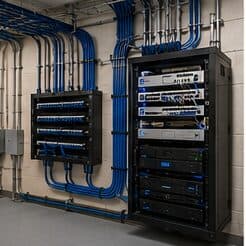
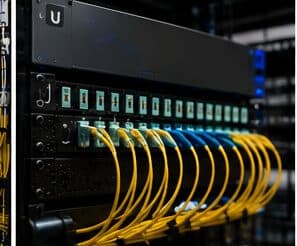
Most data-jack work is one of three things: adding new outlets to existing runs that were left coiled in a wall, replacing damaged or worn jacks, or re-terminating outlets that fail a test. The third is the most common on inherited buildings.
One window, and it does not reopen
Low-voltage rough-in happens in a specific slot: after framing and electrical, before insulation and drywall. Inside that window, running a cable anywhere is straightforward. Once drywall goes up, the same cable costs many times more and sometimes cannot be run at all.
The asymmetry is the whole story of new-construction low voltage. Decisions made cheaply during rough-in become expensive or impossible afterwards, which is why the pre-rough-in planning conversation is worth more than any equipment choice made later.
- Rough-in window sits between electrical and drywall
- Upstream delays compress the window without extending the deadline
- Post-drywall changes cost many times more, if they are possible at all
- Finish work happens months later, after paint and ceilings
What changes data-jack installation from job to job
Small job, but several things change the effort.
- Whether usable cable already exists at the location
- Amount of slack available for termination
- Wall construction and whether a bracket can be installed cleanly
- Number of ports per plate and plate layout consistency
- Whether shielded components are involved, which adds bonding steps
- Whether the corresponding patch-panel port needs work too
Tomball: what the location changes
What separates a Tomball scope from the rest of the city is concrete and local. A historic small-town core with masonry buildings and limited pathway. Growing retail and medical buildouts with suspended-grid ceilings and tenant-improvement conditions. Larger properties and outbuildings toward the northern edge, bringing longer runs. That short list is what actually drives the design in this pocket, and it is why photographs or a brief site visit beat a floor plan — the plan follows the building's real constraints, not the neighborhood name on the map.
- A historic small-town core with masonry buildings and limited pathway
- Growing retail and medical buildouts with suspended-grid ceilings and tenant-improvement conditions
- Larger properties and outbuildings toward the northern edge, bringing longer runs
- Slab-foundation residential across established and newer subdivisions
- Gulf Coast humidity requiring rated exterior housings and sealed penetrations
Getting it done in Tomball
A jack is only finished when the link tests clean. Wire map catches scheme errors and split pairs; a full certification confirms the termination preserved enough margin for the rated category.
Full system design is often not finished when the rough-in window arrives. That is normal, and it is not a reason to skip the pathway. Running conduit or sleeves to likely positions preserves the option cheaply even when the eventual equipment is undecided.
Getting Tomball work done means planning around the site as it actually is. Slab-foundation residential across established and newer subdivisions. Gulf Coast humidity requiring rated exterior housings and sealed penetrations. Both matter as much as the design to how and when the work happens. The scope is drawn from the real property, the coverage is stated as a service area rather than an office, and unverifiable specifics about Tomball are kept off the page on purpose.
Frequently asked questions
Is data-jack installation for new construction different in Tomball?
The sector needs stay the same, but the install changes with the place. In Tomball, the conditions above — not the new construction label — decide routes, mounting, and equipment placement, which is why this page pairs all three.
Why did a link start failing after a jack was replaced?
Usually untwist or category mismatch. If more pair was untwisted at the punch-down than the standard allows, crosstalk performance drops, and a link that previously passed with small margin can fail. If the replacement jack is a lower category than the cable, the whole channel is capped at the lower rating. Both show up immediately in a certification test.