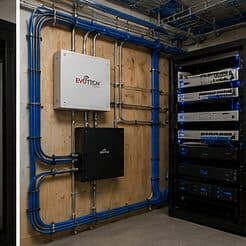
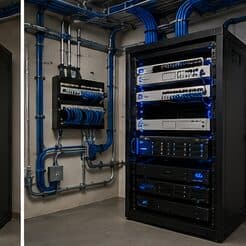
In-wall cable concealment for new construction, in Stafford
In-wall cable concealment for new construction in Stafford is a three-part question: what in-wall cable concealment involves, what new construction need from it, and what Stafford changes about the install. Commercial base weighted toward warehouse, showroom, and light-industrial buildings rather than office space.
The work itself is fishing cable through a finished wall, and how hard that is depends entirely on what is inside it. An open stud cavity is quick; fire blocking, insulation, a masonry or metal-stud wall, or a fireplace structure can stop a fish tape and change the approach. Where a clean in-wall path genuinely isn't available, a paintable surface raceway is the honest alternative.
One window, and it does not reopen
Low-voltage rough-in happens in a specific slot: after framing and electrical, before insulation and drywall. Inside that window, running a cable anywhere is straightforward. Once drywall goes up, the same cable costs many times more and sometimes cannot be run at all.
The asymmetry is the whole story of new-construction low voltage. Decisions made cheaply during rough-in become expensive or impossible afterwards, which is why the pre-rough-in planning conversation is worth more than any equipment choice made later.
- Rough-in window sits between electrical and drywall
- Upstream delays compress the window without extending the deadline
- Post-drywall changes cost many times more, if they are possible at all
- Finish work happens months later, after paint and ceilings
What changes in-wall cable concealment from job to job
Scope depends on the wall and the run.
- Wall construction: drywall, masonry, metal stud, or fireplace
- Fire blocking, insulation, and bracing in the cavity
- Distance from the display to the outlet or equipment
- Whether a recessed outlet must be added
- Number of cables to conceal
- Finish expectations and any patch-and-paint
Stafford: what the location changes
The starting point for any Stafford job is one local fact. Commercial base weighted toward warehouse, showroom, and light-industrial buildings rather than office space. That single condition shapes where cable can run, where equipment can sit, and how coverage is laid out — more than any spec sheet does. Two more conditions weigh on it. Metal building construction that reflects wireless signal and changes coverage behaviour compared with drywall interiors. Building footprints frequently exceeding the 100 m copper channel limit from a single equipment position. Together they make the route specific to this pocket, which is why a short walkthrough or a few clear photos settle the scope faster than a floor plan can.
- Commercial base weighted toward warehouse, showroom, and light-industrial buildings rather than office space
- Metal building construction that reflects wireless signal and changes coverage behaviour compared with drywall interiors
- Building footprints frequently exceeding the 100 m copper channel limit from a single equipment position
- Largely unconditioned operational areas where equipment placement has to account for summer temperatures and dust
- Mixed occupancy within single buildings, with small conditioned office areas attached to large operational space
Getting it done in Stafford
Concealment is judged by a clean result and a safe, code-compliant power path.
Full system design is often not finished when the rough-in window arrives. That is normal, and it is not a reason to skip the pathway. Running conduit or sleeves to likely positions preserves the option cheaply even when the eventual equipment is undecided.
Execution in Stafford is planned around real conditions, not a template. Largely unconditioned operational areas where equipment placement has to account for summer temperatures and dust. Mixed occupancy within single buildings, with small conditioned office areas attached to large operational space. These decide the sequence, the access, and the method as much as the design does. EVOTECH describes Stafford as coverage rather than a place it occupies, and omits any area detail it cannot confirm — building and site conditions only, no invented landmarks or promised arrival times.
Frequently asked questions
Is in-wall cable concealment for new construction different in Stafford?
The sector needs stay the same, but the install changes with the place. In Stafford, the conditions above — not the new construction label — decide routes, mounting, and equipment placement, which is why this page pairs all three.
Can the power cord be hidden in the wall too?
Not the standard cord — running one inside a wall is against code and a genuine hazard. Power is concealed correctly with a recessed outlet behind the display or a rated in-wall power-relocation kit, which puts the outlet where the TV needs it without burying a cord. The signal cables can go in the wall; power is handled the right way.