Security-camera installation for new construction, in Rosenberg
Security-camera installation for new construction in Rosenberg is a three-part question: what security-camera installation involves, what new construction need from it, and what Rosenberg changes about the install. Warehousing and light-industrial buildings along the highway corridor, with metal construction that reflects wireless signal and needs proper cable support.
That number is what determines lens choice and mounting distance. A high-resolution camera aimed at a wide area spreads its pixels thin; the same camera aimed at a doorway concentrates them. This is why a well-planned four-camera system regularly outperforms a poorly planned twelve-camera one, and why 'more megapixels' does not by itself produce usable footage.
Working inside somebody else's schedule
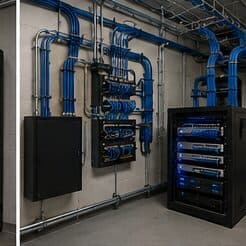
Low voltage is scheduled against a construction programme it does not control. Delays upstream compress the window; a compressed window means either additional mobilisations or work done under pressure. Being ready in advance — decisions made, materials on site, pathway plan settled — is the main defence.
The gap between rough-in and finish is its own risk. Cable sitting in walls for months needs protecting and identifying clearly, or the finish crew spends the first day working out which coil goes where. Documenting as-built positions before the walls close is what makes the return visit efficient.
- Readiness before the window opens, since it will not extend
- Additional mobilisations where the schedule fragments
- Cable protected and clearly identified during the gap
- As-built documentation completed before walls close
- Coordination with electrical, mechanical, and fire-protection trades on pathway
What drives the cost of security-camera installation here
Camera cost is driven by positions and cable routes, with storage the other major line.
- Camera count and the type each objective requires
- Cable run difficulty, particularly exterior and high-level runs
- Recorder capacity sized to the retention target
- Mounting hardware, junction boxes, and weather-appropriate housings
- Lift or scaffold access for elevated positions
- Network and PoE switching capacity
- Configuration of remote access and user permissions
Rosenberg: what the location changes
The starting point for any Rosenberg job is one local fact. Warehousing and light-industrial buildings along the highway corridor, with metal construction that reflects wireless signal and needs proper cable support. That single condition shapes where cable can run, where equipment can sit, and how coverage is laid out — more than any spec sheet does. Two more conditions weigh on it. An older rail-town commercial core with masonry buildings and limited existing pathway. Newer suburban subdivisions on slab foundations following the regional attic-routing pattern. Together they make the route specific to this pocket, which is why a short walkthrough or a few clear photos settle the scope faster than a floor plan can.
- Warehousing and light-industrial buildings along the highway corridor, with metal construction that reflects wireless signal and needs proper cable support
- An older rail-town commercial core with masonry buildings and limited existing pathway
- Newer suburban subdivisions on slab foundations following the regional attic-routing pattern
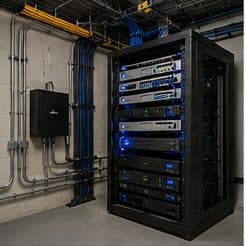
- Dust exposure in industrial and distribution environments, affecting rack and equipment placement
- Gulf Coast humidity and driven-rain events requiring rated exterior housings and sealed penetrations
Getting it done in Rosenberg
A camera system is commissioned by looking at its recordings, not its live view. Live video on a monitor at midday tells you very little about what the recorded file will show at nine in the evening.
Three things matter more than everything else combined: agreeing device locations before rough-in, claiming pathway before the other trades fill the ceiling, and running more capacity than the current plan requires.
Execution in Rosenberg is planned around real conditions, not a template. Dust exposure in industrial and distribution environments, affecting rack and equipment placement. Gulf Coast humidity and driven-rain events requiring rated exterior housings and sealed penetrations. These decide the sequence, the access, and the method as much as the design does. EVOTECH describes Rosenberg as coverage rather than a place it occupies, and omits any area detail it cannot confirm — building and site conditions only, no invented landmarks or promised arrival times.
Popular services nearby
Frequently searched near this area — the pages people look for most.
Frequently asked questions
Is security-camera installation for new construction different in Rosenberg?
The sector needs stay the same, but the install changes with the place. In Rosenberg, the conditions above — not the new construction label — decide routes, mounting, and equipment placement, which is why this page pairs all three.
How many cameras does a property need?
Count objectives, not walls. Each area needs a stated purpose — detect activity, recognise a known person, or identify a stranger — and the camera serving it is chosen for that purpose. A property with four well-framed cameras at the points that matter usually produces more useful footage than one with twelve wide shots covering everything approximately.