Wireless bridge (point-to-point) for new construction, in Katy
Wireless bridge (point-to-point) for new construction in Katy is a three-part question: what wireless bridge (point-to-point) involves, what new construction need from it, and what Katy changes about the install. Housing stock skewed toward newer, larger single-family construction with wide floor plans that exceed single-router coverage.
The engineering is about the path, not the hardware. The two radios need clear line of sight and a clear Fresnel zone (the football-shaped space around the direct line that also has to stay unobstructed), precise alignment so the narrow beams actually meet, and realistic expectations that throughput falls with distance and obstruction. Where those conditions hold, a bridge is reliable; where they don't, no radio fixes it.
One window, and it does not reopen
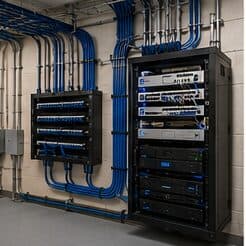
Low-voltage rough-in happens in a specific slot: after framing and electrical, before insulation and drywall. Inside that window, running a cable anywhere is straightforward. Once drywall goes up, the same cable costs many times more and sometimes cannot be run at all.
The asymmetry is the whole story of new-construction low voltage. Decisions made cheaply during rough-in become expensive or impossible afterwards, which is why the pre-rough-in planning conversation is worth more than any equipment choice made later.
- Rough-in window sits between electrical and drywall
- Upstream delays compress the window without extending the deadline
- Post-drywall changes cost many times more, if they are possible at all
- Finish work happens months later, after paint and ceilings
Where wireless bridge (point-to-point) goes wrong — and how it's avoided
Wireless bridges fail on the path and on expectations.
- Planning a link without confirming Fresnel-zone clearance
- Mounting too low, so ground and foliage intrude on the path
- Ignoring seasonal foliage that fills in and degrades the link
- Misaligning the narrow beams
- Promising wired speed regardless of distance and obstruction
- Choosing a congested band without checking interference
Katy: what the location changes
What separates a Katy scope from the rest of the city is concrete and local. Housing stock skewed toward newer, larger single-family construction with wide floor plans that exceed single-router coverage. Structured media panels commonly present but frequently located in a garage or perimeter utility space rather than centrally. Builder-installed cable often terminated to a panel but not extended to ceiling positions suitable for access points. That short list is what actually drives the design in this pocket, and it is why photographs or a brief site visit beat a floor plan — the plan follows the building's real constraints, not the neighborhood name on the map.
- Housing stock skewed toward newer, larger single-family construction with wide floor plans that exceed single-router coverage
- Structured media panels commonly present but frequently located in a garage or perimeter utility space rather than centrally
- Builder-installed cable often terminated to a panel but not extended to ceiling positions suitable for access points
- Slab foundations with accessible attics, making attic-to-interior-wall routing the standard retrofit path
- Suburban commercial development in retail pads and medical suites with suspended-grid ceilings and comparatively straightforward pathway
Getting it done in Katy
A bridge is commissioned on signal, throughput, and stability.
Full system design is often not finished when the rough-in window arrives. That is normal, and it is not a reason to skip the pathway. Running conduit or sleeves to likely positions preserves the option cheaply even when the eventual equipment is undecided.
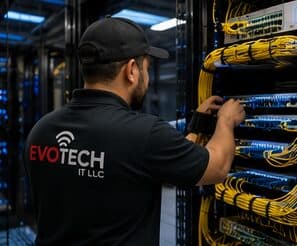
Execution in Katy is planned around real conditions, not a template. Slab foundations with accessible attics, making attic-to-interior-wall routing the standard retrofit path. Suburban commercial development in retail pads and medical suites with suspended-grid ceilings and comparatively straightforward pathway. These decide the sequence, the access, and the method as much as the design does. EVOTECH describes Katy as coverage rather than a place it occupies, and omits any area detail it cannot confirm — building and site conditions only, no invented landmarks or promised arrival times.
Frequently asked questions
Is wireless bridge (point-to-point) for new construction different in Katy?
The sector needs stay the same, but the install changes with the place. In Katy, the conditions above — not the new construction label — decide routes, mounting, and equipment placement, which is why this page pairs all three.
When should I use a wireless bridge instead of running cable?
When a physical run is genuinely impractical — a road, a parking lot, or a distance that would mean major trenching between two buildings. Where a cable can reasonably go, especially fiber between separately grounded structures, it is more reliable. A bridge is the right tool specifically when the gap can't be crossed physically and there is clear line of sight.