Access-control installation for new construction, in Houston
Access-control installation for new construction in Houston is a three-part question: what access-control installation involves, what new construction need from it, and what Houston changes about the install. Building stock spanning multiple construction eras within short distances, producing very different ceiling and pathway conditions.
An access-control system manages who may open which door and when, and records each attempt. The immediate operational benefit over keys is revocation: a lost credential is disabled in seconds instead of prompting a rekey. The secondary benefit is the audit record, which turns 'who was here on Saturday' into a query rather than a guess.
Decide locations, claim pathways, leave capacity
Three things matter more than everything else combined: agreeing device locations before rough-in, claiming pathway before the other trades fill the ceiling, and running more capacity than the current plan requires.
The third is the one most often skipped and most often regretted. An extra run to a likely future access point, camera, or display position costs very little while the walls are open.
- Device locations agreed and marked before rough-in begins
- Pathway claimed early, since low voltage is usually last into the ceiling
- Spare runs to likely future positions while walls are open
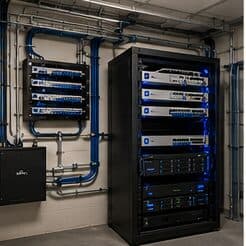
- Equipment room sized for every system, with power and ventilation
- Rated penetrations sleeved and firestopped properly
What changes access-control installation from job to job
Door conditions dominate access-control scope.
- Number of doors and the condition of existing hardware at each
- Frame material and construction, which changes lock options and labour
- Lock type appropriate for each opening
- Whether doors need closer replacement or adjustment before automation
- Fire-alarm interface work
- Credential technology and the number of credentials to issue
- Cable routes from controller to each door
- Whether camera integration or visitor management is included
Houston: what the location changes
Building stock spanning multiple construction eras within short distances, producing very different ceiling and pathway conditions. In Houston, that is where the plan begins, because it changes cable paths, device placement, and access-point counts before anything else does. Slab-on-grade foundations dominate residential construction, which pushes retrofit cable routes into the attic rather than under the floor. Gulf Coast humidity and heavy rainfall events make exterior equipment sealing and drip-loop practice a routine requirement rather than an optional detail. None of these are generic checklist items — each moves the design in a direction a citywide assumption would miss, and the honest recommendation always depends on what this particular property allows.
- Building stock spanning multiple construction eras within short distances, producing very different ceiling and pathway conditions
- Slab-on-grade foundations dominate residential construction, which pushes retrofit cable routes into the attic rather than under the floor
- Gulf Coast humidity and heavy rainfall events make exterior equipment sealing and drip-loop practice a routine requirement rather than an optional detail
- Summer attic temperatures constrain the working window for residential retrofit and rooftop-adjacent work
- Mixed land-use patterns place commercial, light industrial, and residential structures adjacent to each other, so neighbouring buildings often need entirely different approaches
Getting it done in Houston
Access-control commissioning is about failure modes, not just successful entry.
Camera positions are among the cheapest things to prewire and among the most annoying to retrofit, because they are usually exterior, high, and behind finished soffit. Running cable to likely positions during rough-in preserves the option at almost no cost.
Getting Houston work done means planning around the site as it actually is. Summer attic temperatures constrain the working window for residential retrofit and rooftop-adjacent work. Mixed land-use patterns place commercial, light industrial, and residential structures adjacent to each other, so neighbouring buildings often need entirely different approaches. Both matter as much as the design to how and when the work happens. The scope is drawn from the real property, the coverage is stated as a service area rather than an office, and unverifiable specifics about Houston are kept off the page on purpose.
Popular services nearby
Frequently searched near this area — the pages people look for most.
Frequently asked questions
Is access-control installation for new construction different in Houston?
The sector needs stay the same, but the install changes with the place. In Houston, the conditions above — not the new construction label — decide routes, mounting, and equipment placement, which is why this page pairs all three.
What is the difference between fail-safe and fail-secure?
It describes what happens when power is lost. Fail-safe hardware — typically a magnetic lock — releases and the door becomes passable. Fail-secure hardware — typically a standard electric strike — stays locked, though the door can still be opened from the inside by its mechanical hardware. Which is correct for a given opening depends on its role and on applicable life-safety requirements, so it is a design decision rather than a preference.