Access-control installation for new construction, in Humble
Access-control installation for new construction in Humble is a three-part question: what access-control installation involves, what new construction need from it, and what Humble changes about the install. A retail and commercial hub with a broad mix of building ages.
The part that demands the most care is not the software. It is the door. A controlled door has to release for anyone leaving, under all conditions including power loss and fire alarm, and it has to do so in the manner the building's life-safety requirements dictate. Getting that wrong is a serious matter, and it is why door hardware selection is a design decision rather than a purchasing one.
What to rough in even without a final design
Full system design is often not finished when the rough-in window arrives. That is normal, and it is not a reason to skip the pathway. Running conduit or sleeves to likely positions preserves the option cheaply even when the eventual equipment is undecided.
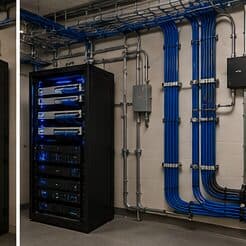
For a commercial building, the reliable rough-in set is: cable to every likely device outlet, ceiling positions for access points spaced for the intended coverage, camera positions at entries and approaches, door positions with cable to the controller location, and pathway to any likely display or AV position. Plus, in every case, a properly located equipment room.
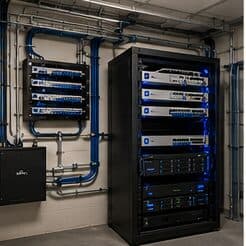
The equipment room deserves particular emphasis because it is the most commonly under-provisioned item. It has to hold the network rack, camera recorder, access-control panel, and any AV equipment, with dedicated power, ventilation, and clearance to work. Sizing it from the network alone is a decision that gets discovered eighteen months later.
- Sleeves and conduit to likely positions even before final design
- Ceiling access-point positions spaced for the intended coverage
- Camera positions at entries, approaches, and service areas
- Cable from every controlled door to the controller position
- Equipment room with dedicated power, ventilation, and working clearance
What changes access-control installation from job to job
Door conditions dominate access-control scope.
- Number of doors and the condition of existing hardware at each
- Frame material and construction, which changes lock options and labour
- Lock type appropriate for each opening
- Whether doors need closer replacement or adjustment before automation
- Fire-alarm interface work
- Credential technology and the number of credentials to issue
- Cable routes from controller to each door
- Whether camera integration or visitor management is included
Humble: what the location changes
The starting point for any Humble job is one local fact. A retail and commercial hub with a broad mix of building ages. That single condition shapes where cable can run, where equipment can sit, and how coverage is laid out — more than any spec sheet does. Two more conditions weigh on it. Warehousing and distribution requiring aisle coverage and longer runs. Older commercial stock needing pathway remediation and rack cleanup. Together they make the route specific to this pocket, which is why a short walkthrough or a few clear photos settle the scope faster than a floor plan can.
- A retail and commercial hub with a broad mix of building ages
- Warehousing and distribution requiring aisle coverage and longer runs
- Older commercial stock needing pathway remediation and rack cleanup
- Retail point-of-sale environments requiring network segmentation
- Slab-foundation residential across established and newer neighbourhoods
Getting it done in Humble
Access-control commissioning is about failure modes, not just successful entry.
Low voltage is scheduled against a construction programme it does not control. Delays upstream compress the window; a compressed window means either additional mobilisations or work done under pressure. Being ready in advance — decisions made, materials on site, pathway plan settled — is the main defence.
Execution in Humble is planned around real conditions, not a template. Retail point-of-sale environments requiring network segmentation. Slab-foundation residential across established and newer neighbourhoods. These decide the sequence, the access, and the method as much as the design does. EVOTECH describes Humble as coverage rather than a place it occupies, and omits any area detail it cannot confirm — building and site conditions only, no invented landmarks or promised arrival times.
Frequently asked questions
Is access-control installation for new construction different in Humble?
The sector needs stay the same, but the install changes with the place. In Humble, the conditions above — not the new construction label — decide routes, mounting, and equipment placement, which is why this page pairs all three.
What is the difference between fail-safe and fail-secure?
It describes what happens when power is lost. Fail-safe hardware — typically a magnetic lock — releases and the door becomes passable. Fail-secure hardware — typically a standard electric strike — stays locked, though the door can still be opened from the inside by its mechanical hardware. Which is correct for a given opening depends on its role and on applicable life-safety requirements, so it is a design decision rather than a preference.