Residential Wi-Fi for new construction, in Friendswood
Residential Wi-Fi for new construction in Friendswood is a three-part question: what residential wi-fi involves, what new construction need from it, and what Friendswood changes about the install. Established suburban homes on larger lots with mature landscaping.
For a larger two-storey house, two or three well-placed access points usually outperform any single device regardless of specification. The reason is physical: signal weakens through floors and walls, and no amount of transmit power at one end of a house creates a usable signal at the other without also creating interference everywhere in between.
Positions to prewire even if cameras come later
Camera positions are among the cheapest things to prewire and among the most annoying to retrofit, because they are usually exterior, high, and behind finished soffit. Running cable to likely positions during rough-in preserves the option at almost no cost.
The positions worth prewiring in nearly every building: primary entrance, rear or service entrance, any delivery or receiving point, parking approaches, and the equipment room itself. In residential construction, add the front door for a doorbell and the driveway approach.
- Primary and secondary entrance positions
- Delivery, receiving, and service door approaches
- Parking and vehicle approach positions
- Doorbell position in residential builds
- Cable terminated and labeled even where no camera is installed yet
What drives the cost of residential wi-fi here
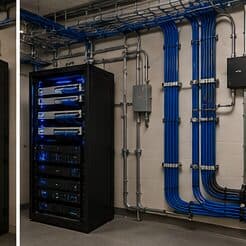
The cabling drives residential cost far more than the access points do.
- Number of access points required
- Difficulty of each cable run, which depends on attic access and wall type
- Whether the equipment position needs to move
- Enclosure or shelf, switch, and power at the equipment position
- Any drywall access and patching required
- Outdoor or detached-structure coverage
Friendswood: what the location changes
The starting point for any Friendswood job is one local fact. Established suburban homes on larger lots with mature landscaping. That single condition shapes where cable can run, where equipment can sit, and how coverage is laid out — more than any spec sheet does. Two more conditions weigh on it. Wider and multi-storey plans needing multiple wired access points. Slab-foundation construction with attic-to-interior-wall retrofit routing. Together they make the route specific to this pocket, which is why a short walkthrough or a few clear photos settle the scope faster than a floor plan can.
- Established suburban homes on larger lots with mature landscaping
- Wider and multi-storey plans needing multiple wired access points
- Slab-foundation construction with attic-to-interior-wall retrofit routing
- Detached structures and outdoor areas needing dedicated coverage
- Mature trees affecting outdoor wireless and camera framing
Getting it done in Friendswood
Validation is a walk through the house with a measurement tool, checking the rooms that prompted the call in the first place.
Low-voltage rough-in happens in a specific slot: after framing and electrical, before insulation and drywall. Inside that window, running a cable anywhere is straightforward. Once drywall goes up, the same cable costs many times more and sometimes cannot be run at all.
Getting Friendswood work done means planning around the site as it actually is. Detached structures and outdoor areas needing dedicated coverage. Mature trees affecting outdoor wireless and camera framing. Both matter as much as the design to how and when the work happens. The scope is drawn from the real property, the coverage is stated as a service area rather than an office, and unverifiable specifics about Friendswood are kept off the page on purpose.
Frequently asked questions
Is residential wi-fi for new construction different in Friendswood?
The sector needs stay the same, but the install changes with the place. In Friendswood, the conditions above — not the new construction label — decide routes, mounting, and equipment placement, which is why this page pairs all three.
Why is upstairs Wi-Fi bad when the router is right below?
Signal loses a meaningful amount of strength passing through a floor, and the router's pattern is not aimed upward. Turning the power up mostly increases interference. The dependable arrangement is a second access point upstairs, placed centrally and connected by cable to the equipment position downstairs.