Smart home & smart locks for new construction, in Brookshire
Smart home & smart locks for new construction in Brookshire is a three-part question: what smart home & smart locks involves, what new construction need from it, and what Brookshire changes about the install. Large warehousing and distribution buildings along the I-10 corridor.
Smart locks are the device people care about most and the one that punishes a weak setup hardest. The lock has to fit the door, hold a reliable connection to whatever controls it, keep its batteries monitored, and always retain a physical or offline way in. Guest and temporary codes — the reason short-term-rental hosts want them — only help if the lock is dependable enough to trust with a stranger arriving at nine at night.
Decide locations, claim pathways, leave capacity
Three things matter more than everything else combined: agreeing device locations before rough-in, claiming pathway before the other trades fill the ceiling, and running more capacity than the current plan requires.
The third is the one most often skipped and most often regretted. An extra run to a likely future access point, camera, or display position costs very little while the walls are open.
- Device locations agreed and marked before rough-in begins
- Pathway claimed early, since low voltage is usually last into the ceiling
- Spare runs to likely future positions while walls are open
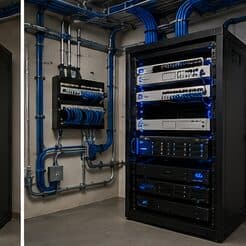
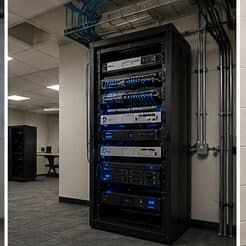
- Equipment room sized for every system, with power and ventilation
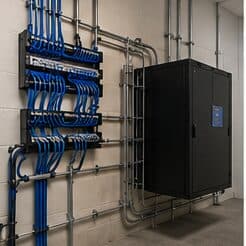
- Rated penetrations sleeved and firestopped properly
What drives the cost of smart home & smart locks here
Device count and the network work behind them drive the cost.
- Number and grade of devices
- Whether a hub and additional wireless coverage are needed
- Smart-lock type and any door adjustment
- Ecosystem and any subscription for remote features
- Automation and guest-access configuration
- Ongoing support expectations
Brookshire: what the location changes
The starting point for any Brookshire job is one local fact. Large warehousing and distribution buildings along the I-10 corridor. That single condition shapes where cable can run, where equipment can sit, and how coverage is laid out — more than any spec sheet does. Two more conditions weigh on it. Metal construction that reflects wireless signal and complicates coverage. Building footprints frequently exceeding the 100 m copper channel limit. Together they make the route specific to this pocket, which is why a short walkthrough or a few clear photos settle the scope faster than a floor plan can.
- Large warehousing and distribution buildings along the I-10 corridor
- Metal construction that reflects wireless signal and complicates coverage
- Building footprints frequently exceeding the 100 m copper channel limit
- Unconditioned operational areas affecting equipment placement
- Long cable runs and yard/dock areas needing distinct approaches
Getting it done in Brookshire
Smart devices are commissioned by proving the important ones still work when things go wrong.
Camera positions are among the cheapest things to prewire and among the most annoying to retrofit, because they are usually exterior, high, and behind finished soffit. Running cable to likely positions during rough-in preserves the option at almost no cost.
Getting Brookshire work done means planning around the site as it actually is. Unconditioned operational areas affecting equipment placement. Long cable runs and yard/dock areas needing distinct approaches. Both matter as much as the design to how and when the work happens. The scope is drawn from the real property, the coverage is stated as a service area rather than an office, and unverifiable specifics about Brookshire are kept off the page on purpose.
Frequently asked questions
Is smart home & smart locks for new construction different in Brookshire?
The sector needs stay the same, but the install changes with the place. In Brookshire, the conditions above — not the new construction label — decide routes, mounting, and equipment placement, which is why this page pairs all three.
Which smart-home ecosystem should we use?
Usually the one that matches the phones and habits in the house, because that is the control surface everyone already reaches for. Committing to one platform lets devices share routines instead of each needing its own app — the tradeoff is favouring devices that support it. Newer interoperability standards are narrowing the differences, but it is still worth checking that the specific devices you want work with the platform you choose.