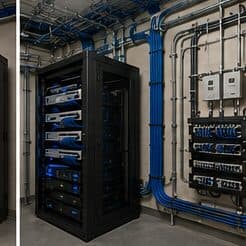
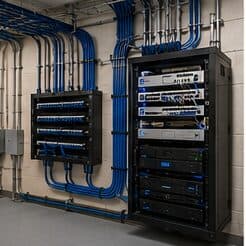
Soundbar mounting for new construction, in Baytown
Soundbar mounting for new construction in Baytown is a three-part question: what soundbar mounting involves, what new construction need from it, and what Baytown changes about the install. An industrial and refining base with rugged operational environments.
The audio connection is where the fiddly part lives. Modern soundbars use HDMI-ARC or eARC so the TV sends sound to the bar and one remote controls the volume — but the handshake has to be set up correctly on both the TV and the bar, or it defaults to an optical connection with no single-remote control and, on some content, reduced audio.
Positions to prewire even if cameras come later
Camera positions are among the cheapest things to prewire and among the most annoying to retrofit, because they are usually exterior, high, and behind finished soffit. Running cable to likely positions during rough-in preserves the option at almost no cost.
The positions worth prewiring in nearly every building: primary entrance, rear or service entrance, any delivery or receiving point, parking approaches, and the equipment room itself. In residential construction, add the front door for a doorbell and the driveway approach.
- Primary and secondary entrance positions
- Delivery, receiving, and service door approaches
- Parking and vehicle approach positions
- Doorbell position in residential builds
- Cable terminated and labeled even where no camera is installed yet
What changes soundbar mounting from job to job
A small job, with a few things that change it.
- Wall construction and mounting method
- Above- versus below-screen placement
- Cable concealment: in-wall versus surface
- Whether a subwoofer or rear speakers are included
- ARC/eARC support on the specific TV and bar
- Whether it is paired with a new TV mount
Baytown: what the location changes
What separates a Baytown scope from the rest of the city is concrete and local. An industrial and refining base with rugged operational environments. Older commercial stock needing pathway remediation and rack cleanup. Newer retail development with more straightforward conditions. That short list is what actually drives the design in this pocket, and it is why photographs or a brief site visit beat a floor plan — the plan follows the building's real constraints, not the neighborhood name on the map.
- An industrial and refining base with rugged operational environments
- Older commercial stock needing pathway remediation and rack cleanup
- Newer retail development with more straightforward conditions
- Coastal humidity and driven rain requiring durable exterior sealing and surge protection
- Slab-foundation residential following the regional pattern
Getting it done in Baytown
A soundbar is checked for alignment, control, and clean cabling.
Low-voltage rough-in happens in a specific slot: after framing and electrical, before insulation and drywall. Inside that window, running a cable anywhere is straightforward. Once drywall goes up, the same cable costs many times more and sometimes cannot be run at all.
Execution in Baytown is planned around real conditions, not a template. Coastal humidity and driven rain requiring durable exterior sealing and surge protection. Slab-foundation residential following the regional pattern. These decide the sequence, the access, and the method as much as the design does. EVOTECH describes Baytown as coverage rather than a place it occupies, and omits any area detail it cannot confirm — building and site conditions only, no invented landmarks or promised arrival times.
Frequently asked questions
Is soundbar mounting for new construction different in Baytown?
The sector needs stay the same, but the install changes with the place. In Baytown, the conditions above — not the new construction label — decide routes, mounting, and equipment placement, which is why this page pairs all three.
Why won't one remote control my soundbar volume?
Almost always ARC/eARC is not enabled on both devices. When it is set up on the TV and matched on the bar, the TV hands volume and power control to a single remote over the HDMI cable. Without it, the system falls back to optical, which plays sound but gives up single-remote control and, on some content, audio quality.