Floodlight camera installation for multifamily properties, in Pearland
Floodlight camera installation for multifamily properties in Pearland is a three-part question: what floodlight camera installation involves, what multifamily properties need from it, and what Pearland changes about the install. Newer residential subdivisions with wide floor plans and builder-installed structured cable of variable quality.
A floodlight camera combines a motion-activated light with a camera, so an area lights up and records when something moves — good for deterrence and for usable colour footage at night. The catch is that the camera is looking into its own light source, so placement has to give useful footage without the floodlight washing out the near field or throwing hard shadows, and the motion detection has to trigger on people rather than every passing car or swaying tree.
Entry, packages, and common-area coverage
The systems residents notice are entry and packages. An entry system that reliably lets residents in and lets them grant access to visitors, and a package room that works, generate more satisfaction than any other technology on the property.
Behind those, common-area wireless coverage in amenity spaces, and camera coverage at entries, parking, and package areas, cover most of what the property needs.
- Controlled entry with fast credential issue and revocation at turnover
- Intercom that lets residents grant visitor access reliably
- Package room access controlled and recorded
- Common-area and amenity-space wireless coverage
- Camera coverage at entries, parking, and package areas
Where floodlight camera installation goes wrong — and how it's avoided
Floodlight cameras fail on glare, triggering, and power.
- Letting the floodlight wash out the near field or reflect into the lens
- Aiming wide and triggering on every car and branch
- Mounting too low for reach and angle
- Relying on battery and Wi-Fi for an always-watch device
- Casting hard shadows that hide the subject
- Reviewing only the daytime live view, not night footage
Pearland: what the location changes
Newer residential subdivisions with wide floor plans and builder-installed structured cable of variable quality. In Pearland, that is where the plan begins, because it changes cable paths, device placement, and access-point counts before anything else does. Expanding medical office space with controlled-area access requirements and clinical scheduling constraints. Food-service commercial space with kitchen environments and narrow after-hours working windows. None of these are generic checklist items — each moves the design in a direction a citywide assumption would miss, and the honest recommendation always depends on what this particular property allows.
- Newer residential subdivisions with wide floor plans and builder-installed structured cable of variable quality
- Expanding medical office space with controlled-area access requirements and clinical scheduling constraints
- Food-service commercial space with kitchen environments and narrow after-hours working windows
- Slab-on-grade residential foundations making attic routing the standard retrofit path
- Newer commercial construction generally offering suspended-grid ceilings and usable pathway
Getting it done in Pearland
A floodlight camera is judged by its footage at night, not its live view by day.
Camera coverage focuses on the points where the property has a legitimate operational interest: building entries, package rooms, parking areas and garages, amenity spaces, and the leasing office. Framing at entries should be tight enough for identification; parking coverage is usually about vehicle movement rather than identifying individuals.
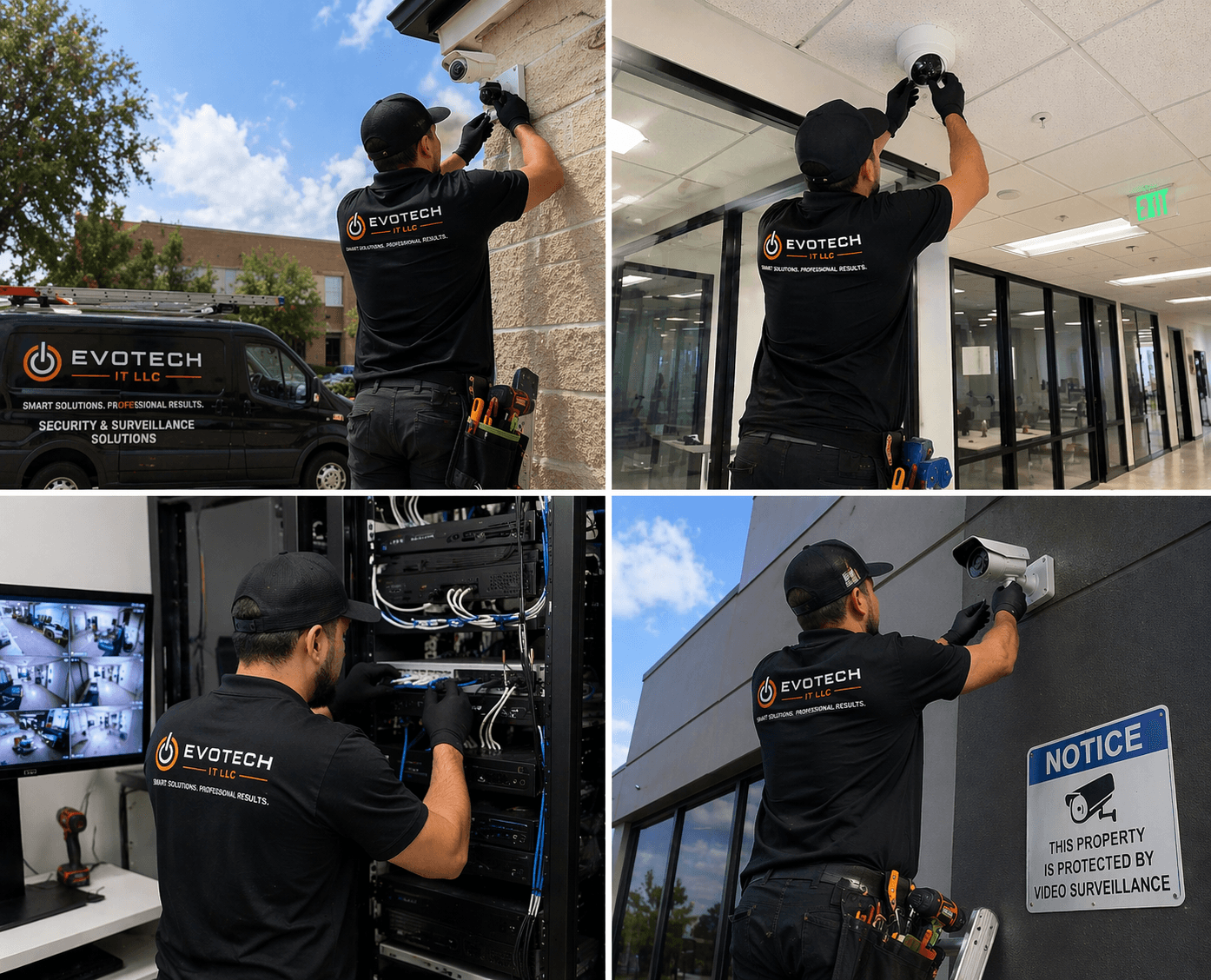
On site, the schedule and working method turn on conditions like these. Slab-on-grade residential foundations making attic routing the standard retrofit path. Newer commercial construction generally offering suspended-grid ceilings and usable pathway. Both shape how and when a crew can actually operate, which is why EVOTECH scopes each Pearland job from the property itself rather than assuming one approach fits every address. Coverage is stated as a service area, never an office claim, and anything about Pearland that cannot be verified is left out instead of invented.
Frequently asked questions
Is floodlight camera installation for multifamily properties different in Pearland?
The sector needs stay the same, but the install changes with the place. In Pearland, the conditions above — not the multifamily properties label — decide routes, mounting, and equipment placement, which is why this page pairs all three.
Why is my floodlight camera's footage washed out at night?
The camera is fighting its own light. If the floodlight blows out the near field or reflects off a nearby wall or soffit back into the lens, the footage is worse than a plain camera would give. Aiming the light onto the scene and off the lens's immediate foreground — and away from reflective surfaces — is what fixes it.