Gate & license-plate cameras for multifamily properties, in Pearland
Gate & license-plate cameras for multifamily properties in Pearland is a three-part question: what gate & license-plate cameras involves, what multifamily properties need from it, and what Pearland changes about the install. Newer residential subdivisions with wide floor plans and builder-installed structured cable of variable quality.
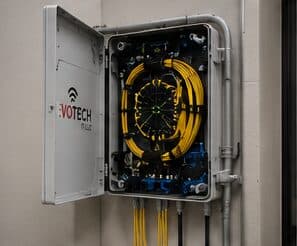
The other half of the job is getting to the gate. Entry points are often far from the building, so power and a reliable connection to a gate or driveway position have to be planned — frequently a fiber or intermediate-powered run rather than a stretched copper one — along with mounting that gives the right angle and distance for the plate.
Entry, packages, and common-area coverage
The systems residents notice are entry and packages. An entry system that reliably lets residents in and lets them grant access to visitors, and a package room that works, generate more satisfaction than any other technology on the property.
Behind those, common-area wireless coverage in amenity spaces, and camera coverage at entries, parking, and package areas, cover most of what the property needs.
- Controlled entry with fast credential issue and revocation at turnover
- Intercom that lets residents grant visitor access reliably
- Package room access controlled and recorded
- Common-area and amenity-space wireless coverage
- Camera coverage at entries, parking, and package areas
Where gate & license-plate cameras goes wrong — and how it's avoided
Entry camera systems fail when one camera is asked to do two jobs.
- Expecting one camera to both show the scene and read plates
- A slow shutter smearing plates on moving vehicles
- Uncontrolled infrared blowing out the reflective plate
- Field of view too wide to resolve a plate
- Stretching copper to a gate beyond its reach
- Skipping the overview camera and losing context
Pearland: what the location changes
What separates a Pearland scope from the rest of the city is concrete and local. Newer residential subdivisions with wide floor plans and builder-installed structured cable of variable quality. Expanding medical office space with controlled-area access requirements and clinical scheduling constraints. Food-service commercial space with kitchen environments and narrow after-hours working windows. That short list is what actually drives the design in this pocket, and it is why photographs or a brief site visit beat a floor plan — the plan follows the building's real constraints, not the neighborhood name on the map.
- Newer residential subdivisions with wide floor plans and builder-installed structured cable of variable quality
- Expanding medical office space with controlled-area access requirements and clinical scheduling constraints
- Food-service commercial space with kitchen environments and narrow after-hours working windows
- Slab-on-grade residential foundations making attic routing the standard retrofit path
- Newer commercial construction generally offering suspended-grid ceilings and usable pathway
Getting it done in Pearland
Entry cameras are verified against their objectives, day and night.
Camera coverage focuses on the points where the property has a legitimate operational interest: building entries, package rooms, parking areas and garages, amenity spaces, and the leasing office. Framing at entries should be tight enough for identification; parking coverage is usually about vehicle movement rather than identifying individuals.
Execution in Pearland is planned around real conditions, not a template. Slab-on-grade residential foundations making attic routing the standard retrofit path. Newer commercial construction generally offering suspended-grid ceilings and usable pathway. These decide the sequence, the access, and the method as much as the design does. EVOTECH describes Pearland as coverage rather than a place it occupies, and omits any area detail it cannot confirm — building and site conditions only, no invented landmarks or promised arrival times.
Frequently asked questions
Is gate & license-plate cameras for multifamily properties different in Pearland?
The sector needs stay the same, but the install changes with the place. In Pearland, the conditions above — not the multifamily properties label — decide routes, mounting, and equipment placement, which is why this page pairs all three.
Can one camera watch the gate and read plates?
Rarely well. Reading a plate needs a fast shutter, a narrow view, a shallow angle, and controlled infrared — settings that make the plate legible also make the wider scene dark. A general overview camera cannot resolve a plate on a moving vehicle. The reliable approach is two cameras: one for the scene, one dedicated to plates.