Commercial IT solutions for medical offices, in Tomball
Commercial IT solutions for medical offices in Tomball is a three-part question: what commercial it solutions involves, what medical offices need from it, and what Tomball changes about the install. A historic small-town core with masonry buildings and limited pathway.
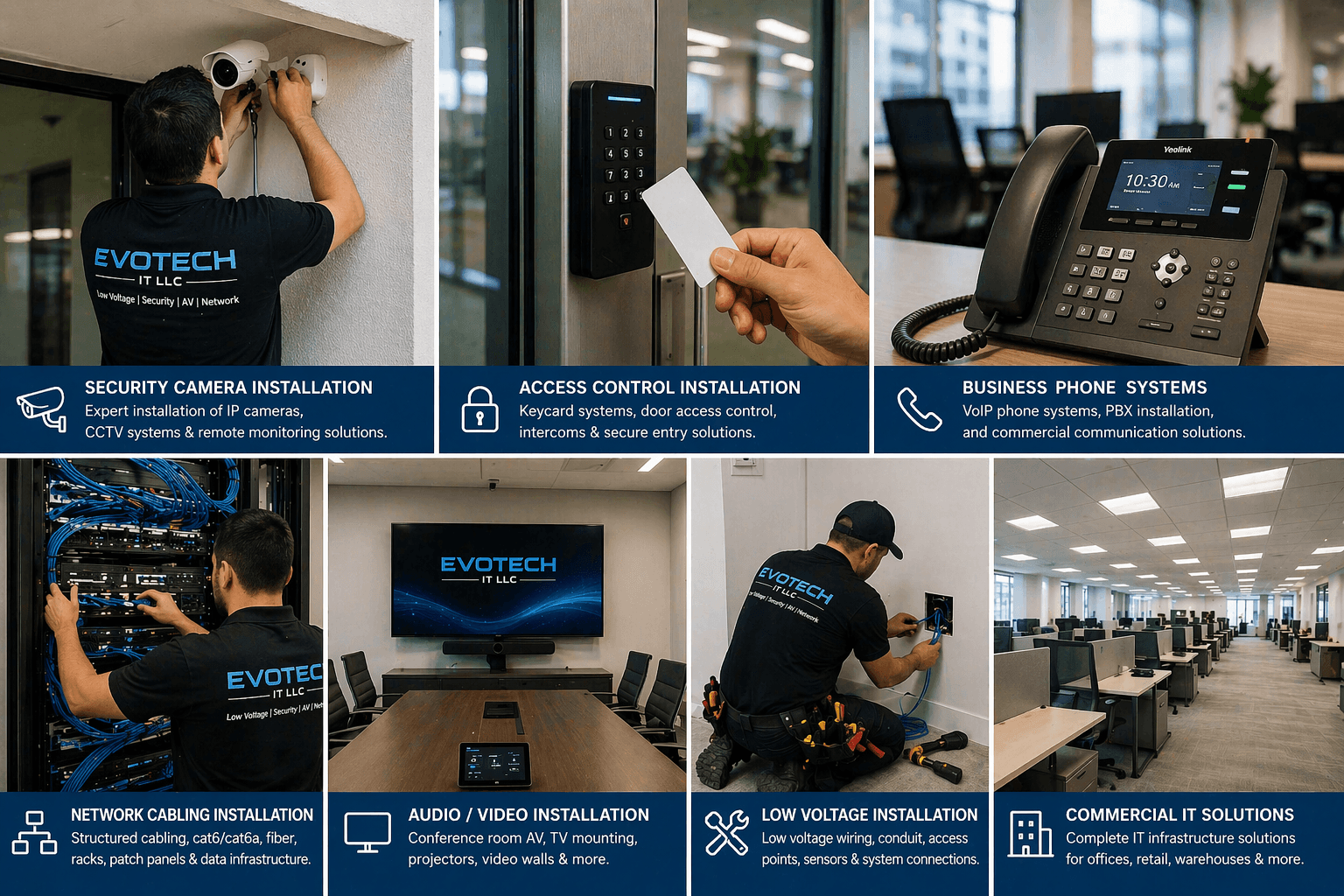
A business does not need a network, then some cameras, then a phone system, then Wi-Fi, each chosen by a different vendor at a different time. It needs those systems designed to work together on shared infrastructure, sized for how the business will grow, and delivered so one party is accountable for the whole thing working. That is what commercial IT solutions means here: the full low-voltage and network stack — structured cabling, managed switching and Wi-Fi, cameras, access control, and phones — planned as a single system rather than assembled from disconnected projects.
Separation, access, and continuity
Three priorities dominate. Separate the networks so patient-facing guest access cannot reach clinical systems. Control access to the areas that require it, with records that show who entered and when. Plan any cutover so clinical operations are not interrupted mid-session.
Everything else — coverage quality, cable tidiness, camera placement — matters, but these three are the ones with consequences beyond inconvenience.
- Guest, staff, clinical, and building-system networks kept separate
- Access control on records, medication, and treatment areas as appropriate
- Cutovers scheduled around clinical sessions, not around installer convenience
- Wired connections for imaging and other equipment that depends on throughput
- Equipment position secured against casual access
What changes commercial it solutions from job to job
Scope is driven by the number of systems, the site count, and the continuity requirements.
- Which systems are in scope and how they integrate
- Site size, count, and whether it is a fit-out or a relocation
- Uptime and business-continuity requirements
- Growth headroom designed into the infrastructure
- Existing systems to migrate versus new installation
- Ongoing support and management expectations
Tomball: what the location changes
A historic small-town core with masonry buildings and limited pathway. In Tomball, that is where the plan begins, because it changes cable paths, device placement, and access-point counts before anything else does. Growing retail and medical buildouts with suspended-grid ceilings and tenant-improvement conditions. Larger properties and outbuildings toward the northern edge, bringing longer runs. None of these are generic checklist items — each moves the design in a direction a citywide assumption would miss, and the honest recommendation always depends on what this particular property allows.
- A historic small-town core with masonry buildings and limited pathway
- Growing retail and medical buildouts with suspended-grid ceilings and tenant-improvement conditions
- Larger properties and outbuildings toward the northern edge, bringing longer runs
- Slab-foundation residential across established and newer subdivisions
- Gulf Coast humidity requiring rated exterior housings and sealed penetrations
Getting it done in Tomball
A coordinated system is verified as a whole, not one component at a time.
Camera coverage in medical settings is deliberately limited in scope. Entrances, corridors leading to controlled areas, medication storage approaches, parking areas, and after-hours coverage of the perimeter are the usual placements. Treatment areas are not camera locations, and this is worth stating plainly during design so the boundary is explicit.
On site, the schedule and working method turn on conditions like these. Slab-foundation residential across established and newer subdivisions. Gulf Coast humidity requiring rated exterior housings and sealed penetrations. Both shape how and when a crew can actually operate, which is why EVOTECH scopes each Tomball job from the property itself rather than assuming one approach fits every address. Coverage is stated as a service area, never an office claim, and anything about Tomball that cannot be verified is left out instead of invented.
Frequently asked questions
Is commercial it solutions for medical offices different in Tomball?
The sector needs stay the same, but the install changes with the place. In Tomball, the conditions above — not the medical offices label — decide routes, mounting, and equipment placement, which is why this page pairs all three.
How is this different from just hiring separate installers?
Coordination and accountability. Separate installers each optimise their own system, which is how a business ends up with everything on one flat network, cabling that suits nobody, and no one able to say why something does not work. A coordinated design puts every system on shared, segmented infrastructure and gives you one party accountable for the whole thing working — which is usually cheaper over the life of the fit-out, not just simpler.