NVR installation for medical offices, in Katy
NVR installation for medical offices in Katy is a three-part question: what nvr installation involves, what medical offices need from it, and what Katy changes about the install. Housing stock skewed toward newer, larger single-family construction with wide floor plans that exceed single-router coverage.
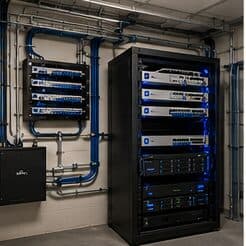
A network video recorder receives streams from the cameras, writes them to disk, and serves them back for review. Its capacity determines how far back the footage goes, and that number is arithmetic, not a product feature: camera count, resolution, frame rate, compression efficiency, and how much of the day actually gets recorded all multiply together against the drive capacity.
Controlled areas and uninterruptible systems
A medical office has a clear division between public, staff, and controlled areas, and the technology follows that division. Waiting areas need guest connectivity that reaches nothing internal. Treatment rooms need reliable connectivity for clinical systems. Records areas and medication storage need controlled access with a usable audit trail.
The other defining characteristic is that some systems cannot simply be taken down for an afternoon. Practice management, imaging, and anything connected to patient scheduling has a real cost when interrupted, so cutover planning matters more here than in most commercial environments.
- Distinct public, staff, and controlled zones with different requirements
- Clinical systems that cannot tolerate unplanned interruption
- Records and medication areas requiring access control with audit records
- Patient scheduling constraining when work can happen in treatment areas
What changes nvr installation from job to job
Retention target and scene activity are the two dominant inputs.
- Camera count, resolution, and frame rate
- Retention target in days
- Recording mode and schedule
- Scene complexity, which drives real compression efficiency
- Drive capacity, count, and whether redundancy is required
- Recorder location, ventilation, and physical security
- Remote-access requirements and number of users
Katy: what the location changes
Housing stock skewed toward newer, larger single-family construction with wide floor plans that exceed single-router coverage. In Katy, that is where the plan begins, because it changes cable paths, device placement, and access-point counts before anything else does. Structured media panels commonly present but frequently located in a garage or perimeter utility space rather than centrally. Builder-installed cable often terminated to a panel but not extended to ceiling positions suitable for access points. None of these are generic checklist items — each moves the design in a direction a citywide assumption would miss, and the honest recommendation always depends on what this particular property allows.
- Housing stock skewed toward newer, larger single-family construction with wide floor plans that exceed single-router coverage
- Structured media panels commonly present but frequently located in a garage or perimeter utility space rather than centrally
- Builder-installed cable often terminated to a panel but not extended to ceiling positions suitable for access points
- Slab foundations with accessible attics, making attic-to-interior-wall routing the standard retrofit path
- Suburban commercial development in retail pads and medical suites with suspended-grid ceilings and comparatively straightforward pathway
Getting it done in Katy
Verification means letting the system run and measuring, because the calculation is a projection until real footage lands on the disk.
Clinical systems belong on their own segment, separate from staff general-purpose devices, separate again from patient guest access, and separate from building systems such as cameras and door controllers. This limits what any single compromised device can reach and makes the network far easier to reason about when something misbehaves.
On site, the schedule and working method turn on conditions like these. Slab foundations with accessible attics, making attic-to-interior-wall routing the standard retrofit path. Suburban commercial development in retail pads and medical suites with suspended-grid ceilings and comparatively straightforward pathway. Both shape how and when a crew can actually operate, which is why EVOTECH scopes each Katy job from the property itself rather than assuming one approach fits every address. Coverage is stated as a service area, never an office claim, and anything about Katy that cannot be verified is left out instead of invented.
Frequently asked questions
Is nvr installation for medical offices different in Katy?
The sector needs stay the same, but the install changes with the place. In Katy, the conditions above — not the medical offices label — decide routes, mounting, and equipment placement, which is why this page pairs all three.
How much storage is needed for 30 days of footage?
It is a calculation, not a fixed number: per-camera bitrate multiplied by hours recorded per day multiplied by thirty, summed across cameras. Resolution, frame rate, recording mode, and how busy each scene is all move the result substantially. Two eight-camera systems can differ by a factor of three for the same retention target.