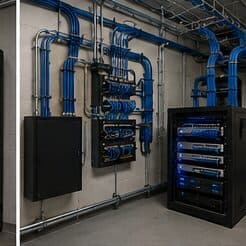
NVR installation for home offices, in Webster
NVR installation for home offices in Webster is a three-part question: what nvr installation involves, what home offices need from it, and what Webster changes about the install. A concentration of medical suites with controlled areas and clinical scheduling.
The most common disappointment is discovering that a system advertised as recording for a month is actually holding eight days, because the calculation assumed motion-only recording and the cameras are recording continuously, or assumed a compression efficiency the scene does not achieve. Doing the arithmetic before purchase, with the intended settings, avoids that.
Working in an occupied house
Residential work happens in an occupied home, which means dust control, furniture protection, and leaving each area clean at the end of the day. Attic work in this region is constrained by heat and is generally scheduled early in the day during summer months.
Finish expectations are higher than in commercial work. A cable route that involves any drywall access needs a clear conversation about patching and paint before the first cut, not after.
- Dust control and furniture protection in occupied rooms
- Attic work scheduled early during summer months
- Drywall access, patching, and paint agreed before cutting
- Work sequenced so the household is not without connectivity overnight
- Equipment position agreed with the household, not just chosen for convenience
What drives the cost of nvr installation here
Storage capacity is the main variable, and it is set by the retention decision.
- Retention target, which drives total capacity
- Camera count, resolution, and frame rate
- Drive capacity, count, and any redundancy
- Recorder capability, including supported channel count
- UPS protection for the recorder
- Remote-access setup and user configuration
Webster: what the location changes
The starting point for any Webster job is one local fact. A concentration of medical suites with controlled areas and clinical scheduling. That single condition shapes where cable can run, where equipment can sit, and how coverage is laid out — more than any spec sheet does. Two more conditions weigh on it. Retail and hospitality venues requiring guest and payment segmentation. Multi-tenant buildings with base-building rules on riser and core access. Together they make the route specific to this pocket, which is why a short walkthrough or a few clear photos settle the scope faster than a floor plan can.
- A concentration of medical suites with controlled areas and clinical scheduling
- Retail and hospitality venues requiring guest and payment segmentation
- Multi-tenant buildings with base-building rules on riser and core access
- Tenant-improvement buildouts with suspended-grid ceilings and usable pathway
- Slab-foundation residential secondary to the commercial base
Getting it done in Webster
Verification means letting the system run and measuring, because the calculation is a projection until real footage lands on the disk.
The single highest-value change for a home office is a wired connection to the desk. It removes wireless variability entirely for the machine that matters, and it is usually one cable run.
Getting Webster work done means planning around the site as it actually is. Tenant-improvement buildouts with suspended-grid ceilings and usable pathway. Slab-foundation residential secondary to the commercial base. Both matter as much as the design to how and when the work happens. The scope is drawn from the real property, the coverage is stated as a service area rather than an office, and unverifiable specifics about Webster are kept off the page on purpose.
Popular services nearby
Frequently searched near this area — the pages people look for most.
Frequently asked questions
Is nvr installation for home offices different in Webster?
The sector needs stay the same, but the install changes with the place. In Webster, the conditions above — not the home offices label — decide routes, mounting, and equipment placement, which is why this page pairs all three.
How much storage is needed for 30 days of footage?
It is a calculation, not a fixed number: per-camera bitrate multiplied by hours recorded per day multiplied by thirty, summed across cameras. Resolution, frame rate, recording mode, and how busy each scene is all move the result substantially. Two eight-camera systems can differ by a factor of three for the same retention target.