NVR installation for medical offices, in Baytown
NVR installation for medical offices in Baytown is a three-part question: what nvr installation involves, what medical offices need from it, and what Baytown changes about the install. An industrial and refining base with rugged operational environments.
The most common disappointment is discovering that a system advertised as recording for a month is actually holding eight days, because the calculation assumed motion-only recording and the cameras are recording continuously, or assumed a compression efficiency the scene does not achieve. Doing the arithmetic before purchase, with the intended settings, avoids that.
Controlled areas and uninterruptible systems
A medical office has a clear division between public, staff, and controlled areas, and the technology follows that division. Waiting areas need guest connectivity that reaches nothing internal. Treatment rooms need reliable connectivity for clinical systems. Records areas and medication storage need controlled access with a usable audit trail.
The other defining characteristic is that some systems cannot simply be taken down for an afternoon. Practice management, imaging, and anything connected to patient scheduling has a real cost when interrupted, so cutover planning matters more here than in most commercial environments.
- Distinct public, staff, and controlled zones with different requirements
- Clinical systems that cannot tolerate unplanned interruption
- Records and medication areas requiring access control with audit records
- Patient scheduling constraining when work can happen in treatment areas
What changes nvr installation from job to job
Retention target and scene activity are the two dominant inputs.
- Camera count, resolution, and frame rate
- Retention target in days
- Recording mode and schedule
- Scene complexity, which drives real compression efficiency
- Drive capacity, count, and whether redundancy is required
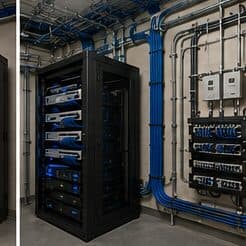
- Recorder location, ventilation, and physical security
- Remote-access requirements and number of users
Baytown: what the location changes
The starting point for any Baytown job is one local fact. An industrial and refining base with rugged operational environments. That single condition shapes where cable can run, where equipment can sit, and how coverage is laid out — more than any spec sheet does. Two more conditions weigh on it. Older commercial stock needing pathway remediation and rack cleanup. Newer retail development with more straightforward conditions. Together they make the route specific to this pocket, which is why a short walkthrough or a few clear photos settle the scope faster than a floor plan can.
- An industrial and refining base with rugged operational environments
- Older commercial stock needing pathway remediation and rack cleanup
- Newer retail development with more straightforward conditions
- Coastal humidity and driven rain requiring durable exterior sealing and surge protection
- Slab-foundation residential following the regional pattern
Getting it done in Baytown
Verification means letting the system run and measuring, because the calculation is a projection until real footage lands on the disk.
Clinical systems belong on their own segment, separate from staff general-purpose devices, separate again from patient guest access, and separate from building systems such as cameras and door controllers. This limits what any single compromised device can reach and makes the network far easier to reason about when something misbehaves.
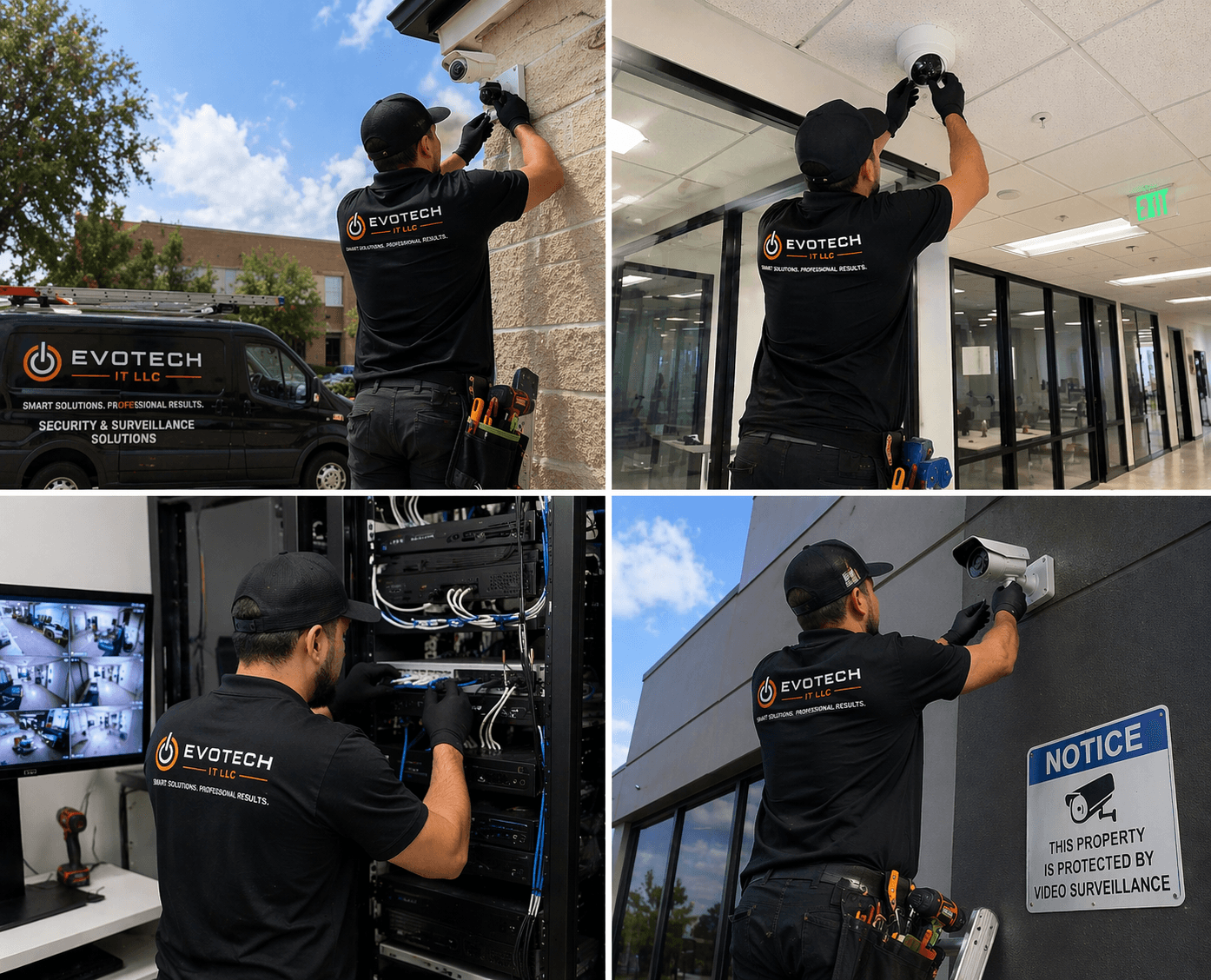
Execution in Baytown is planned around real conditions, not a template. Coastal humidity and driven rain requiring durable exterior sealing and surge protection. Slab-foundation residential following the regional pattern. These decide the sequence, the access, and the method as much as the design does. EVOTECH describes Baytown as coverage rather than a place it occupies, and omits any area detail it cannot confirm — building and site conditions only, no invented landmarks or promised arrival times.
Frequently asked questions
Is nvr installation for medical offices different in Baytown?
The sector needs stay the same, but the install changes with the place. In Baytown, the conditions above — not the medical offices label — decide routes, mounting, and equipment placement, which is why this page pairs all three.
How much storage is needed for 30 days of footage?
It is a calculation, not a fixed number: per-camera bitrate multiplied by hours recorded per day multiplied by thirty, summed across cameras. Resolution, frame rate, recording mode, and how busy each scene is all move the result substantially. Two eight-camera systems can differ by a factor of three for the same retention target.