Projector & screen installation for home offices, in Kingwood
Projector & screen installation for home offices in Kingwood is a three-part question: what projector & screen installation involves, what home offices need from it, and what Kingwood changes about the install. Mature tree cover on wooded residential lots, attenuating outdoor wireless and generating camera motion events.
Those three inputs drive the whole design. The projector's throw ratio and the desired image size fix where it mounts; the seating distance sets a sensible screen size; and the room's light determines whether an ambient-light-rejecting screen is needed or whether the room can be darkened. The mount, the screen, and the long cable run follow from there.
Wire the desk, then fix the coverage
The single highest-value change for a home office is a wired connection to the desk. It removes wireless variability entirely for the machine that matters, and it is usually one cable run.
After that: an access point positioned to serve the office area properly for the devices that stay wireless, and enough separation that work equipment is not sharing a flat network with everything else in the house.
- One wired run to the primary work position
- An access point positioned for the office end of the house
- Work equipment separated from household and guest devices
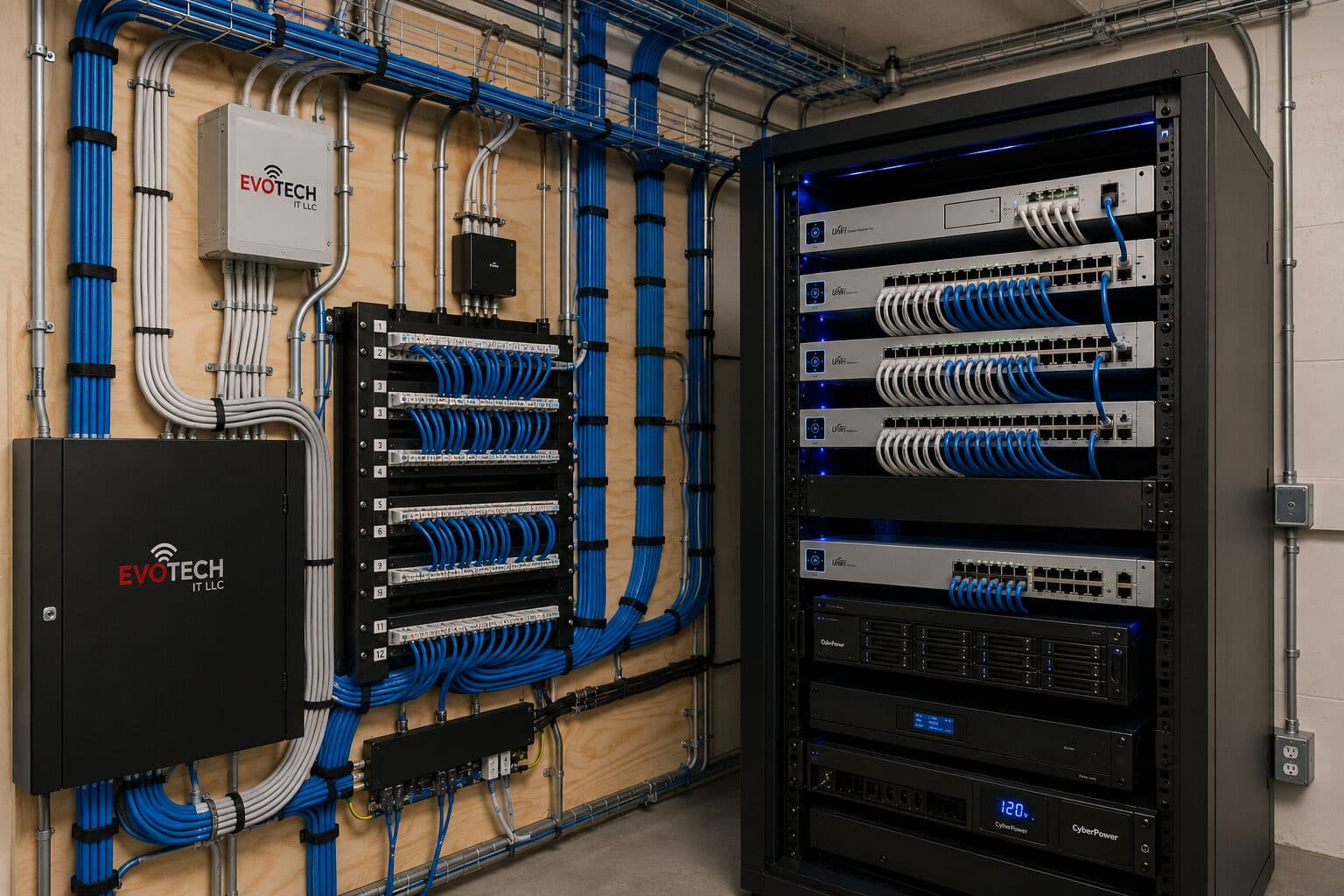
- Equipment position with power and ventilation, not a sealed cabinet
- Wired connections for stationary devices elsewhere that compete for airtime
What changes projector & screen installation from job to job
Scope depends on the room, the light, and the mounting.
- Screen size and type for the room and light
- Projector throw ratio and mounting distance
- Ceiling mount height and structure
- Long cable run length and whether an extender is needed
- Ambient light control versus an ALR screen
- Motorised versus fixed screen
Kingwood: what the location changes
The starting point for any Kingwood job is one local fact. Mature tree cover on wooded residential lots, attenuating outdoor wireless and generating camera motion events. That single condition shapes where cable can run, where equipment can sit, and how coverage is laid out — more than any spec sheet does. Two more conditions weigh on it. Larger lots with detached garages, workshops, and pool structures needing their own connectivity. Predominantly newer slab-foundation homes with good attic access. Together they make the route specific to this pocket, which is why a short walkthrough or a few clear photos settle the scope faster than a floor plan can.
- Mature tree cover on wooded residential lots, attenuating outdoor wireless and generating camera motion events
- Larger lots with detached garages, workshops, and pool structures needing their own connectivity
- Predominantly newer slab-foundation homes with good attic access
- Multi-storey floor plans benefiting from a wired access point per floor
- Seasonal foliage variation affecting any wireless link between structures
Getting it done in Kingwood
A projector is commissioned by confirming geometry, light, and signal.
Home office projects frequently expand slightly, because the same attic access and the same equipment position serve other things. A doorbell run, a camera at the driveway approach, a wired connection to a television, and an access point for the upstairs are all much cheaper done in the same visit than separately.
Getting Kingwood work done means planning around the site as it actually is. Multi-storey floor plans benefiting from a wired access point per floor. Seasonal foliage variation affecting any wireless link between structures. Both matter as much as the design to how and when the work happens. The scope is drawn from the real property, the coverage is stated as a service area rather than an office, and unverifiable specifics about Kingwood are kept off the page on purpose.
Frequently asked questions
Is projector & screen installation for home offices different in Kingwood?
The sector needs stay the same, but the install changes with the place. In Kingwood, the conditions above — not the home offices label — decide routes, mounting, and equipment placement, which is why this page pairs all three.
How far should the projector be from the screen?
It is set by the projector's throw ratio and the screen size you want — a calculation, not a guess. The projector produces a given image size only at the right distance, so the mount goes where the geometry says, kept square to the screen so keystone correction, which softens the image, stays minimal.