Residential Wi-Fi for home offices, in Kingwood
Residential Wi-Fi for home offices in Kingwood is a three-part question: what residential wi-fi involves, what home offices need from it, and what Kingwood changes about the install. Mature tree cover on wooded residential lots, attenuating outdoor wireless and generating camera motion events.
A single router placed wherever the internet service happens to enter the house is the root of most residential wireless complaints. That position is frequently a corner of the garage or a front closet, which means a large share of the signal is heading outdoors. Coverage improves dramatically when access points are placed centrally in the areas people use, and fed by cable.
Wire the desk, then fix the coverage
The single highest-value change for a home office is a wired connection to the desk. It removes wireless variability entirely for the machine that matters, and it is usually one cable run.
After that: an access point positioned to serve the office area properly for the devices that stay wireless, and enough separation that work equipment is not sharing a flat network with everything else in the house.
- One wired run to the primary work position
- An access point positioned for the office end of the house
- Work equipment separated from household and guest devices
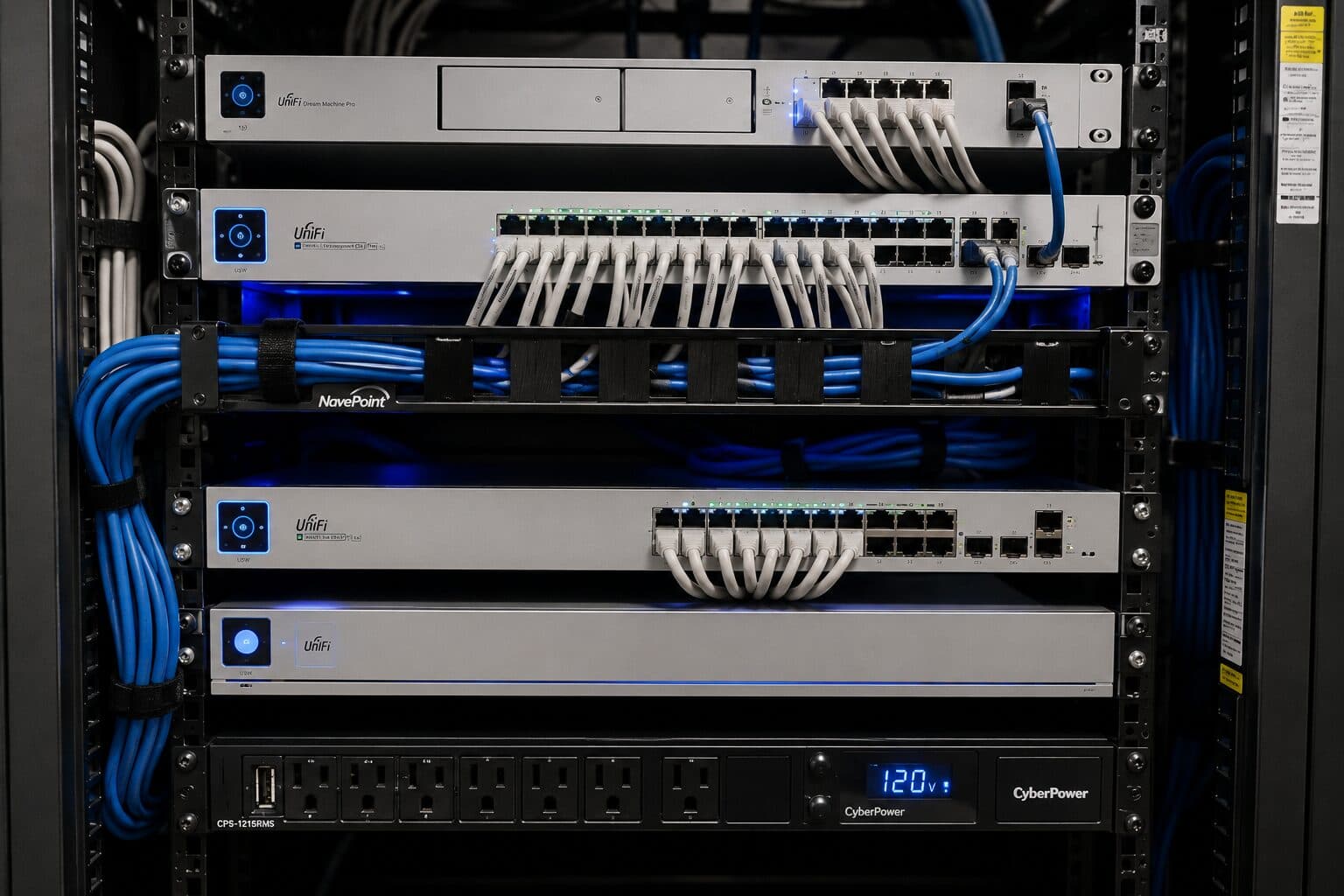
- Equipment position with power and ventilation, not a sealed cabinet
- Wired connections for stationary devices elsewhere that compete for airtime
What changes residential wi-fi from job to job
Residential scope is driven by the building more than by the household.
- Number of storeys and total area needing coverage
- Construction materials, particularly masonry, tile, and foil-backed insulation
- Attic access and whether destination walls are interior
- Where the internet service enters and whether the equipment can move
- Outdoor areas: patios, pool decks, detached garages, and workshops
- Number of access points the coverage design calls for
- Finish expectations in occupied living space
Kingwood: what the location changes
In Kingwood, the plan is built outward from the conditions that are actually here. Mature tree cover on wooded residential lots, attenuating outdoor wireless and generating camera motion events. Larger lots with detached garages, workshops, and pool structures needing their own connectivity. Predominantly newer slab-foundation homes with good attic access. Each one changes where cable can run, where equipment can sit, and how coverage is shaped, which is why a walkthrough settles a Kingwood scope faster than any generic estimate.
- Mature tree cover on wooded residential lots, attenuating outdoor wireless and generating camera motion events
- Larger lots with detached garages, workshops, and pool structures needing their own connectivity
- Predominantly newer slab-foundation homes with good attic access
- Multi-storey floor plans benefiting from a wired access point per floor
- Seasonal foliage variation affecting any wireless link between structures
Getting it done in Kingwood
Validation is a walk through the house with a measurement tool, checking the rooms that prompted the call in the first place.
Home office projects frequently expand slightly, because the same attic access and the same equipment position serve other things. A doorbell run, a camera at the driveway approach, a wired connection to a television, and an access point for the upstairs are all much cheaper done in the same visit than separately.
Getting Kingwood work done means planning around the site as it actually is. Multi-storey floor plans benefiting from a wired access point per floor. Seasonal foliage variation affecting any wireless link between structures. Both matter as much as the design to how and when the work happens. The scope is drawn from the real property, the coverage is stated as a service area rather than an office, and unverifiable specifics about Kingwood are kept off the page on purpose.
Frequently asked questions
Is residential wi-fi for home offices different in Kingwood?
The sector needs stay the same, but the install changes with the place. In Kingwood, the conditions above — not the home offices label — decide routes, mounting, and equipment placement, which is why this page pairs all three.
Why is upstairs Wi-Fi bad when the router is right below?
Signal loses a meaningful amount of strength passing through a floor, and the router's pattern is not aimed upward. Turning the power up mostly increases interference. The dependable arrangement is a second access point upstairs, placed centrally and connected by cable to the equipment position downstairs.