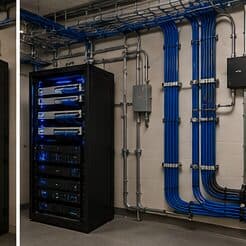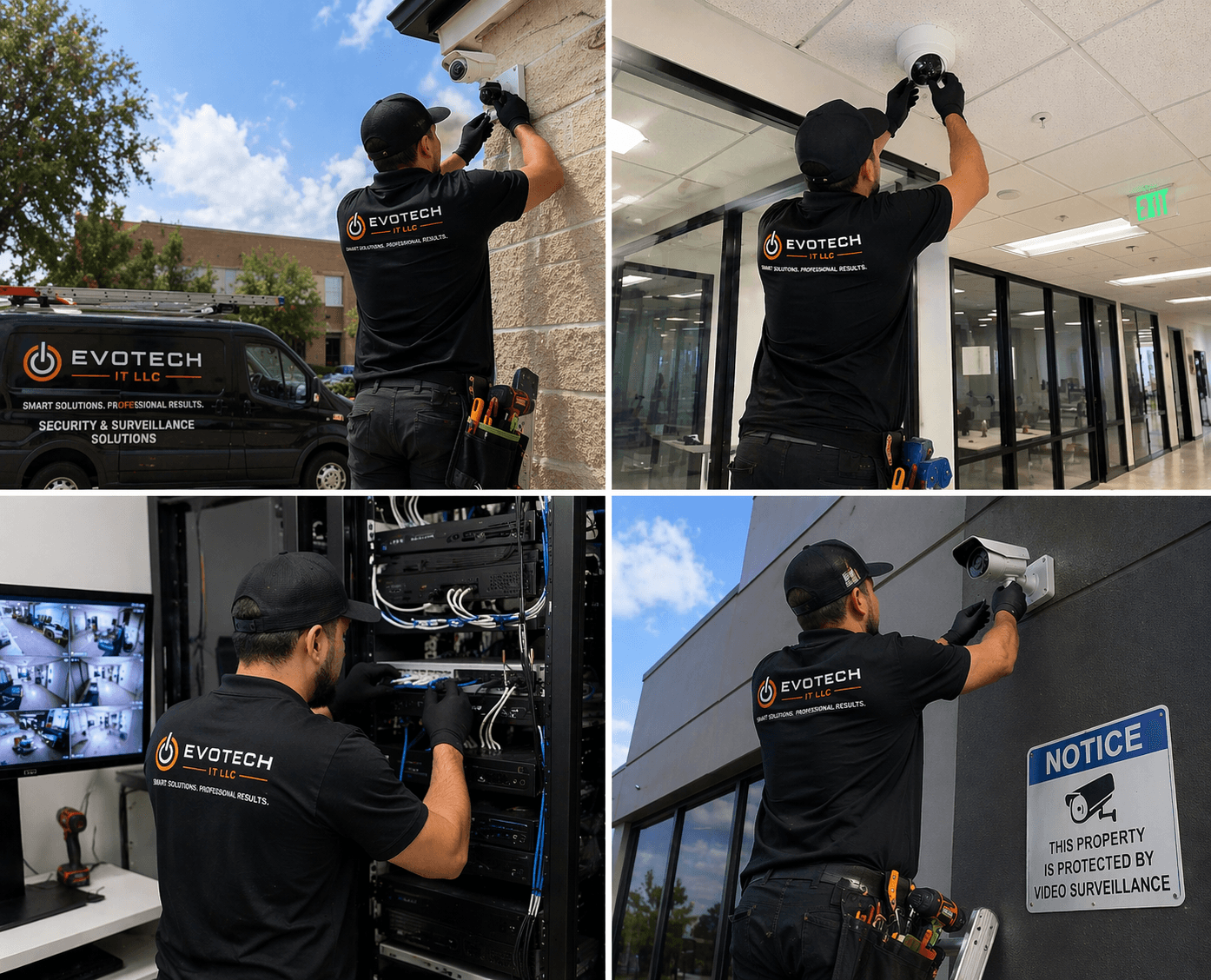
Access-control installation for home offices, in Houston
Access-control installation for home offices in Houston is a three-part question: what access-control installation involves, what home offices need from it, and what Houston changes about the install. Building stock spanning multiple construction eras within short distances, producing very different ceiling and pathway conditions.
The part that demands the most care is not the software. It is the door. A controlled door has to release for anyone leaving, under all conditions including power loss and fire alarm, and it has to do so in the manner the building's life-safety requirements dictate. Getting that wrong is a serious matter, and it is why door hardware selection is a design decision rather than a purchasing one.
The house is competing with the work
A home office shares its connection with everything else in the house, and household demand is highest during exactly the hours that matter least to the household and most to the person working. Streaming, gaming, backups, and connected devices all contend for the same circuit and, if the office is on wireless, for the same airtime.
The second factor is position. Home offices frequently end up in a spare bedroom at the far corner of the house, which is often the worst wireless position in the building — furthest from the router, through the most walls.
- Household traffic peaking during working hours
- Office often located at the far edge of wireless coverage
- Video calls being the least tolerant workload in the house
- Work equipment sharing a flat network with household devices
What drives the cost of access-control installation here
Door hardware and its condition drive access-control cost more than the electronics.
- Door count and hardware condition
- Lock type and whether frames need modification
- Closer repair or replacement
- Controller capacity and panel location
- Cable runs from controller to each opening
- Credential technology and quantity issued
- Fire-alarm interface coordination
- Camera or visitor-management integration
Houston: what the location changes
The starting point for any Houston job is one local fact. Building stock spanning multiple construction eras within short distances, producing very different ceiling and pathway conditions. That single condition shapes where cable can run, where equipment can sit, and how coverage is laid out — more than any spec sheet does. Two more conditions weigh on it. Slab-on-grade foundations dominate residential construction, which pushes retrofit cable routes into the attic rather than under the floor. Gulf Coast humidity and heavy rainfall events make exterior equipment sealing and drip-loop practice a routine requirement rather than an optional detail. Together they make the route specific to this pocket, which is why a short walkthrough or a few clear photos settle the scope faster than a floor plan can.
- Building stock spanning multiple construction eras within short distances, producing very different ceiling and pathway conditions
- Slab-on-grade foundations dominate residential construction, which pushes retrofit cable routes into the attic rather than under the floor
- Gulf Coast humidity and heavy rainfall events make exterior equipment sealing and drip-loop practice a routine requirement rather than an optional detail
- Summer attic temperatures constrain the working window for residential retrofit and rooftop-adjacent work
- Mixed land-use patterns place commercial, light industrial, and residential structures adjacent to each other, so neighbouring buildings often need entirely different approaches
Getting it done in Houston
Access-control commissioning is about failure modes, not just successful entry.
A wired connection to the desk eliminates the variables that cause most home-office call problems: signal strength, interference from neighbouring networks, and contention with household devices for airtime. In slab-foundation construction the run typically goes up into the attic and down an interior wall, which is why the destination wall matters more than the distance.
Execution in Houston is planned around real conditions, not a template. Summer attic temperatures constrain the working window for residential retrofit and rooftop-adjacent work. Mixed land-use patterns place commercial, light industrial, and residential structures adjacent to each other, so neighbouring buildings often need entirely different approaches. These decide the sequence, the access, and the method as much as the design does. EVOTECH describes Houston as coverage rather than a place it occupies, and omits any area detail it cannot confirm — building and site conditions only, no invented landmarks or promised arrival times.
Popular services nearby
Frequently searched near this area — the pages people look for most.
Frequently asked questions
Is access-control installation for home offices different in Houston?
The sector needs stay the same, but the install changes with the place. In Houston, the conditions above — not the home offices label — decide routes, mounting, and equipment placement, which is why this page pairs all three.
What is the difference between fail-safe and fail-secure?
It describes what happens when power is lost. Fail-safe hardware — typically a magnetic lock — releases and the door becomes passable. Fail-secure hardware — typically a standard electric strike — stays locked, though the door can still be opened from the inside by its mechanical hardware. Which is correct for a given opening depends on its role and on applicable life-safety requirements, so it is a design decision rather than a preference.