Why this page exists
Technology for churches in Midtown and the Museum District sits where two things meet: how churches actually operate, and what Midtown and the Museum District specifically brings to the building. 77004 spans dense Midtown mid-rise, the Museum District, and parts of the historic Third Ward, so the building stock ranges from new apartment blocks to century-old wood-frame homes within the same ZIP.
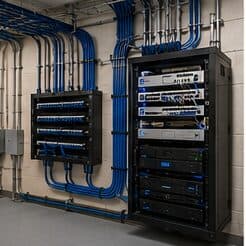
Church networks often have to cover a surprising spread: a sanctuary, classrooms, offices, a fellowship hall, and sometimes separate buildings. Where separate structures are involved, the link between them should be fiber rather than copper, both for distance and because a copper run between buildings carries genuine electrical risk.
Campus coverage and the systems that share it
Church networks often have to cover a surprising spread: a sanctuary, classrooms, offices, a fellowship hall, and sometimes separate buildings. Where separate structures are involved, the link between them should be fiber rather than copper, both for distance and because a copper run between buildings carries genuine electrical risk.
Segmentation is worth doing here for a specific reason: churches typically offer guest wireless, run children's-ministry check-in systems, operate AV equipment on the network, and have office computers handling sensitive information. Those should not share one flat network, and separating them is straightforward at installation.
Streaming has become a standard requirement, and it adds an upload-bandwidth dependency that most other building systems do not have. Confirming the circuit's upload capacity, and separating streaming traffic so it does not contend with guest use during a service, is worth doing before rather than after the first stream.
- Fiber between separate buildings on the campus
- Separate segments for guest, office, AV, and check-in systems
- Upload bandwidth confirmed where services are streamed
- Coverage extended to classrooms and fellowship areas, not just the sanctuary
- AV control devices wired rather than depending on wireless during a service
Midtown and the Museum District: what the location adds
77004 spans dense Midtown mid-rise, the Museum District, and parts of the historic Third Ward, so the building stock ranges from new apartment blocks to century-old wood-frame homes within the same ZIP. In Midtown and the Museum District, that is where the plan begins, because it changes cable paths, device placement, and access-point counts before anything else does. Historic wood-frame homes here have knob-and-tube-era wall cavities and plaster walls, where fishing cable takes care and sometimes surface pathways instead. Mid-rise multifamily needs riser coordination and property-management access, unlike the single-family blocks a few streets over. None of these are generic checklist items — each moves the design in a direction a citywide assumption would miss, and the honest recommendation always depends on what this particular property allows.
- 77004 spans dense Midtown mid-rise, the Museum District, and parts of the historic Third Ward, so the building stock ranges from new apartment blocks to century-old wood-frame homes within the same ZIP
- Historic wood-frame homes here have knob-and-tube-era wall cavities and plaster walls, where fishing cable takes care and sometimes surface pathways instead
- Mid-rise multifamily needs riser coordination and property-management access, unlike the single-family blocks a few streets over
- Mature live oaks and narrow lots affect where exterior cameras and wireless links can actually see
- The mix of institutional, cultural, and residential use means one street's scope is commercial-grade and the next is residential retrofit
Access control and modest camera coverage
Church buildings are used by many people at many different times, which makes key management genuinely burdensome and access control genuinely useful. Credential access with schedules — different groups having access to different areas at different times — solves a problem that physical keys solve badly.
Camera coverage is usually focused on entrances, children's-ministry areas' approaches, offices, parking areas, and equipment storage. As in clinical settings, the boundary matters: worship spaces and children's classrooms are not general camera locations, and agreeing that explicitly during design prevents awkward conversations later.
- Credential access with per-group schedules replacing widely copied keys
- Entrance, office, and equipment storage coverage
- Parking area coverage for evening and weekend use
- Children's area approaches rather than interiors
- Access records that show who entered outside normal hours
Installing in Midtown and the Museum District
Church buildings frequently comprise an original structure plus additions from several eras, each with different construction and no consistent pathway. Masonry walls, hard-lid ceilings, and limited access are common, and pathway discovery is often a genuine part of the project rather than a formality.
Getting Midtown and the Museum District work done means planning around the site as it actually is. Mature live oaks and narrow lots affect where exterior cameras and wireless links can actually see. The mix of institutional, cultural, and residential use means one street's scope is commercial-grade and the next is residential retrofit. Both matter as much as the design to how and when the work happens. The scope is drawn from the real property, the coverage is stated as a service area rather than an office, and unverifiable specifics about Midtown and the Museum District are kept off the page on purpose.
Popular services nearby
Frequently searched near this area — the pages people look for most.
Frequently asked questions
What do churches in Midtown and the Museum District usually need first?
It varies by site, but the pattern for churches holds in Midtown and the Museum District: get the network and cabling backbone right, then layer cameras and access on top. What Midtown and the Museum District changes is the physical install — the conditions listed above drive routes and equipment placement more than the sector alone does.
What makes a church AV system volunteer-friendly?
A small number of clearly labeled controls that produce the normal configuration reliably, with complexity hidden behind them. If starting a service requires selecting sources, adjusting levels, and remembering a sequence, it will eventually fail during a service. The design goal is that a new volunteer can run the routine case on their first attempt.