Why this page exists
Technology for churches in Spring Branch sits where two things meet: how churches actually operate, and what Spring Branch specifically brings to the building. Spring Branch 77043 is a study in contrasts — original 1950s-1960s ranch homes on large lots sitting beside dense new townhome infill and light-commercial frontage.
The first design priority is that the routine operation is genuinely simple: a small number of clearly labeled controls that start the normal service configuration. Everything complex sits behind that, available to whoever maintains the system but not required for weekly use.
Simple to operate, then everything else
The first design priority is that the routine operation is genuinely simple: a small number of clearly labeled controls that start the normal service configuration. Everything complex sits behind that, available to whoever maintains the system but not required for weekly use.
After that: audio intelligibility in the main space, display visibility from the back, coverage across the campus including classrooms and offices, and access control for a building that many people use at many different times.
- A simple, labeled routine operation that volunteers can run confidently
- Speech intelligibility prioritised over volume in the main space
- Displays sized and positioned for the furthest seats
- Wireless coverage across sanctuary, classrooms, offices, and fellowship areas
- Access control suited to many users and irregular schedules
Spring Branch: what the location adds
Spring Branch 77043 is a study in contrasts — original 1950s-1960s ranch homes on large lots sitting beside dense new townhome infill and light-commercial frontage. In Spring Branch, that is where the plan begins, because it changes cable paths, device placement, and access-point counts before anything else does. The mid-century ranch stock is slab with accessible attics, while the new townhomes are tight three-story vertical builds. Deep original lots leave room for detached structures and long driveway runs that lengthen camera and gate wiring. None of these are generic checklist items — each moves the design in a direction a citywide assumption would miss, and the honest recommendation always depends on what this particular property allows.
- Spring Branch 77043 is a study in contrasts — original 1950s-1960s ranch homes on large lots sitting beside dense new townhome infill and light-commercial frontage
- The mid-century ranch stock is slab with accessible attics, while the new townhomes are tight three-story vertical builds
- Deep original lots leave room for detached structures and long driveway runs that lengthen camera and gate wiring
- Commercial frontage along the major roads brings small-business network and camera work adjacent to the residential streets
- Teardown-rebuild activity means modern prewire and untouched original wiring coexist block by block
Campus coverage and the systems that share it
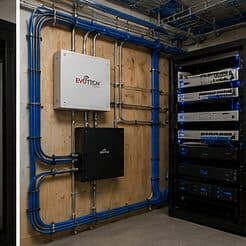
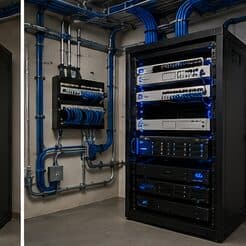
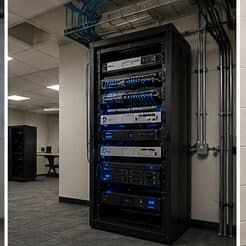
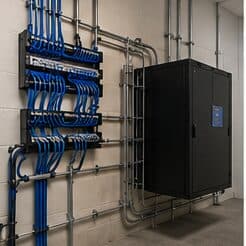
Church networks often have to cover a surprising spread: a sanctuary, classrooms, offices, a fellowship hall, and sometimes separate buildings. Where separate structures are involved, the link between them should be fiber rather than copper, both for distance and because a copper run between buildings carries genuine electrical risk.
Segmentation is worth doing here for a specific reason: churches typically offer guest wireless, run children's-ministry check-in systems, operate AV equipment on the network, and have office computers handling sensitive information. Those should not share one flat network, and separating them is straightforward at installation.
Streaming has become a standard requirement, and it adds an upload-bandwidth dependency that most other building systems do not have. Confirming the circuit's upload capacity, and separating streaming traffic so it does not contend with guest use during a service, is worth doing before rather than after the first stream.
- Fiber between separate buildings on the campus
- Separate segments for guest, office, AV, and check-in systems
- Upload bandwidth confirmed where services are streamed
- Coverage extended to classrooms and fellowship areas, not just the sanctuary
- AV control devices wired rather than depending on wireless during a service
Installing in Spring Branch
Church buildings are used by many people at many different times, which makes key management genuinely burdensome and access control genuinely useful. Credential access with schedules — different groups having access to different areas at different times — solves a problem that physical keys solve badly.
On site, the schedule and working method turn on conditions like these. Commercial frontage along the major roads brings small-business network and camera work adjacent to the residential streets. Teardown-rebuild activity means modern prewire and untouched original wiring coexist block by block. Both shape how and when a crew can actually operate, which is why EVOTECH scopes each Spring Branch job from the property itself rather than assuming one approach fits every address. Coverage is stated as a service area, never an office claim, and anything about Spring Branch that cannot be verified is left out instead of invented.
Popular services nearby
Frequently searched near this area — the pages people look for most.
Frequently asked questions
What do churches in Spring Branch usually need first?
It varies by site, but the pattern for churches holds in Spring Branch: get the network and cabling backbone right, then layer cameras and access on top. What Spring Branch changes is the physical install — the conditions listed above drive routes and equipment placement more than the sector alone does.
What makes a church AV system volunteer-friendly?
A small number of clearly labeled controls that produce the normal configuration reliably, with complexity hidden behind them. If starting a service requires selecting sources, adjusting levels, and remembering a sequence, it will eventually fail during a service. The design goal is that a new volunteer can run the routine case on their first attempt.