Business phone & VoIP for churches, in Cypress
Business phone & VoIP for churches in Cypress is a three-part question: what business phone & voip involves, what churches need from it, and what Cypress changes about the install. Large newer residential floor plans that exceed single-position wireless coverage.
Because the phones are network devices, their call quality depends on the network. Voice is unforgiving of jitter and packet loss in a way that a file download is not, so a phone system going onto a busy flat network without any prioritisation is the most common cause of choppy or dropped calls — and it is a design problem, not a handset fault.
Built for volunteers, used intermittently
The defining constraint in church technology is who operates it. Systems are typically run by volunteers who rotate, may have limited technical background, and are operating live in front of a congregation. A system that requires specialist knowledge to start is a system that will fail publicly.
The second constraint is the building. Sanctuaries are large, often with high ceilings and hard reflective surfaces, and were frequently not designed with audio or cable pathways in mind. Older buildings add masonry walls, limited ceiling access, and additions built across several decades.
- Volunteer operators rotating through the roles
- Live use with no opportunity to troubleshoot mid-service
- Large, acoustically challenging main spaces
- Buildings extended over time with inconsistent construction and pathways
- Many small rooms used intermittently rather than continuously
What changes business phone & voip from job to job
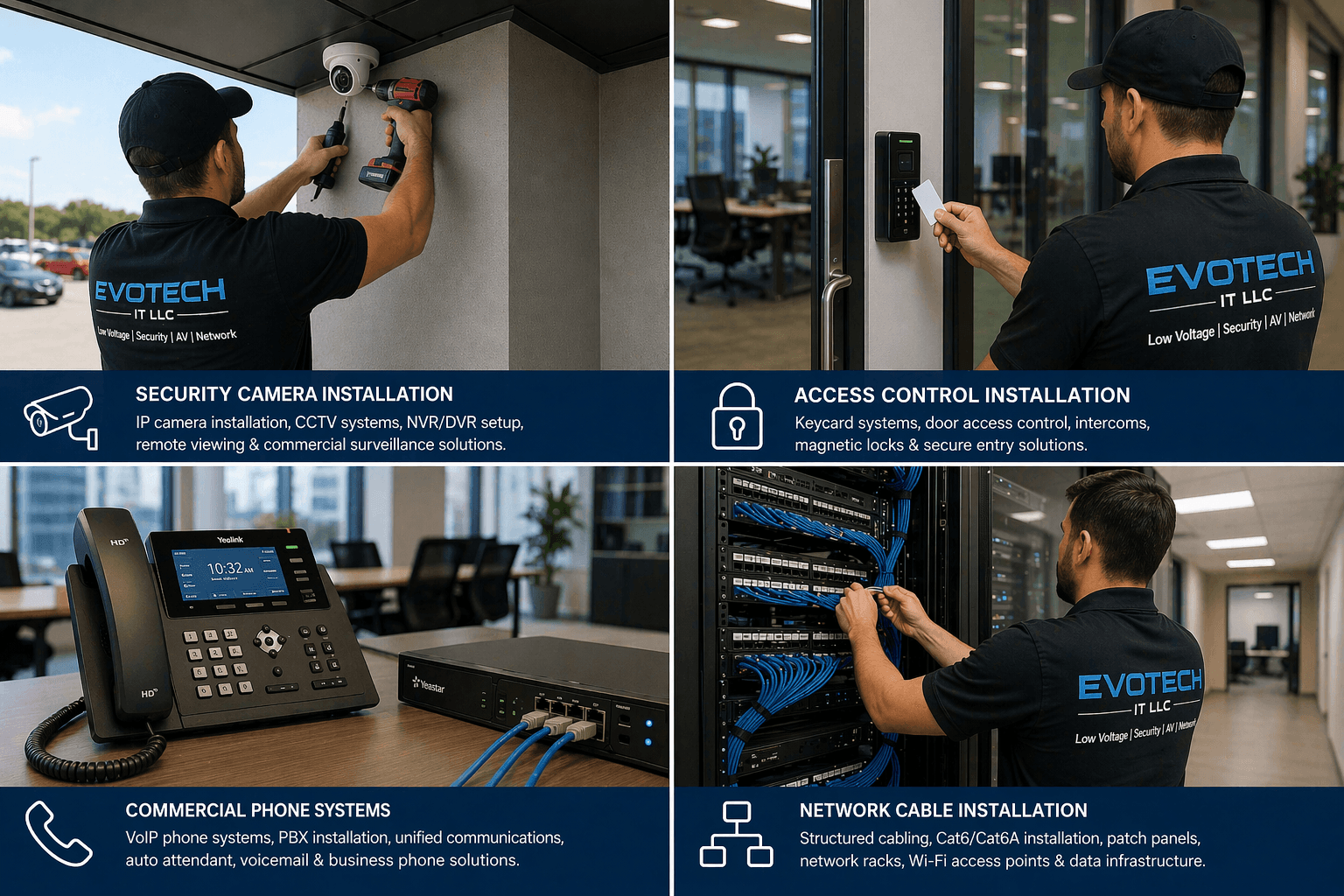
Phone-system scope moves with the number of extensions and the call features, not the building size.
- Handset count and any conference, paging, or door-phone endpoints
- On-premise call server versus a hosted platform
- Peak concurrent calls and the resulting upload requirement
- Whether the existing cabling and switching can carry the handsets
- Number porting complexity and how many numbers move
- Auto-attendant, voicemail, call-group, and after-hours routing complexity
- Multi-site dial plan requirements
Cypress: what the location changes
The starting point for any Cypress job is one local fact. Large newer residential floor plans that exceed single-position wireless coverage. That single condition shapes where cable can run, where equipment can sit, and how coverage is laid out — more than any spec sheet does. Two more conditions weigh on it. Community and worship facilities with large main spaces and high ceilings requiring distributed coverage. Retail centres with substantial footprints and mixed ceiling construction between units. Together they make the route specific to this pocket, which is why a short walkthrough or a few clear photos settle the scope faster than a floor plan can.
- Large newer residential floor plans that exceed single-position wireless coverage
- Community and worship facilities with large main spaces and high ceilings requiring distributed coverage
- Retail centres with substantial footprints and mixed ceiling construction between units
- Renovation and remodel work common, with pathway discovery a genuine part of the project rather than a formality
- Slab foundations with attic access as the standard residential retrofit route
Getting it done in Cypress
Phones are commissioned by making real calls under real conditions, not by confirming the handsets register.
Church networks often have to cover a surprising spread: a sanctuary, classrooms, offices, a fellowship hall, and sometimes separate buildings. Where separate structures are involved, the link between them should be fiber rather than copper, both for distance and because a copper run between buildings carries genuine electrical risk.
Execution in Cypress is planned around real conditions, not a template. Renovation and remodel work common, with pathway discovery a genuine part of the project rather than a formality. Slab foundations with attic access as the standard residential retrofit route. These decide the sequence, the access, and the method as much as the design does. EVOTECH describes Cypress as coverage rather than a place it occupies, and omits any area detail it cannot confirm — building and site conditions only, no invented landmarks or promised arrival times.
Popular services nearby
Frequently searched near this area — the pages people look for most.
Frequently asked questions
Is business phone & voip for churches different in Cypress?
The sector needs stay the same, but the install changes with the place. In Cypress, the conditions above — not the churches label — decide routes, mounting, and equipment placement, which is why this page pairs all three.
Why do our VoIP calls sound choppy when the internet seems fine?
Almost always jitter or contention rather than raw bandwidth. Voice packets are time-sensitive, and on a network that treats them the same as a backup or a large upload they get delayed or dropped whenever the network is busy. A dedicated voice segment with quality-of-service prioritisation fixes the majority of these cases without changing the internet plan.