
Network cabling in the Westchase District, in plain terms
This page is about network cabling in the Westchase District (77042) — one distinct pocket of the Houston area, with its own building stock and its own constraints. Westchase 77042 is a concentrated office and corporate district of mid- and high-rise towers, so structured cabling, conference AV, and access control dominate over residential work. The plan follows those realities, not a citywide template.
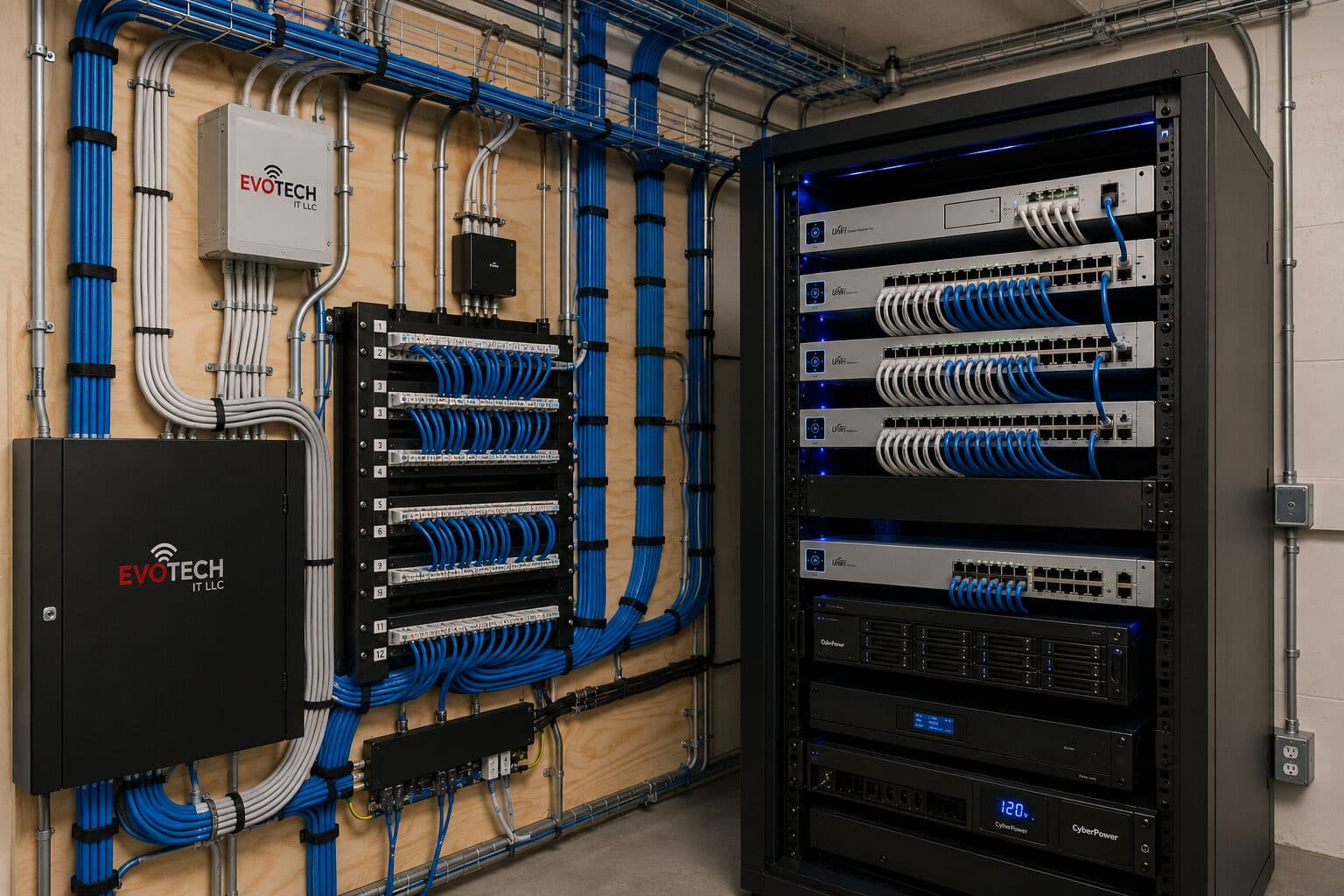
Network cabling is the permanent copper and fiber pathway between a building's equipment room and every device location. Done properly it is a structured system — horizontal runs from a patch panel out to labeled outlets, each one under the 90-metre permanent-link limit, each one tested and documented. Done casually it is a bundle of unlabeled patch cords stapled to a joist, and every future change costs someone an afternoon of tracing.
What changes network cabling from job to job
Two buildings with the same square footage can differ by a factor of three in cabling effort. What drives that spread is access, not area.
- Ceiling type: accessible grid versus hard lid, and whether the plenum is shared
- Building age and whether existing pathway can be reused
- Number of outlets and whether each location gets one, two, or more
- Rack or wall-cabinet location relative to the incoming service
- Fire-rated wall and floor penetrations requiring proper sleeving and firestop
- Occupied-space constraints: after-hours access, dust control, furniture protection
- Whether the design leaves spare capacity for the next expansion
the Westchase District: the conditions that change the plan
Westchase 77042 is a concentrated office and corporate district of mid- and high-rise towers, so structured cabling, conference AV, and access control dominate over residential work. In the Westchase District, that is where the plan begins, because it changes cable paths, device placement, and access-point counts before anything else does. Multi-tenant office floors mean cabling is planned around demising walls, shared risers, and future tenant-improvement churn. Building management controls roof and riser access, so wireless backhaul and rooftop equipment need coordinated approvals. None of these are generic checklist items — each moves the design in a direction a citywide assumption would miss, and the honest recommendation always depends on what this particular property allows.
- Westchase 77042 is a concentrated office and corporate district of mid- and high-rise towers, so structured cabling, conference AV, and access control dominate over residential work
- Multi-tenant office floors mean cabling is planned around demising walls, shared risers, and future tenant-improvement churn
- Building management controls roof and riser access, so wireless backhaul and rooftop equipment need coordinated approvals
- Plenum ceilings and raised-floor or under-carpet pathways in older towers shape how horizontal runs are dressed
- Surrounding corporate apartments and hotels share the concrete high-rise constraints of the office stock
On-site in the Westchase District (77042)
The sequence is deliberately front-loaded. Walking the pathway before pulling anything is what prevents the expensive surprises — a firewall with no sleeve, a hard-lid ceiling with no access, a rack location with no dedicated circuit nearby.
Execution in the Westchase District is planned around real conditions, not a template. Plenum ceilings and raised-floor or under-carpet pathways in older towers shape how horizontal runs are dressed. Surrounding corporate apartments and hotels share the concrete high-rise constraints of the office stock. These decide the sequence, the access, and the method as much as the design does. EVOTECH describes the Westchase District as coverage rather than a place it occupies, and omits any area detail it cannot confirm — building and site conditions only, no invented landmarks or promised arrival times.
Who this suits in the Westchase District
In the Westchase District (77042), network cabling tends to be the right call for the owners and managers described below — the neighborhood's commercial and mixed-use properties fit this work well.
Structured cabling work usually starts from one of three situations: a tenant improvement where the space is open and the ceiling is accessible, an occupied building that has outgrown whatever was installed by a previous tenant, or a new build where the low-voltage rough-in has to land between the electrical and drywall stages.
- Office suites adding desks, phones, or access points beyond the original outlet count
- Retail and restaurant spaces wiring point-of-sale stations, kitchen displays, and back-office equipment
- Warehouses feeding scanners, ceiling-mounted access points, and dock-door cameras
- General contractors who need low-voltage rough-in coordinated with the electrical trade
- Property managers inheriting a wiring closet with no labels and no documentation
Popular services nearby
Frequently searched near this area — the pages people look for most.
Frequently asked questions
Do you cover the Westchase District (77042)?
Yes. EVOTECH serves the Westchase District in 77042 as part of the Houston service area. This is coverage, not an office claim — the page describes the neighborhood's conditions, not a location we occupy.
How long can a single network cable run be?
The fixed cable between patch panel and outlet is limited to 90 metres, with patch cords at each end bringing the total channel to 100 metres. Beyond that, the answer is not a longer cable — it is either an intermediate equipment location or a fiber link to a secondary switch.