
Why this page exists
Network cabling in Rice Military / Washington Ave (77007) answers a specific long-tail search: people in Rice Military and Washington Avenue looking for exactly this work, in this pocket of Houston. It reads through the conditions that actually define Rice Military and Washington Avenue rather than treating the whole Houston market as one thing. 77007 is dominated by dense new three- and four-story townhomes — the tall, narrow 'skinny house' pattern — where cabling is a vertical problem organized around the stair chase, not a horizontal attic run.
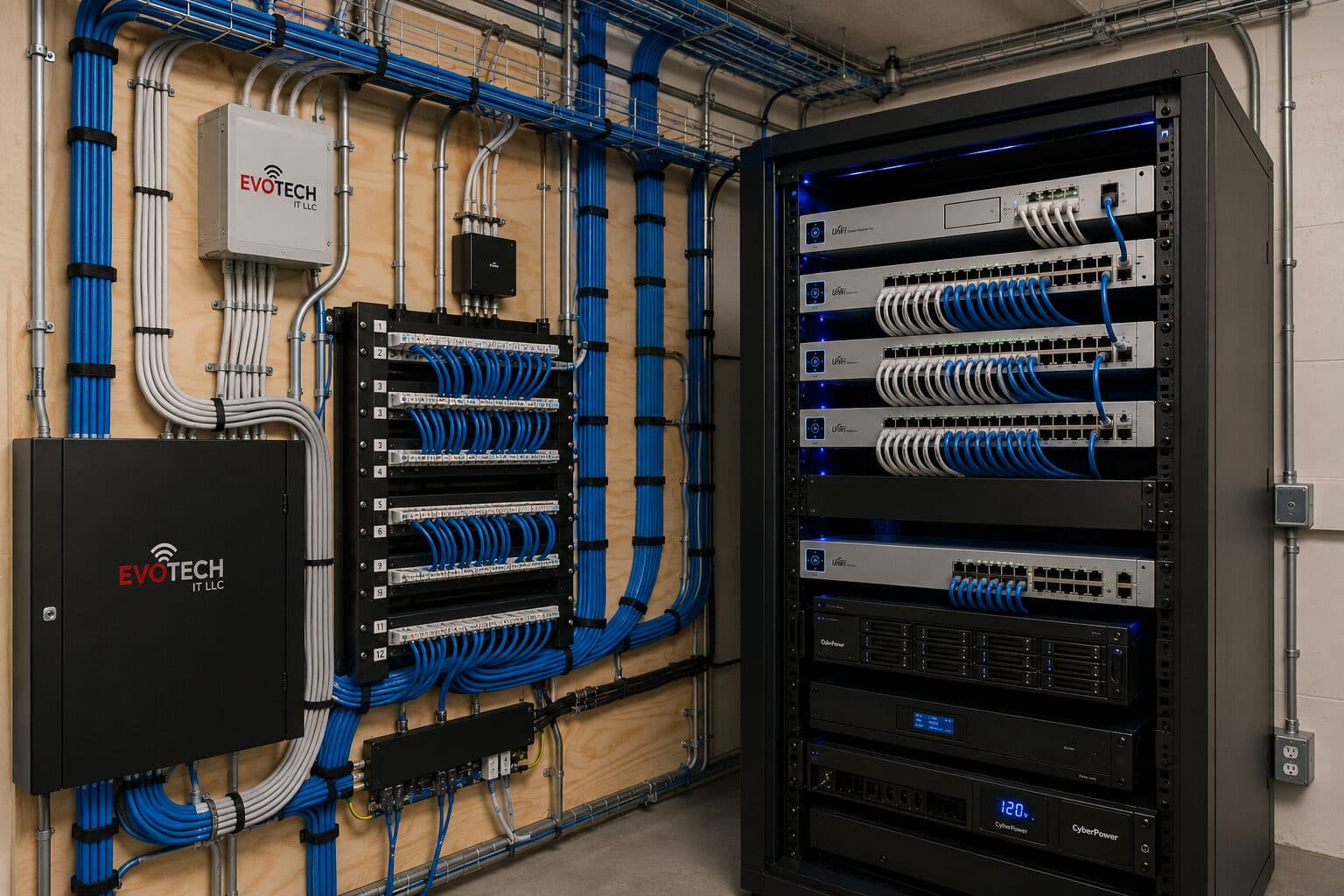
The reason cabling deserves planning attention is that it is the longest-lived part of the system. Switches get replaced on a five-year cycle and access points sooner, but the cable in the wall tends to stay for the life of the tenancy. Deciding where outlets go, how many, and what category of cable feeds them is a decision that either quietly supports the next decade or quietly constrains it.
What drives the cost of network cabling here
Cabling scope is priced from conditions, not from a per-outlet number, which is why a walkthrough or a good set of photos changes an estimate more than any other input. The largest single driver is usually whether the pathway already exists.
- Total run count and average run length
- Whether existing tray, conduit, or sleeves can be reused
- Ceiling and wall construction, including hard-lid areas requiring cut and patch
- Category of cable specified and whether shielding is required
- Depth of testing and documentation requested
- Working hours: occupied space and after-hours windows extend the schedule
What Rice Military and Washington Avenue changes about the job
The starting point for any Rice Military and Washington Avenue job is one local fact. 77007 is dominated by dense new three- and four-story townhomes — the tall, narrow 'skinny house' pattern — where cabling is a vertical problem organized around the stair chase, not a horizontal attic run. That single condition shapes where cable can run, where equipment can sit, and how coverage is laid out — more than any spec sheet does. Two more conditions weigh on it. Rooftop terraces and top-floor living spaces push Wi-Fi and access-point placement upward, away from the ground-floor garage level. Shared demising walls between attached units limit where camera and speaker wiring can be routed without crossing into a neighbor's structure. Together they make the route specific to this pocket, which is why a short walkthrough or a few clear photos settle the scope faster than a floor plan can.
- 77007 is dominated by dense new three- and four-story townhomes — the tall, narrow 'skinny house' pattern — where cabling is a vertical problem organized around the stair chase, not a horizontal attic run
- Rooftop terraces and top-floor living spaces push Wi-Fi and access-point placement upward, away from the ground-floor garage level
- Shared demising walls between attached units limit where camera and speaker wiring can be routed without crossing into a neighbor's structure
- Slab-on-grade construction means no crawlspace, so any missed low-voltage rough-in becomes a surface-raceway or finished-wall fishing job
- Compact lots set close together complicate exterior camera sightlines and any point-to-point wireless aiming
Getting network cabling done in Rice Military and Washington Avenue
Testing is what separates a cabling installation from a cable pull. A basic continuity or wire-map check confirms the pairs land in the right order; it says nothing about whether the link will carry its rated bandwidth. Certification testing against the relevant TIA channel or permanent-link limits measures insertion loss, return loss, near-end crosstalk, and delay skew, and produces a per-port record.
On site, the schedule and working method turn on conditions like these. Slab-on-grade construction means no crawlspace, so any missed low-voltage rough-in becomes a surface-raceway or finished-wall fishing job. Compact lots set close together complicate exterior camera sightlines and any point-to-point wireless aiming. Both shape how and when a crew can actually operate, which is why EVOTECH scopes each Rice Military and Washington Avenue job from the property itself rather than assuming one approach fits every address. Coverage is stated as a service area, never an office claim, and anything about Rice Military and Washington Avenue that cannot be verified is left out instead of invented.
Who this suits in Rice Military and Washington Avenue
In Rice Military and Washington Avenue (77007), network cabling tends to be the right call for the owners and managers described below — the neighborhood's homeowners and residential properties fit this work well.
Structured cabling work usually starts from one of three situations: a tenant improvement where the space is open and the ceiling is accessible, an occupied building that has outgrown whatever was installed by a previous tenant, or a new build where the low-voltage rough-in has to land between the electrical and drywall stages.
- Office suites adding desks, phones, or access points beyond the original outlet count
- Retail and restaurant spaces wiring point-of-sale stations, kitchen displays, and back-office equipment
- Warehouses feeding scanners, ceiling-mounted access points, and dock-door cameras
- General contractors who need low-voltage rough-in coordinated with the electrical trade
- Property managers inheriting a wiring closet with no labels and no documentation
Popular services nearby
Frequently searched near this area — the pages people look for most.
Frequently asked questions
Do you cover Rice Military and Washington Avenue (77007)?
Yes. EVOTECH serves Rice Military and Washington Avenue in 77007 as part of the Houston service area. This is coverage, not an office claim — the page describes the neighborhood's conditions, not a location we occupy.
How long can a single network cable run be?
The fixed cable between patch panel and outlet is limited to 90 metres, with patch cords at each end bringing the total channel to 100 metres. Beyond that, the answer is not a longer cable — it is either an intermediate equipment location or a fiber link to a secondary switch.