
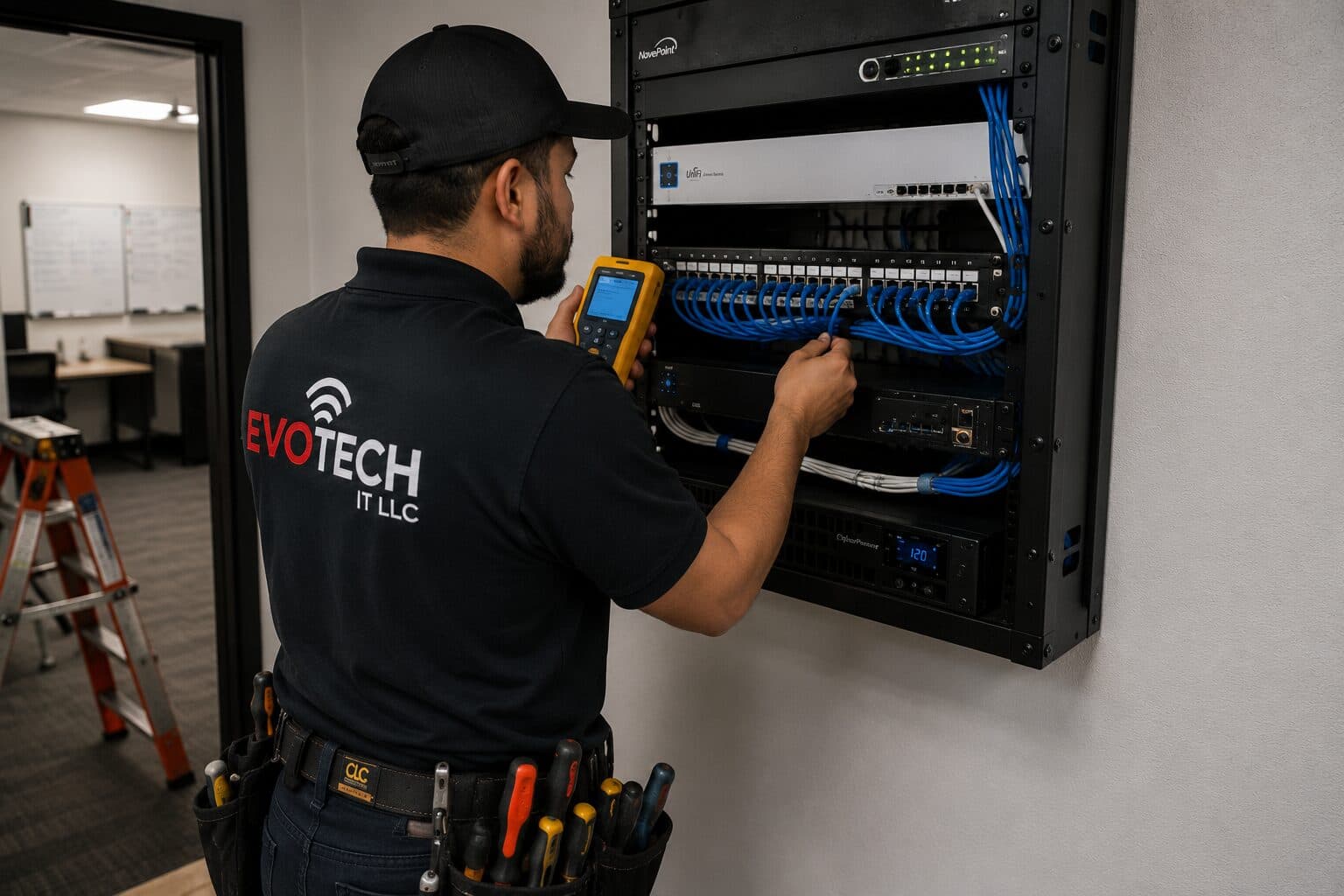
Fiber-optic cabling in the Texas Medical Center area, in plain terms
Fiber-optic cabling in Texas Medical Center (77030) answers a specific long-tail search: people in the Texas Medical Center area looking for exactly this work, in this pocket of Houston. It reads through the conditions that actually define the Texas Medical Center area rather than treating the whole Houston market as one thing. 77030 is the Texas Medical Center — dense institutional, research, and high-rise medical buildings where nearly all work is commercial-grade inside managed facilities.
Inside a single building, fiber typically appears as a backbone between the main equipment room and intermediate closets, with copper handling the horizontal runs from those closets out to devices. That split is the standard structured-cabling shape and it exists because each medium is doing what it is good at.
What drives the cost of fiber-optic cabling here
Fiber cost concentrates in the route and the terminations rather than the cable itself.
- Route length and construction method, especially for outdoor segments
- Strand count and whether spares are included
- Number of terminations and the method used
- Enclosures, trays, and protection hardware
- Transceivers at each end
- Testing and documentation depth
- Trenching, boring, or aerial work on between-building routes
What the Texas Medical Center area changes about the job
The starting point for any the Texas Medical Center area job is one local fact. 77030 is the Texas Medical Center — dense institutional, research, and high-rise medical buildings where nearly all work is commercial-grade inside managed facilities. That single condition shapes where cable can run, where equipment can sit, and how coverage is laid out — more than any spec sheet does. Two more conditions weigh on it. Riser, plenum, and MDF/IDF access is controlled by facility engineering, so escorts, badging, and after-hours windows govern the schedule. Concrete structures and interior rooms with no exterior walls make wired coverage and careful access-point planning essential. Together they make the route specific to this pocket, which is why a short walkthrough or a few clear photos settle the scope faster than a floor plan can.
- 77030 is the Texas Medical Center — dense institutional, research, and high-rise medical buildings where nearly all work is commercial-grade inside managed facilities
- Riser, plenum, and MDF/IDF access is controlled by facility engineering, so escorts, badging, and after-hours windows govern the schedule
- Concrete structures and interior rooms with no exterior walls make wired coverage and careful access-point planning essential
- Surrounding high-rise residential and hotel stock is also concrete-framed, sharing the same fish-versus-surface-route constraints
- Life-safety and continuous-operation requirements mean cutovers are staged so systems are never fully down
How the work actually runs in the Texas Medical Center area
The baseline test is an insertion-loss measurement across the installed link, compared against the calculated budget for that distance and connector count. A link that passes with margin is a link that will tolerate a future re-patch.
Getting the Texas Medical Center area work done means planning around the site as it actually is. Surrounding high-rise residential and hotel stock is also concrete-framed, sharing the same fish-versus-surface-route constraints. Life-safety and continuous-operation requirements mean cutovers are staged so systems are never fully down. Both matter as much as the design to how and when the work happens. The scope is drawn from the real property, the coverage is stated as a service area rather than an office, and unverifiable specifics about the Texas Medical Center area are kept off the page on purpose.
Who this suits in the Texas Medical Center area
In the Texas Medical Center area (77030), fiber-optic cabling tends to be the right call for the owners and managers described below — the neighborhood's commercial and mixed-use properties fit this work well.
Fiber requests cluster around distance, separation, and capacity.
- Warehouses and large-footprint buildings where a single equipment room cannot reach every area within copper limits
- Campus and multi-building sites needing a link between structures
- Buildings with intermediate distribution closets requiring backbone uplinks
- Sites aggregating many cameras or access points into a core switch
- Detached outbuildings, shops, and guardhouses beyond copper distance
Popular services nearby
Frequently searched near this area — the pages people look for most.
Frequently asked questions
Do you cover the Texas Medical Center area (77030)?
Yes. EVOTECH serves the Texas Medical Center area in 77030 as part of the Houston service area. This is coverage, not an office claim — the page describes the neighborhood's conditions, not a location we occupy.
When is fiber necessary rather than optional?
Two situations make it necessary rather than a preference. First, distance: past the 100-metre copper channel limit there is no compliant copper answer. Second, links between separate buildings, where a copper conductor creates a path for surge and ground-potential differences. Inside those two cases fiber is not an upgrade — it is the correct method.