
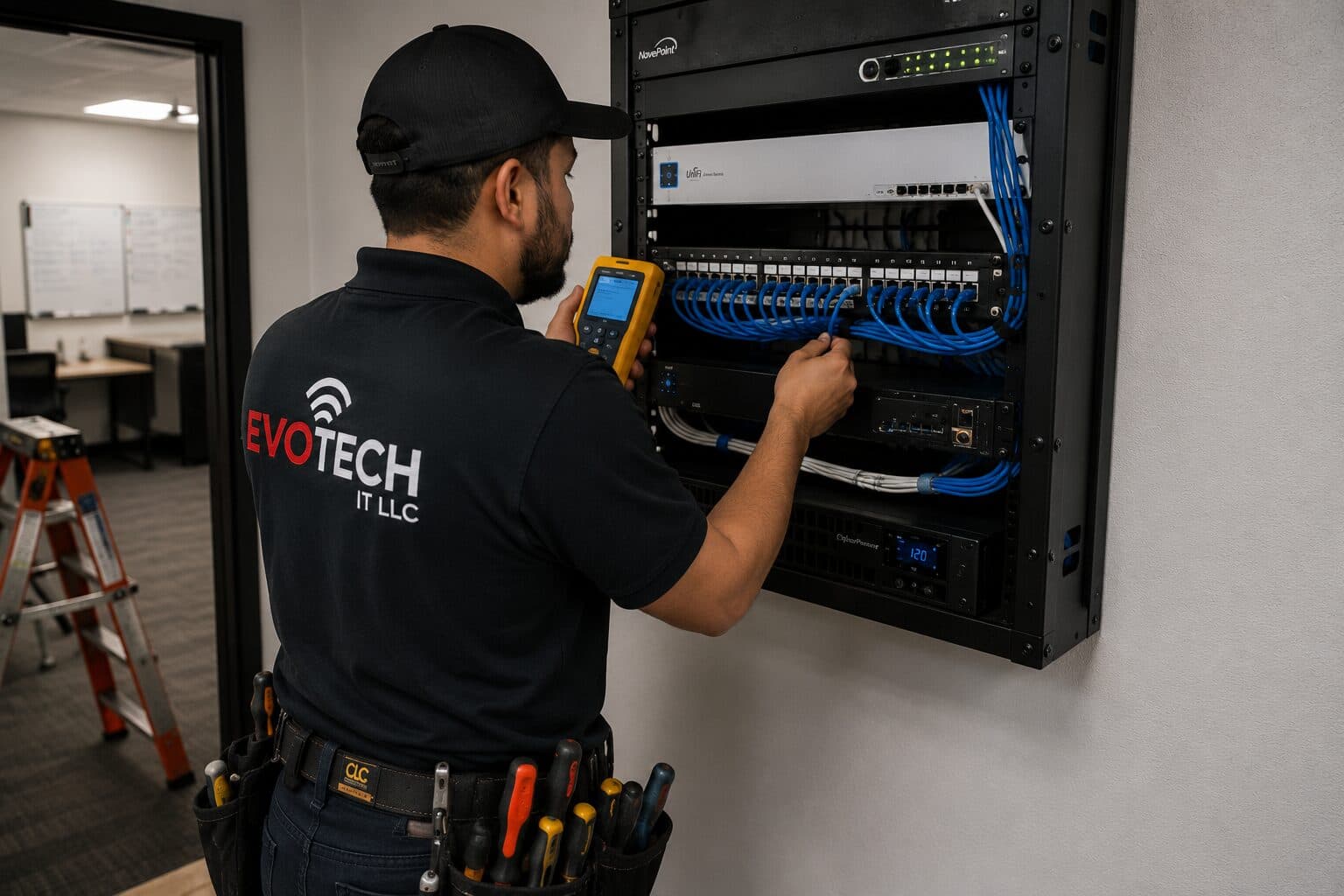
Why this page exists
This page is about network troubleshooting in the 77338 Humble area (77338) — one distinct pocket of the Humble area, with its own building stock and its own constraints. 77338 is core Humble — older single-family neighborhoods, older apartment stock, and commercial frontage near the retail corridor. The plan follows those realities, not a citywide template.
Effective troubleshooting is a process of elimination against a specific, reproducible symptom. 'The internet is slow' is not yet a diagnosis — slow for whom, on which devices, wired or wireless, at what times, to which destinations. Those answers usually point at a layer before any equipment is touched.
Where network troubleshooting goes wrong — and how it's avoided
Troubleshooting goes wrong mainly by skipping the narrowing step.
- Replacing the router first because it is the most visible device
- Changing several things at once, so the actual cause stays unknown
- Accepting 'the internet is slow' without narrowing scope and timing
- Ignoring switch error counters that already identify the faulty port
- Blaming wireless for a saturated circuit or an oversubscribed uplink
- Fixing the symptom without documenting the cause, so it recurs unrecognised
the 77338 Humble area: the conditions that change the plan
In the 77338 Humble area, the plan is built outward from the conditions that are actually here. 77338 is core Humble — older single-family neighborhoods, older apartment stock, and commercial frontage near the retail corridor. Older slab homes with accessible attics keep residential retrofits approachable. Retail and small-business frontage brings commercial camera and network work into the ZIP. Each one changes where cable can run, where equipment can sit, and how coverage is shaped, which is why a walkthrough settles a the 77338 Humble area scope faster than any generic estimate.
- 77338 is core Humble — older single-family neighborhoods, older apartment stock, and commercial frontage near the retail corridor
- Older slab homes with accessible attics keep residential retrofits approachable
- Retail and small-business frontage brings commercial camera and network work into the ZIP
- Aging apartment complexes present shared-attic, common-chase retrofit conditions
- The maturing residential stock is a frequent first-time low-voltage upgrade target
On-site in the 77338 Humble area (77338)
The sequence is designed to eliminate whole categories before spending time inside any one of them.
Execution in the 77338 Humble area is planned around real conditions, not a template. Aging apartment complexes present shared-attic, common-chase retrofit conditions. The maturing residential stock is a frequent first-time low-voltage upgrade target. These decide the sequence, the access, and the method as much as the design does. EVOTECH describes the 77338 Humble area as coverage rather than a place it occupies, and omits any area detail it cannot confirm — building and site conditions only, no invented landmarks or promised arrival times.
Who this suits in the 77338 Humble area
In the 77338 Humble area (77338), network troubleshooting tends to be the right call for the owners and managers described below — the neighborhood's mix of residential and light-commercial properties fit this work well.
Troubleshooting requests usually arrive after something has already been tried.
- Offices where calls drop or applications stall at particular times of day
- Sites that replaced a router and kept the same symptom
- Buildings where one area works and another does not
- Point-of-sale or camera systems dropping intermittently
- Networks that grew organically and now behave unpredictably
- Properties where nobody is sure what is connected to what
Frequently asked questions
Do you cover the 77338 Humble area (77338)?
Yes. EVOTECH serves the 77338 Humble area in 77338 as part of the Humble service area. This is coverage, not an office claim — the page describes the neighborhood's conditions, not a location we occupy.
Why is the network slow only in the afternoon?
Time-correlated symptoms usually mean capacity rather than a fault. Something is consuming the shared resource at that time — backups, updates, more people on site, or a scheduled process. Measuring at the gateway during the slow period, and comparing it to a quiet period, distinguishes a saturated circuit from an internal bottleneck quickly.